
China intensified its aggressive position regarding Taiwan on Thursday, cautioning the United States that the two superpowers could face “clashes and even conflicts” if Taiwan matters aren’t managed appropriately.
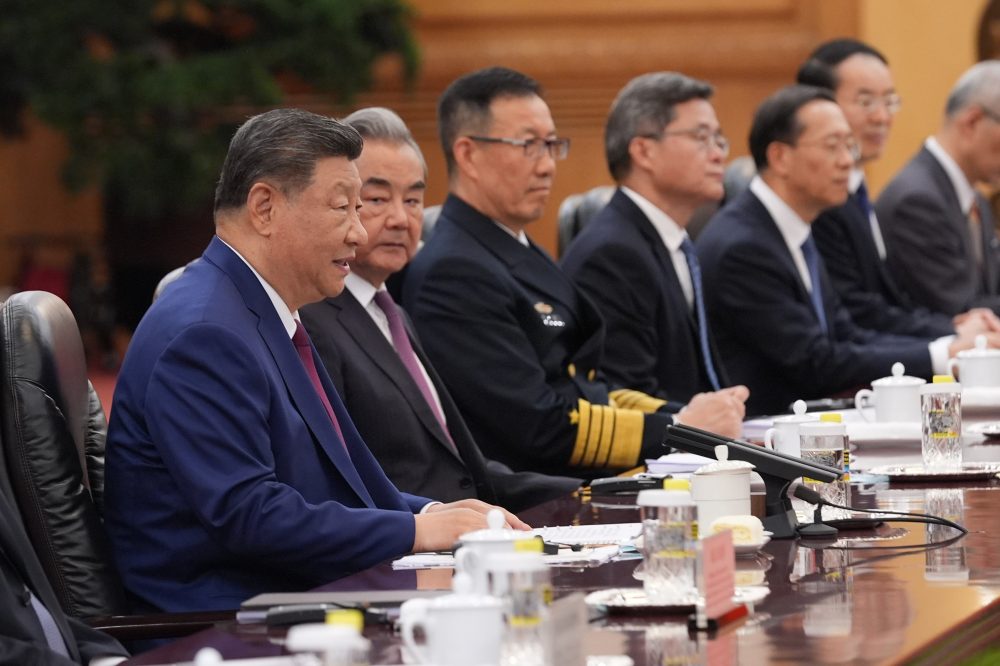
During a summit meeting with U.S. President Donald Trump, China’s President Xi Jinping emphasized that the “Taiwan question” represents the most critical matter affecting relations between the two nations, based on an official statement from China’s foreign ministry.
“‘Taiwan independence’ and cross-Strait peace are as irreconcilable as fire and water,” Xi declared to Trump, the ministry’s statement revealed.
The Chinese leader’s harsh language demonstrates Beijing’s mounting pressure on America, which serves as Taiwan’s primary unofficial partner. While U.S. law mandates ensuring Taiwan maintains defensive capabilities, Washington officially follows what experts call strategic ambiguity — avoiding clear commitments about potential military intervention should China attempt forcible reunification.
“If it is handled properly, the bilateral relationship will enjoy overall stability. Otherwise, the two countries will have clashes and even conflicts, putting the entire relationship in great jeopardy,” Xi stated, the ministry reported.
China has already intensified efforts in recent years to persuade Taiwan’s diplomatic partners to switch allegiances while escalating military intimidation around the island.
Secretary of State Marco Rubio declared Thursday that America’s Taiwan policy remains “unchanged” while cautioning that Chinese military action against Taiwan would constitute “a terrible mistake.”
“U.S. policy on the issue of Taiwan is unchanged as of today,” he stated during an NBC News interview.
The mainland and Taiwan have operated under separate governments since 1949, following the Communist Party’s victory in Beijing after civil warfare. Defeated Nationalist forces retreated to Taiwan, which eventually evolved from military rule into a multi-party democratic system.
Beijing considers independently-governed Taiwan a rebellious territory that must be reclaimed through force if needed.
Tensions between the mainland and Taiwan have escalated since Taiwan initially elected Tsai Ing-wen as president in 2016. Her Democratic Progressive Party maintains Taiwan operates as an independent, sovereign nation. China suspended most official communications with Taiwan’s administration. Recently, Beijing has deployed naval vessels and military aircraft near the island almost continuously.
The Chinese president has previously declared China would “surely be reunified” with Taiwan, home to approximately 23 million residents.
Apart from political considerations, Taiwan serves as a crucial producer of AI servers, semiconductor chips and advanced manufacturing equipment. The artificial intelligence surge has driven Taiwan’s top tech firms to unprecedented earnings and sales.
Experts suggest Xi’s statements reveal China’s concerns about strengthening defense cooperation between Taiwan and America.
“If China had secured any meaningful concession on Taiwan from Trump, it would have been reflected” in Beijing’s official summary of the leaders’ discussion, explained William Yang, a senior analyst for Northeast Asia for International Crisis Group.
“The lack of such mention and the relatively stern tone suggest Trump may not have budged on Taiwan in principle,” he noted.
In December, Trump’s administration revealed an $11 billion arms deal for Taiwan, representing the largest such package ever. Trump has also pressed Taiwan to boost its defense expenditures.
Ma Chun-wei, a specialist in China-Taiwan affairs at Taiwan’s Tamkang University, suggested China might also be concerned the Trump administration has shifted from traditional diplomatic terminology regarding Taiwan. America’s stance has historically acknowledged China’s Taiwan position while maintaining unofficial island relationships.
The most recent national security strategy from the Trump administration, released last December, states simply: “We will also maintain our longstanding declaratory policy on Taiwan, meaning that the United States does not support any unilateral change to the status quo in the Taiwan Strait.”
America typically employs highly standardized phrasing regarding its Taiwan relationship.
“For Xi Jinping, he must show that the Taiwan issue is in China’s hands. He must demonstrate this image, or else he would be criticized,” Ma observed.