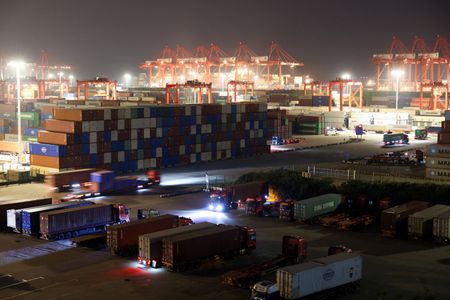

Economic forecasters anticipate that China’s overseas sales momentum picked up pace in May, bolstered by international buyers accelerating their purchasing schedules to avoid potential energy cost increases linked to Middle Eastern conflicts, combined with ongoing worldwide appetite for computer chips and artificial intelligence components.
Analysts surveyed predict the world’s second-largest economy saw its overseas shipments climb 15% compared to the same period last year when measured in U.S. dollars, based on responses from 32 economic experts polled. This represents an uptick from April’s recorded increase of 14.1%.
While the ongoing Middle Eastern crisis hasn’t yet impacted China’s export performance – a key economic growth mechanism favored by government officials – analysts believe disruption is inevitable. They expect that as international purchasers complete their inventory building and the advantages of accelerated ordering diminish while production costs climb, buyers will reduce stockpiles and delay purchases until conflicts resolve.
Expert opinions varied significantly regarding China’s international shipping performance last month. China Industrial Securities, Huachuang Securities and Zheshang Securities projected the most conservative estimates around 10% expansion, while the Economist Intelligence Unit and JP Morgan anticipated export growth would moderate to approximately 12%. ING provided the most optimistic projection of a 19.5% surge.
Additional manufacturing sector information for May revealed a steep monthly decline in new overseas orders following their peak at a two-year high in April, when facility supervisors characterized operations as “booming” during a rush by international manufacturers to secure supplies before possible cost increases, indicating the advance ordering trend may be weakening.
Robust international sales helped drive the $20 trillion economy beyond projections during the initial quarter, though progress has subsequently slowed, strengthening analysts’ worries that insufficient internal demand leaves China vulnerable should external circumstances deteriorate, potentially necessitating additional government intervention.
Incoming goods are projected to have increased by 25%, maintaining roughly the same trajectory as April’s 25.3% rate. South Korea’s overseas sales, an important indicator of China’s purchasing activity, jumped 80.9% in June, driven by semiconductors and technology components utilized in China’s production networks.
However, Chinese leadership faces mounting international criticism to strengthen domestic spending. Detractors contend the government relies excessively on bringing in components and shipping out completed products rather than encouraging internal consumption, an approach that threatens to push other developing nations out of more valuable manufacturing sectors.
The Organisation for Economic Cooperation and Development reinforced this worry recently, stating in a publication that almost 60% of Chinese companies’ “market share gains can be explained by subsidies received.”
A recent U.S. Federal Reserve study determined that China’s trade surplus – calculated relative to worldwide economic output – has exceeded 1%, surpassing the highs achieved by Japan and Germany during the late 20th century, with minimal indication of reduction. This suggests ongoing Chinese industrial excess capacity will continue reshaping global manufacturing for the foreseeable future.
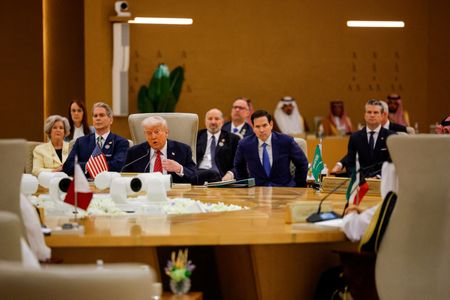
A highly anticipated meeting last month between U.S. President Donald Trump and President Xi Jinping helped reduce friction but yielded no substantial progress, either regarding tariff disagreements or collaboration on resolving the Iran conflict.
China’s trade surplus is expected to reach $92.1 billion in May, rising from $84.8 billion the previous month and $51.3 billion in March.