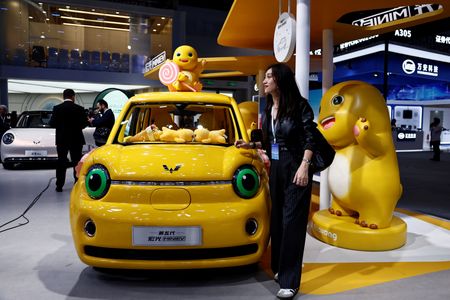

A striking price comparison has emerged from China’s automotive market that highlights just how affordable electric vehicles have become in the world’s largest car marketplace.
Data from the Beijing Auto Show, which welcomed public visitors this week, reveals an extraordinary pricing gap between Chinese and American vehicle markets. While March statistics from Kelley Blue Book show the typical new vehicle in the United States carries a $51,456 price tag, Chinese consumers have access to more than 200 battery-powered vehicles priced below $25,000, according to automotive platform DCar.
The price difference becomes even more dramatic when examining China’s most popular budget electric models. Research compiled using DCar information identifies five top-selling Chinese electric vehicles that start under $12,000 – collectively costing less than one average American car.
Leading this affordable lineup is the Geely EX2, starting at $10,060. This compact electric vehicle claimed the title of China’s best-selling car of any type in 2025. Despite its budget price, the EX2 includes advanced features like front trunk storage, multiple cabin compartments, and a 14.6-inch touchscreen powered by Geely’s proprietary software. The highest-end version delivers approximately 255 miles of driving range under Chinese testing protocols.
Marketed in China as the “Star Wish,” the EX2 launched in 2024 and quickly expanded to international markets including Brazil, Indonesia, and Thailand. Auto analyst Felipe Munoz praised the vehicle’s interior experience, stating: “When you get in, you don’t feel like you are in a small car. It feels better in terms of quality and bigger in terms of size.”
At the budget end sits the Wuling Hongguang MiniEV, priced from just $6,560. This micro-vehicle embraces a deliberately simple, cheerful design philosophy reminiscent of earlier economy cars. For 2026, Wuling expanded the MiniEV to include four doors and improved rear passenger space, though it remains extremely compact by American standards – two previous-generation MiniEVs could fit in the parking space required for a Ford F-150.
The basic MiniEV reaches maximum speeds of 62 mph with a 127-mile battery range according to Chinese standards. Wuling also produces the retro-styled Bingo Pro, a larger subcompact starting just above $8,000 with highway capabilities and 250-mile range.
Chinese automotive giant BYD dominates the affordable electric segment with three models under $12,000: the Seagull at $10,200, Yuan UP at $10,945, and Qin Plus DM at $11,675. These three vehicles alone generated 700,000 sales in China over the past year.
The Seagull particularly impressed industry observers when it debuted three years ago, surprising analysts with its combination of performance, design, and pricing. The 2026 Seagull includes optional lidar technology for driving assistance and automated lane changes, plus fast-charging capabilities and up to 314 miles of range on premium versions.
BYD initially equipped the Seagull with a single “monoblade” windshield wiper as a cost-saving measure – a decision that drew mixed reactions from analysts who praised the innovation and drivers who complained about poor heavy-rain performance. The 2026 model returns to conventional dual wipers.
These ultra-affordable Chinese electric vehicles remain unavailable in American dealerships and may never reach U.S. shores, highlighting the vast differences in automotive markets shaped by local competition and consumer preferences.