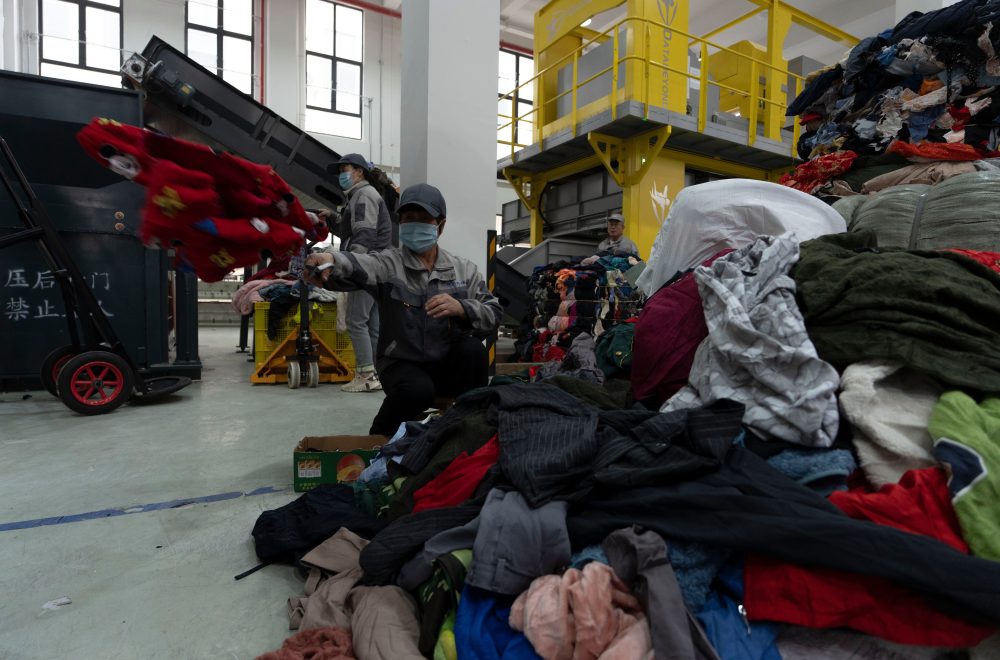

ZHANGJIAGANG, China — A groundbreaking artificial intelligence system is transforming textile recycling operations at an industrial facility on China’s eastern coastline, demonstrating how technology could help address the growing problem of clothing waste worldwide.
The innovative Fastsort-Textile system, developed by Chinese AI recycling firm DataBeyond since 2018, earned recognition as one of Time magazine’s Best Inventions of 2025. The technology uses advanced scanning to identify fabric compositions and separate materials at unprecedented speeds.
“We can make full use of textile waste and reduce the amount that is incinerated which will be a great help to recycling resources,” explained DataBeyond CEO Mo Zhuoya.
The machine’s performance capabilities far exceed human workers, processing 220 pounds of garments in just two to three minutes versus the four hours required for manual sorting. According to Shanhesheng Environmental Technology Ltd., the facility where the equipment operates, the AI system can handle two tons hourly while maintaining superior accuracy compared to the two-day timeframe needed for two workers to complete equivalent tasks.
Synthetic fabrics, which comprise approximately 70% of worldwide textile manufacturing according to Amsterdam-based Circle Economy research, present significant environmental challenges as they originate from petroleum-based materials. China dominates global textile exports with $142 billion in sales, more than twice the European Union’s output, based on World Trade Organization data from 2025.
The 16-by-6.5-foot scanner operates alongside conveyor belt systems, analyzing each item’s material makeup in under one second. Workers feed clothing stacks onto moving belts that transport items through the scanner, which produces distinctive sounds while conducting its analysis. Real-time results appear on a monitor attached to the scanning unit.
Following identification, textiles move to designated areas for nylon and polyester recycling. Items falling below quality standards are directed toward incineration or landfill disposal, the primary sources of textile-related environmental damage.
“This sort of thing saves money on labor costs, it saves time. When people sort materials, they can’t tell accurately if it’s 80 or 90% polyester. This machine rarely makes mistakes,” noted Shanhesheng Sales Manager Cui Peng.
The technology has achieved measurable environmental improvements, reducing unrecyclable waste from 50% to 30% since installation, according to Sales Director Li Bin.
“Now, though machines are already capable of sorting, people’s energy is limited,” Li Bin observed. “People can’t work for 24 hours straight, so robots may take over the roles in the end. The ultimate goal is a ‘dark factory’ with the robots running 24 hours.”