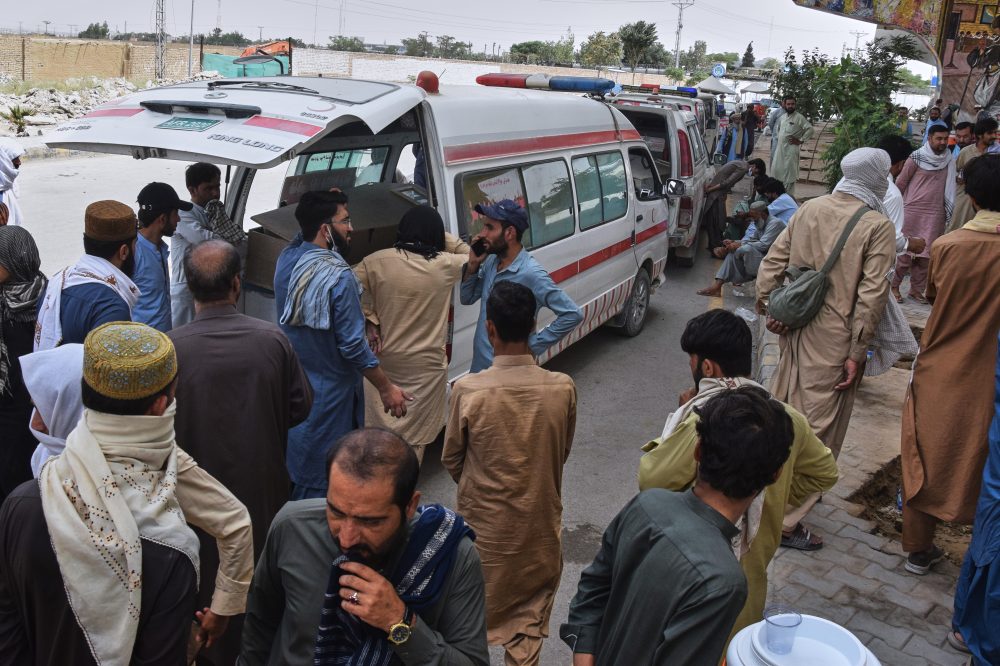

QUETTA, Pakistan — Pakistan’s Prime Minister Shehbaz Sharif made a personal visit Thursday to Balochistan province in the country’s southwest, meeting with families of the 42 people — the majority of them security personnel — who lost their lives in a series of militant attacks that began earlier this week.
Since the attacks started Monday, Pakistani authorities have launched counteroperations that have resulted in the deaths of at least 54 insurgents, according to the military and local officials.
The surge in violence led Sharif to travel to Quetta, the provincial capital, where members of the banned Baloch Liberation Army carried out multiple separate strikes beginning Monday. The growing boldness of these attacks has sparked concern that separatist factions once viewed as relatively minor are now extending their influence across a wider area.
The single deadliest incident occurred at a police post in Balochistan’s Ziarat district on Monday, where nine officers were killed. Eighteen additional officers who were taken hostage during that attack were later executed by their captors.
Outraged by the killings, relatives of roughly two dozen of the slain officers gathered in Quetta for a sit-in protest alongside the bodies of the victims, calling on the government to hold the perpetrators accountable.
“The war against terrorism will continue until the last terrorist in Pakistan is eliminated,” Sharif declared in televised comments while presiding over a security meeting that included army chief Field Marshal Asim Munir and Balochistan Chief Minister Sarfraz Bugti.
While stopping short of directly naming India, Sharif stated there was “no doubt” that Pakistan’s eastern neighbor was playing a significant role in stoking the insurgency — allegedly supplying militants with weapons, funding, and other forms of support. He also accused militants of using Afghan soil as a launchpad for attacks in both the northwestern province of Khyber Pakhtunkhwa and in Balochistan, pledging that the state would defeat what he called their “nefarious designs.”
Neither Kabul nor New Delhi issued an immediate response, though both governments have denied similar accusations in the past.
Balochistan, which is Pakistan’s largest province by area but its least populated, has been a long-running flashpoint for a separatist insurgency. It has also seen repeated attacks from the Pakistani Taliban — known as Tehrik-e-Taliban Pakistan, or TTP — a militant organization that is distinct from but aligned with the Afghan Taliban.
The TTP has grown increasingly powerful since the Afghan Taliban reclaimed control of Afghanistan in 2021.