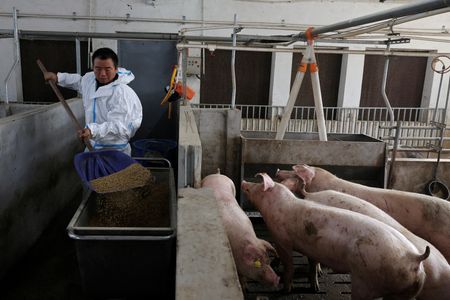

In the agricultural regions surrounding Taizhou, China, located two hours northwest of Shanghai, pig farmers are experimenting with an innovative feeding approach that could reshape global soybean markets.
At one local farm, owner Gao Qinshan, 47, has installed two large pools containing a fermented mixture of locally-sourced materials including grain brans, pumpkin vines, and wine byproducts. This ochre-colored liquid represents a significant departure from traditional soybean-based feeds.
The fermentation process breaks down proteins similar to yogurt production, making nutrients more digestible for livestock while reducing the need for premium soybean proteins. China currently imports 80% of its soybeans, creating vulnerability to price fluctuations and trade disruptions.
“Soybean prices have become so unstable,” Gao explained. With feed representing 70% of pig production expenses and soybean costs rising due to trade tensions with Washington and Middle East conflicts, “pig farming has become unprofitable. Everyone is thinking about how to cut costs.”
Beyond individual farm economics, Beijing has strategic motivations for this agricultural transformation. The government intensified efforts to diversify livestock protein sources in March of last year, coinciding with escalating trade disputes during President Trump’s second term, when soybeans became a negotiating tool.
Reuters investigations involving dozens of livestock producers, feed manufacturers, government researchers, and industry analysts show Beijing is advancing alternative feed technologies more rapidly than previously understood.
This agricultural initiative parallels Beijing’s technological independence campaigns in semiconductors and artificial intelligence, responding to Washington’s restrictions on advanced technology exports to China.
“The biggest national policy goal right now is soymeal reduction,” stated Fu Zhenzhen, a feed analyst at Beijing Orient Agribusiness Consultants. “The most direct reason for that is the trade war with the United States. Fermentation is essential.”
China leads global soybean purchases, importing $52.7 billion worth in 2024, with $12 billion originating from the United States, according to World Bank data. Last year’s imports increased 6.5% from 2024 to reach a record 111.8 million metric tons, Chinese customs reported.
Fermented feed currently represents 8% of China’s industrial feed production, rising from 3% in 2022, with industry projections reaching 15% by 2030. This growth could reduce Chinese soybean imports by up to 6.3% from current levels, based on Reuters analysis.
Pig farming represents a crucial component of Beijing’s food security strategy. Pork remains a dietary staple for Chinese consumers, with China housing half the world’s pig population. Swine require more soymeal than poultry or cattle, making feed alternatives particularly important.
Operations like Gao’s produce one-third of China’s livestock, making the country the world’s largest meat producer.
However, transitioning to fermented feed systems requires substantial investment and often complete feeding infrastructure overhauls. Gao initially struggled with mold contamination and feed waste, challenges that cause many farmers to abandon the approach.
Beijing is addressing these obstacles through comprehensive industry incentives targeting every supply chain segment.
Muyuan Foods, the world’s largest pig farming operation, has decreased soymeal content from 10% six years ago to 7.3% currently using synthetic amino acids derived from fermented corn starch, according to feed division director Zhang Meng.
Agricultural conglomerate New Hope Liuhe has created soymeal-free poultry feeds by fermenting duckweed and other affordable protein sources, according to informed sources. New Hope did not respond to comment requests.
Collaborating with government agencies, China’s leading dairy producers Yili and Mengniu have reduced cattle feed soymeal content by 20%, according to sources at the state-supported National Center of Technology Innovation for Dairy. Yili declined comment, while Mengniu did not respond to inquiries.
These soymeal reduction figures are being disclosed publicly for the first time.
International investment is also flowing into China’s fermented feed sector, with Netherlands-based trading company Louis Dreyfus planning its first fermented feed production facility in the northern port city of Tianjin.
“China is standing at the forefront of fermentation technology,” observed Shambhu Nath Jha, principal consultant at Fact.MR.
The US-based consulting firm estimates China’s fermented feed market reached $6 billion in value last year, rapidly approaching Europe’s mature $7 billion market. By comparison, the US market totals just $2.5 billion due to readily available domestic soybeans and corn.
In poultry applications, China’s 25% fermented feed adoption rate already exceeds Europe’s 20%, according to Fact.MR data.
Beijing benefits from favorable market conditions, as pork prices at 16-year lows make cost-reduction strategies attractive to producers.
However, the fermentation approach faces challenges from lack of standardized methods, analysts note.
Some experts argue that pigs fed improvised fermented feeds may mature more slowly and show increased disease susceptibility.
Consumer preferences may provide the ultimate evaluation criterion.
“There is so much demand from consumers for better quality meat, but the industry is just focused on reducing costs and doing what the government wants,” said Ian Lahiffe, a Beijing-based agriculture consultant.
“There are a lot of benefits to feeding soybeans,” he added. “They need to think about how to avoid sacrificing animal health and meat flavour.”