
Satellite imagery has uncovered a massive military construction project in China’s remote desert regions, where security experts believe the country is building extensive infrastructure to safeguard its nuclear missile capabilities from potential first strikes.
The satellite photos examined by news organizations show China constructing an expansive network of launch platforms, protective bunkers and communication centers near the isolated nuclear missile sites housing the military’s most powerful long-range weapons.
According to three security analysts who reviewed the imagery, the photographs reveal more than 80 platforms that could accommodate China’s growing collection of mobile missile systems and air-defense equipment. The facilities may also support electronic warfare operations, satellite communications and command functions.
This previously unreported construction demonstrates a major expansion of reinforced infrastructure meant to protect and operate China’s ground-based nuclear capabilities. The network represents a substantial upgrade in the country’s efforts to maintain second-strike abilities, highlighting escalating nuclear rivalry with the United States amid growing tensions over Taiwan’s status.
“We can see this infrastructure is being built on a grand scale, covering thousands of square kilometers of desert beyond the silo fields,” said Alexander Neill, an adjunct fellow at Hawaii’s Pacific Forum think tank. Based on the potential capabilities, he noted, “we’re looking at a very considerable enhancement and diversification of China’s strategic nuclear deterrent.”
Protecting these desert installations is crucial to China’s declared objective of maintaining a minimal yet effective nuclear deterrent — a strategy based on the ability to strike back if attacked first. Although the People’s Liberation Army can launch nuclear weapons from submarines and aircraft, the missile sites in northwestern Xinjiang region and Gansu province form the foundation of its nuclear arsenal.
China’s nuclear expansion ranks among the most closely watched aspects of President Xi Jinping’s military modernization efforts, partly due to what some foreign diplomats characterize as insufficient transparency from the country and unsuccessful American attempts to engage Chinese leadership about their developing nuclear capabilities and goals.
A fundamental element of China’s approach is its “no first use” policy, indicating its forces would not begin a nuclear conflict. However, some senior Western diplomats and analysts suggest China might potentially use nuclear threats to discourage outside intervention in a Taiwan conflict.
Earlier this month, Xi cautioned U.S. President Donald Trump that poor management of their nations’ Taiwan disputes, which China considers its territory, could bring them to a “dangerous place.” Taiwan’s government disputes China’s territorial claims.
China’s defense ministry did not respond to inquiries about its nuclear program and the developments shown in the satellite images. The Pentagon declined to comment on intelligence-related issues.
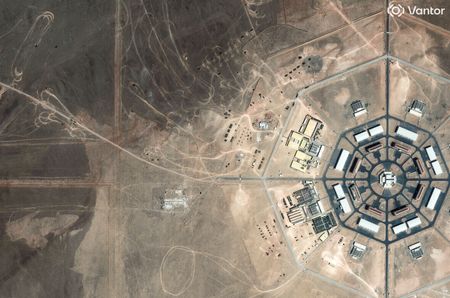
The new desert facilities center on two octagon-shaped installations constructed over the past six years in eastern Xinjiang. Both are located southwest of the Hami nuclear missile sites — one approximately 140 kilometers away, the other roughly 230 kilometers distant.
Satellite images reveal the octagonal structures house personnel quarters and large military vehicles. They are surrounded by armored bunkers and fortified weapons storage areas, plus airfields and rail connections linking the octagons to the Hami installations.
Images show exercises involving large military vehicles took place around the northern octagon this month and in April. Recent photographs also display large tents and what two analysts identified as camouflaged launch sites carved into the desert, some equipped with air-defense missile systems.
While the octagons have been documented before, this is the first report detailing the scope of the launch-pad network connected to the octagons, recent military activity at one facility, and analysts’ evaluations that the pads could accommodate mobile missile launchers and electronic-warfare operations.
Five security scholars consulted agreed the infrastructure could broadly support China’s nuclear program and other military functions. However, they noted that crucial details remain unclear — including what weapons China might position at the launch pads and whether the octagon structures contain truck-mounted ballistic missiles or nuclear warhead assembly facilities.
The PLA showcased nuclear-capable weapons during a Beijing parade last September marking the 80th anniversary of World War II’s end. These included silo-based and truck-mounted intercontinental ballistic missiles.
U.S. officials and arms-control experts say China is expanding and upgrading its nuclear weapons capabilities more rapidly than any other country. The most recent Pentagon assessment of China’s military modernization indicates the nation’s warhead production has decelerated but remains on course to deploy 1,000 warheads by 2030. The December report estimated China likely has positioned 100 ICBMs across its three primary silo locations.
China has also been enhancing its early-warning capabilities, supported by its Huoyan-1 satellites, according to U.S. officials. The system can identify an approaching ICBM within 90 seconds of launch and notify a command center within three to four minutes, according to the Pentagon — enough time for China to launch its own silo-based weapons before impact.
Each octagon anchors a network of dirt roads and conduits extending deep into the desert. These pathways connect to concrete platforms positioned among rocky formations and dry creek beds.
Three security scholars said the platforms could deploy mobile air-defense missiles, electronic warfare equipment or, from some larger ones, road-mobile ICBM launchers.
Hans Kristensen, director of the Federation of American Scientists’ Nuclear Information Project, said while determining how the various installations would be utilized was challenging, “it is hard to rule anything out” considering the infrastructure’s scale in such a harsh environment.
Kristensen and Neill suggested the conduits linking the pads to the octagon structures might house fiber-optic cables for communications.
At the northernmost octagon, three analysts identified a possible space or microwave communications facility under construction, pointing to satellite dishes and two large towers.
“Taken together, I think there is a real possibility that the octagonal structures and the strange towers are linked to C3 — command, control, and communications — as well as maintenance and storage activities related to China’s nuclear operations at the Hami ICBM silo site,” said Tong Zhao, a senior fellow in nuclear policy at the Carnegie Endowment for International Peace.
A third octagon-shaped facility south of the Lop Nur nuclear test sites is less advanced. It appears to function as a target range: Images reveal pock-marked terrain, damaged structures and what analysts at Vantor, a commercial satellite imagery provider, identified as replicas of Western jet fighters.
The scope of the defensive network surrounding its silos potentially distinguishes China from other major nuclear powers. The U.S. and Russia — whose warhead inventories and deployed weapons greatly surpass those of China — depend on a combination of large numbers of silos, their remote locations and reinforced construction to prevent a first strike, rather than extensive missile defense, Kristensen explained.
The magnitude of what is developing in China’s northwestern desert has surprised even experienced analysts.
“I’ve never seen anything quite like it,” Kristensen said. “It’s an extraordinary effort.”