
BEIJING (AP) — Despite global focus on conflicts in Iran, China has continued advancing its domestic agenda with worldwide implications during its most significant annual political gathering.
While Beijing acknowledges the war’s effects on energy markets and international relations, the world’s second-largest economy remains focused on its technological competition with America rather than military conflicts elsewhere.
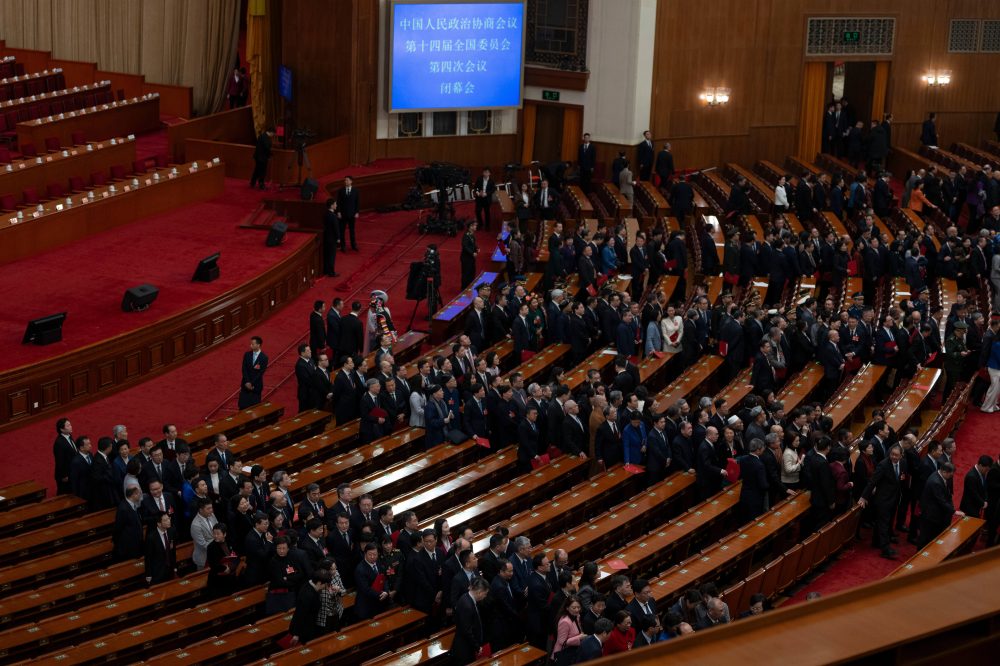
This priority became clear Thursday when the National People’s Congress approved a comprehensive five-year development plan during the conclusion of its yearly session, China’s most important political gathering. The plan reinforces China’s commitment to economic transformation and technological leadership. Government-controlled media portrayed China’s unwavering focus on economic progress as providing global stability during uncertain times.
“A stable and developing China injects more stability and certainty into a world fraught with change and turbulence,” the official People’s Daily newspaper said in a front-page column on Wednesday. Additional state-controlled outlets repeated similar themes.
These official statements avoided mentioning U.S. President Donald Trump, whose trade policies and military interventions from Venezuela to Iran are disrupting the international framework established after World War II. China openly supports this existing system while advocating for modifications to better serve developing nations alongside wealthy countries.
Trump plans to travel to Beijing in three weeks for discussions with Chinese President Xi Jinping.
During its final session, the National People’s Congress also approved three pieces of legislation, including measures affecting ethnic minorities. These votes follow ceremonial procedures with near-universal approval, demonstrating support for the Communist Party’s national vision. The five-year plan received approval with 2,758 supporting votes, one opposition vote, and two abstentions.
“We are forging ahead at full speed in building a great country,” Foreign Minister Wang Yi said at an annual news conference during the Congress.
Economic experts argue China should prioritize putting more money in consumers’ pockets to increase domestic spending and decrease reliance on export-driven growth.
While Chinese leadership agrees conceptually, the approved five-year plan emphasizes technology as the central focus, confirming it remains the government’s top priority. Experts anticipate consumer spending improvements will occur slowly through expanded social services and healthcare benefits, while government investment flows into artificial intelligence, robotics and related fields.
Chinese Premier Li Qiang revealed an economic growth target of 4.5% to 5% for 2026 when Congress began, providing officials flexibility to pursue long-term objectives rather than achieving higher short-term targets.
The development plan avoids promising overall carbon emission reductions, instead committing to lower “emissions intensity” — measuring pollution relative to economic output. This approach allows total emissions to increase alongside economic expansion.
Officials set the intensity reduction goal at 17%, which analysts say could permit emissions to rise 3% or higher. “International good practice is to move away from intensity targets towards absolute emission reduction targets,” said Niklas Hohne of the NewClimate Institute in Germany.
China typically establishes modest targets, and its rapid solar energy expansion plus other clean technologies may reduce emissions regardless. As the world’s largest greenhouse gas producer, Chinese officials have consistently argued that population size and economic scale must factor into pollution assessments.
A comprehensive ethnic minorities law approved by Congress strengthens what opponents describe as government assimilation policies, emphasizing development of “a common consciousness of the Chinese nation.”
Officials claim the legislation aims to build stronger community bonds and shared economic development among ethnic populations. The law reflects Xi’s approach promoting unity over distinct ethnic cultures and languages.
“It puts a death nail in the party’s original promise of meaningful autonomy,” said James Leibold, a professor at Australia’s LaTrobe University who has studied China’s changing policies towards its ethnic minorities.
Official proposals and suggestions for reducing working hours in various ways attracted significant social media attention during this year’s Congress.
Many focused on establishing a “right to rest,” including proposals allowing employees to ignore work communications outside business hours. Most Chinese workers receive just five paid vacation days annually. Yu Miaojie, an economist and Congress representative, suggested increasing minimum statutory leave from five to 10 days.
These proposals’ popularity demonstrates concerns about China’s demanding workplace environment. Providing workers additional leisure time also represents a strategy for boosting consumer spending by creating more opportunities to spend money.