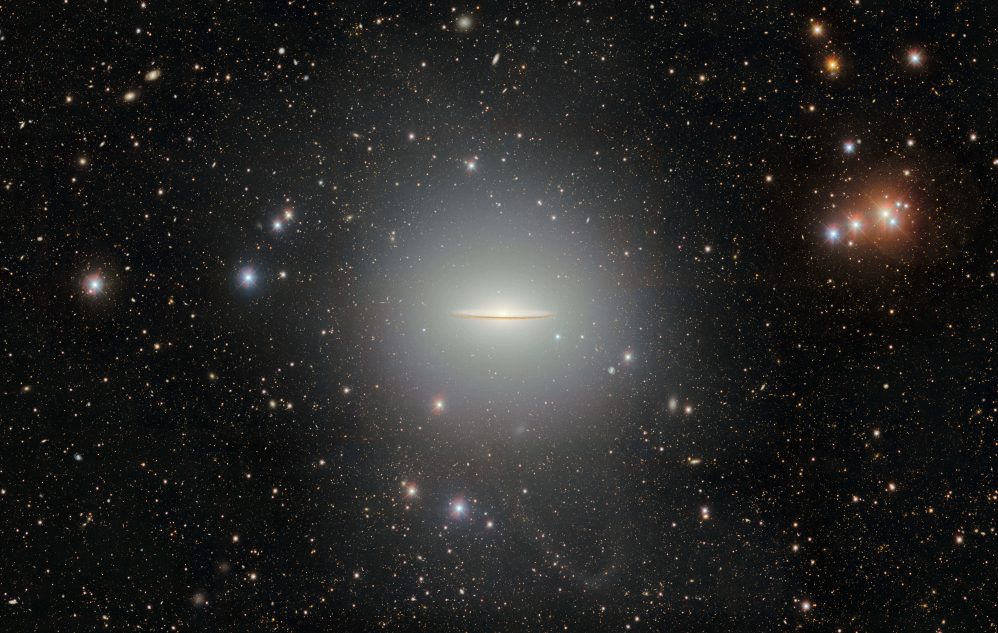

CAPE CANAVERAL, Fla. — Astronomers have unveiled their most spectacular view yet of the famous Sombrero galaxy, showcasing its brilliant ring of stars in unprecedented detail.
The National Science Foundation’s NOIRLab made public on Friday their latest photograph of this distinctive hat-shaped cosmic formation. While a Chilean telescope captured the observations four years earlier, scientists only finished processing the color imagery this week.
Sitting roughly 30 million light-years from Earth, this spiral formation — officially designated as Messier 104 — ranks among the most massive galaxies within the Virgo constellation cluster. The galaxy spans an estimated 50,000 light-years in diameter. Each light-year represents approximately 6 trillion miles.
The remarkable new image shows the galaxy’s luminous stellar halo extending to roughly three times the width of the central sombrero structure.
Using a specialized dark energy camera, the telescope also detected a trail of stars flowing from the galaxy’s southern boundary. Researchers theorize these streaming stars, along with the surrounding halo, originated from smaller galaxies that were torn apart during ancient cosmic collisions.
The Sombrero galaxy was first identified by astronomers during the 1700s.