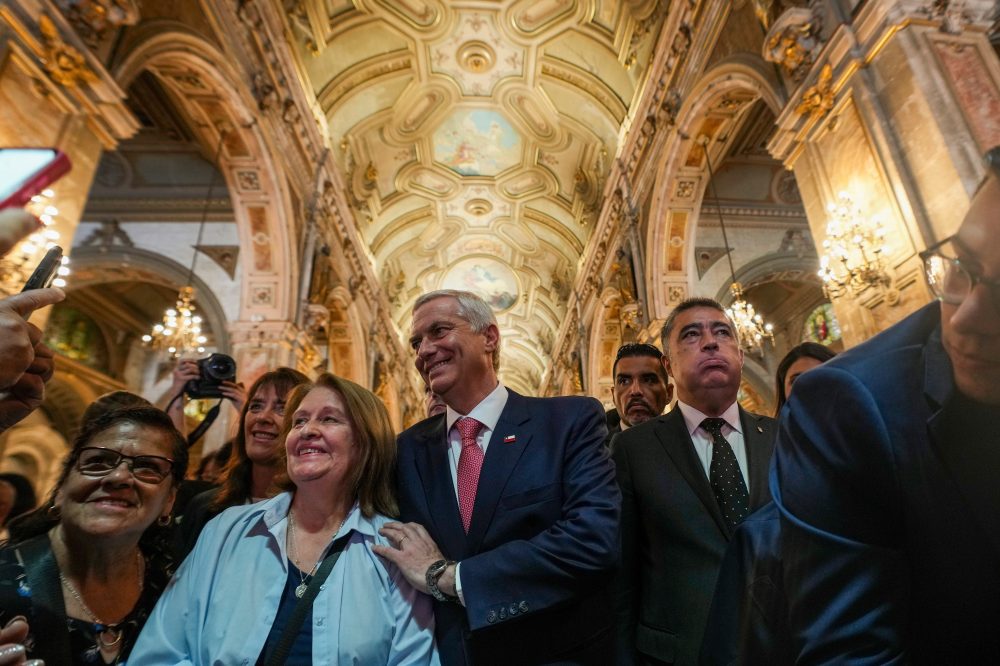

SANTIAGO, Chile — Chile has sworn in a new president who openly displays his religious faith, adding to a wave of conservative leadership sweeping across Latin America.
José Antonio Kast, who assumed the presidency on March 11, practices Catholicism and participates in the Schoenstatt movement, an international Catholic group centered on devotion to the Virgin Mary. The 60-year-old former legislator and father of nine has previously taken strong stances against emergency contraceptive sales in 2009, while also voicing opposition to same-sex marriage and abortion during his 2021 campaign.
“We are inviting you on a journey to recover values for a proper and healthy life,” Kast declared to supporters on election night in December. “It requires everyone’s commitment.”
Advocates for reproductive and LGBTQ+ rights express concern about Kast’s presidency. While immediate policy shifts may not occur, they fear progress on their issues will face new obstacles.
Kast secured 58% of voter support after promising tough action on crime and pledging to remove undocumented immigrants. His rise mirrors a regional pattern where conservative figures like El Salvador’s Nayib Bukele and Argentina’s Javier Milei have gained power focusing on security and economic changes.
The new Chilean leader’s viewpoints share similarities with those of U.S. President Donald Trump, whose administration celebrated Kast’s electoral success.
Chile has experienced declining Catholic membership over the past twenty years, reflecting broader trends throughout Latin America. A 2024 Latinobarómetro survey found regional Catholic identification dropped from 80% in 1995 to 54% in 2024.
Within Chile specifically, 45% of citizens consider themselves Catholic, while 37% claim no religious affiliation and approximately 12% identify as Protestant.
Luis Bahamondes, who studies religion at the University of Chile, notes the Catholic Church ranked among the nation’s most respected institutions during the 1990s. However, social changes and sexual abuse controversies damaged that standing. “It became one of the most questioned institutions and one of the least trusted,” Bahamondes explained.
Despite this decline, conservative attitudes remain visible in Chilean society, he observed.
Chile became the final Latin American nation to permit divorce in 2004, Bahamondes noted. Recently, resistance to school-based sex education has emerged.
Religious instruction remains voluntary in Chile’s public and private schools rather than mandatory.
“There are still concepts that resonate strongly in Chilean society — such as family and marriage — which carry a strong religious weight,” Bahamondes stated. “There is often talk of a crisis of Catholicism, but what is in crisis is the institution, not the belief itself.”
Both Kast and his wife participate in Schoenstatt, a Catholic movement dedicated to the Virgin Mary that began in Germany in 1914 during World War I’s early days.
The movement reached Chile in 1947, establishing its first shrine in the port city of Valparaíso before spreading to Santiago, Temuco and Concepción. Today it claims roughly 10,000 members and operates more than 20 shrines nationwide.
Rev. Gonzalo Illanes, who leads the movement in Chile, describes Schoenstatt’s three foundations: personal development, integrating faith with everyday life, and emphasizing the Virgin Mary’s importance.
Illanes confirmed Kast’s longtime membership in the community, which encourages members to improve the world. “Schoenstatt, like the Catholic Church, is not a political movement but a space for formation, faith and transcendence,” he said.
Similar to Kast’s position, Schoenstatt supports protecting life from conception until natural death. However, Illanes emphasized the group welcomes dialogue. “The challenge is how to move forward,” he said. “Not to stop talking.”
“He’s a president who gives me a lot of confidence,” said Jorge Herrera, a Schoenstatt Catholic who supported Kast. “I share his values.”
Herrera explained that Schoenstatt teaches each person possesses a distinct life purpose. “God did not bring us here by chance,” he said. “We exist because there is something special we are called to do.”
While Kast’s anti-abortion stance matches Herrera’s beliefs, the voter was also drawn to the candidate’s political agenda before the 2025 elections.
“He’s someone very capable and has a plan,” Herrera said. “I think Chile needed a plan.”
This confidence in Kast extends beyond South American borders.
In Mexico, where a leftist government has decriminalized abortion in over half the states, some desire similar leadership.
“It gives me confidence that he publicly acknowledges being inspired by a Christian faith,” said Rodrigo Iván Cortés, who heads a conservative advocacy organization. “That does not mean that he wants to impose his faith on others, but simply that he professes it.”
Kast narrowly missed Chile’s presidency in 2021, losing to Gabriel Boric. His opposition to abortion and same-sex marriage, plus his history of defending Augusto Pinochet’s dictatorship, faced widespread Chilean rejection then.
While Kast focused his 2025 campaign on security issues, experts believe his views could still affect reproductive and LGBTQ+ rights.
“There are valid reasons for concern, though not necessarily for an immediate rollback as seen with Milei,” said Cristian González Cabrera, an LGBTQ-rights researcher at Human Rights Watch, referencing the Argentine president’s prohibition of gender-affirming care for minors under 18.
“The risk with Kast could be more gradual: slowing progress, weakening public policies and legitimizing anti-LGBTQ+ rhetoric,” González Cabrera added.
Concerning women’s reproductive rights, Catalina Calderón from the Women’s Equality Center highlighted that Kast implemented a 3% budget reduction as one of his initial presidential actions.
“Across the region, we have seen that when leaders from the political wing to which Kast belongs take office, one of the first things that happens is a rollback of individual rights and women’s rights,” she stated.
Calderón referenced Argentina, where Milei eliminated funding for comprehensive sex education programs designed to prevent teenage pregnancy.
She also noted the significance of Chile’s new Women and Health ministers being openly religious individuals.
“That belongs to the private sphere,” she said. “But how that vision could shape the administration is something that should be watched closely.”