
For more than three decades, Antonio Bustamante has displayed a watercolor portrait of César Chavez in his Yuma, Arizona law office. During his youth, Bustamante felt inspired by the labor organizer and worked to mobilize workers before becoming part of Chavez’s security detail.
Now, like countless others, Bustamante faces the difficult task of reconciling his admiration for Chavez with recent accusations that the leader sexually abused women and girls.
“I’m trying to figure out how emotionally and intellectually I’ll be able to understand my perception of him as an extremely good man,” Bustamante said, his voice heavy with emotion, “compared to these things that are said he did.”
Chavez gained nationwide recognition for his work organizing agricultural laborers. Working alongside Dolores Huerta — who is also alleged to be among his victims — he established the United Farm Workers union, conducted hunger strikes, organized grape boycotts with Filipino agricultural workers, and ultimately forced growers to negotiate improved wages and working conditions for Mexican American laborers.
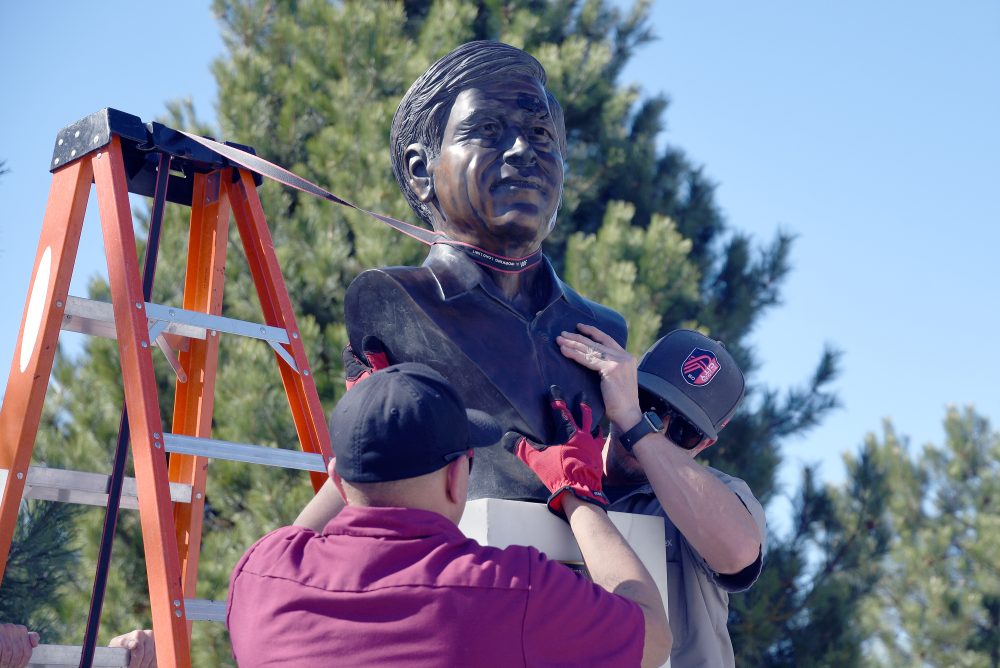
Almost two weeks have passed since The New York Times published detailed sexual abuse allegations, and communities and advocacy organizations nationwide continue grappling with how Chavez should be remembered. His name and likeness have already been removed from monuments, street signs and murals across the nation.
Bustamante learned about the allegations when a longtime friend contacted him about the forthcoming news report. He said what immediately came to mind were the faces of others who had known and respected Chavez, and “how their eyes would be devastated.”
“We were looked down upon by society, we were Mexicans,” Bustamante said, remembering the first time he heard Chavez speak outside the Arizona Capitol in 1972 as he began a hunger strike. He “gave us worth, and for young people that was everything.”
Some of Bustamante’s acquaintances have now removed Chavez images from their homes. In his community, Bustamante compared it to rejecting Catholicism and taking down photographs of the pope.
Many view this situation as evidence that movements shouldn’t center around one individual leader.
Teresa Romero, president of United Farm Workers, acknowledged the unavoidable contradiction between Chavez’s achievements and the allegations.
“We have in one hand César Chavez, the man who committed horrible acts that we’re not going to justify,” Romero said. “On the other hand, we have César Chavez, the organizer who brought thousands and thousands of people together to be able to work for farm workers, and improve their lives and working conditions.”
Romero noted that unfortunately, both aspects came from the same individual.
Sehila Mota Casper, executive director of Latinos in Heritage Conservation, emphasized that the farmworker movement was always powered by collective action.
“The rights and protections that came from it belongs to the people that built it,” she said. “It wasn’t just one individual.”
This viewpoint, she explained, provides a path forward: acknowledging Chavez’s contributions while not allowing them to eclipse the work of others, including Huerta, and the obstacles they overcame.
Organizations like the nonprofit Voto Latino adopted a similar position, stating, “The women who organized, marched, and sacrificed alongside farmworkers carried this movement on their backs.”
The allegations also triggered immediate public responses. Within days, statues were taken down and celebrations were canceled or renamed, including events connected to the federal César Chavez Day on March 31.
Political figures from both parties have denounced the alleged abuse. Some Republicans, including Texas Gov. Greg Abbott, referenced it as part of broader criticism of Chavez’s progressive legacy.
Abbott announced that Texas — a state containing dozens of Confederate monuments — would no longer observe César Chavez Day, stating the allegations “undermine the narrative that elevated Chavez as a figure worthy of official state celebration.”
Meanwhile, organizations like the nonpartisan Latino Victory Project, which focuses on developing Hispanic political leadership, argued this current situation should not overshadow ongoing civil rights struggles.
“Those legacies are unchanged,” said Paul Ortiz, a labor history professor at Cornell University and director of graduate studies for Latino Studies. “And those legacies are all about people power.”
Bustamante believes there will always be questions surrounding Chavez’s name going forward.
“Does that take away the greatness of what his accomplishments were, the meaning of them? No, it doesn’t,” he said. “But can we look past that to honor him? That’s the tough part.”