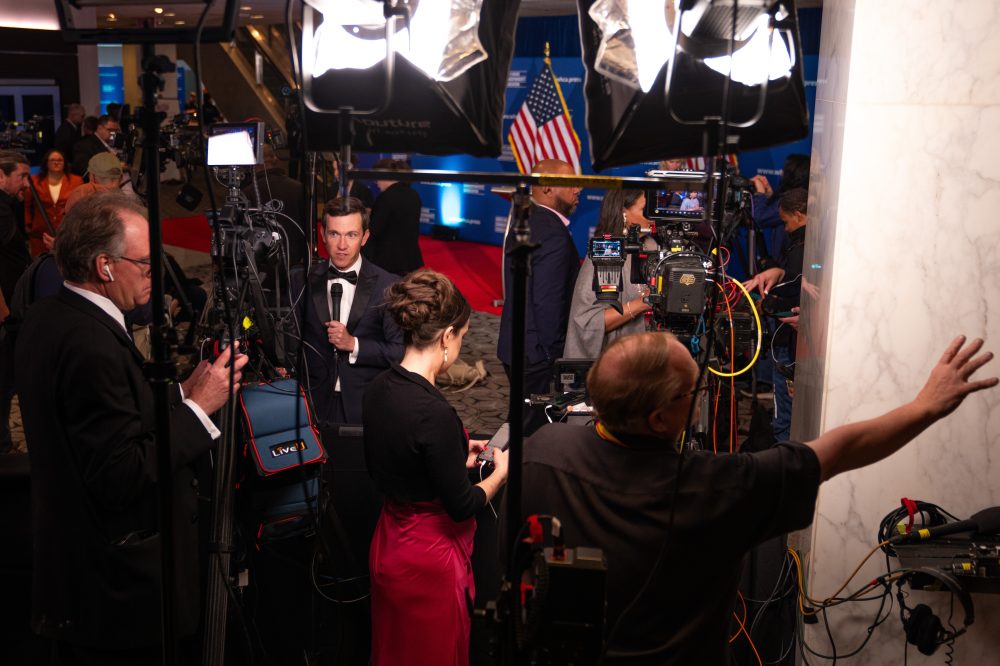

Washington D.C. reporters typically pursue breaking news stories, but Saturday evening brought the action directly to them when an armed attacker disrupted the White House Correspondents’ Association dinner, forcing hundreds of media professionals to shelter in place.
The incident occurred as President Donald Trump was scheduled to address the gathering, instantly transforming the formal event into a scene of confusion and fear as journalists and officials sought safety.
Following the initial panic, professional instincts kicked in as some of the country’s leading reporters and editors attempted to understand and document the unfolding situation around them.
Many attendees, dressed in formal evening wear, immediately dropped beneath their tables seeking protection. “We were under the table before we knew what was happening,” wrote Atlantic magazine reporters Missy Ryan, Matt Viser and Michael Scherer about their experience.
Once the immediate danger passed, journalists relied on their smartphones as makeshift reporting equipment to capture photos, record video, conduct interviews, and maintain communication with newsroom colleagues working remotely.
“For many people who have either been in a war zone or in the midst of a crisis, I don’t think there was any fear,” explained former CBS News president Susan Zirinsky, who attended the event. “It was get it, find it, shoot it, report it. But it was very frustrating not getting a signal out of the room.”
The venue’s poor cellular reception proved both challenging and beneficial for news coverage that night.
Associated Press photographer Alex Brandon leveraged the connectivity issues to capture some of the evening’s most significant images, including photos of suspect Cole Tomas Allen detained outside the ballroom with his shirt removed.
Brandon, attending as a guest without his professional equipment, immediately stood and aimed his phone camera at Trump after hearing gunshots, documenting the president being surrounded by Secret Service agents before being escorted away from the podium.
Recognizing the importance of his photos, Brandon needed to transmit them globally but faced no cellular service. He moved toward the ballroom exit and spotted someone on the ground under law enforcement supervision, immediately identifying this as the suspect and continuing to photograph.
“Frankly, it was muscle memory,” the experienced photographer explained. “The whole thing was muscle memory.”
CNN’s Wolf Blitzer encountered the shooter at close range while returning from a restroom break. A police officer tackled Blitzer to the ground and subsequently moved him into the men’s restroom for protection, as he later reported on air.
“I happened to be a few feet away from him as he was shooting and the first thing that went through my mind was, ‘Is he trying to shoot me?’” Blitzer said. “I don’t think he was trying to shoot me but I was very close to him as the shots were fired and it was very, very scary but I’m OK now.”
Washington Post reporter Maura Judkis, covering the social aspects of the event, observed how “most of the crowd immediately began to cover the story. Print journalists interviewed eyewitnesses. Television reporters shot selfie-style video, angled so that the now-empty dais was in the background. Non reporters reached for the wine on the tables, hoping to steady their nerves.”
After seeking cover under her table, Judkis messaged colleagues via Slack: “shots fired.” She later acknowledged she should have marked those reports as unconfirmed, questioning whether she actually heard gunshots or something else.
The rapid pace of breaking news presented the classic journalism challenge of balancing speed with accuracy. CNN’s Kaitlan Collins, broadcasting live, incorrectly reported that the suspect “is confirmed dead,” citing a security official from the education secretary’s detail seated nearby. The information proved false.
Earlier that day, many journalists’ primary concern was potential criticism from Trump, whose hostility toward the press through rhetoric, policy, and legal challenges has characterized his second presidency. This marked his first correspondents’ dinner attendance as president.
White House press secretary Karoline Leavitt’s preview comments to Fox News’ Jimmy Failla on the red carpet proved unfortunately prophetic. “It will be funny,” she said of Trump’s planned speech. “It will be entertaining. There will be some shots fired in the room.”
Trump never delivered his address. While both the president and correspondents have discussed rescheduling, logistical challenges following Saturday’s events make this uncertain.
Speaking at the White House after the incident concluded the evening early, Trump noted seeing “a tremendous amount of love and coming together” following the shooting.
“This was an event dedicated to the freedom of speech that was supposed to bring together members of both parties with members of the press and in a certain way it did,” he stated. “I saw a room that was totally united — in one way, it was a very beautiful thing to see.”
Trump commended CBS News’ Weijia Jiang, the correspondents’ association president who sat beside him Saturday night. Despite previous contentious interactions, Trump said she performed a “fantastic job” organizing the event and gave her the first question at his press conference.
Not everyone shared Trump’s conciliatory tone. Kari Lake, who oversees the U.S. Agency for Global Media and faces related legal challenges, posted on social media about confronting CNN’s Jake Tapper as he left the dinner. “These reporters have spent a decade spreading absolute lies about President Trump,” she wrote. “They share some of the blame for what happened tonight.”
CBS’ Zirinsky detected a new mutual respect in Trump’s comments, noting a shared experience between the president and press corps. CNN’s Brian Stelter observed in his Sunday newsletter that “Thousands of media and political elites now have gone through what countless millions of other Americans have experienced in their schools, offices, malls and churches.”
“I felt it,” Zirinsky said. “I may have been the only one. But I was literally sensing when I was listening to him at the White House that there was this shared experience and the relationship, is this a change? Is this the mark of a change of a relationship?”