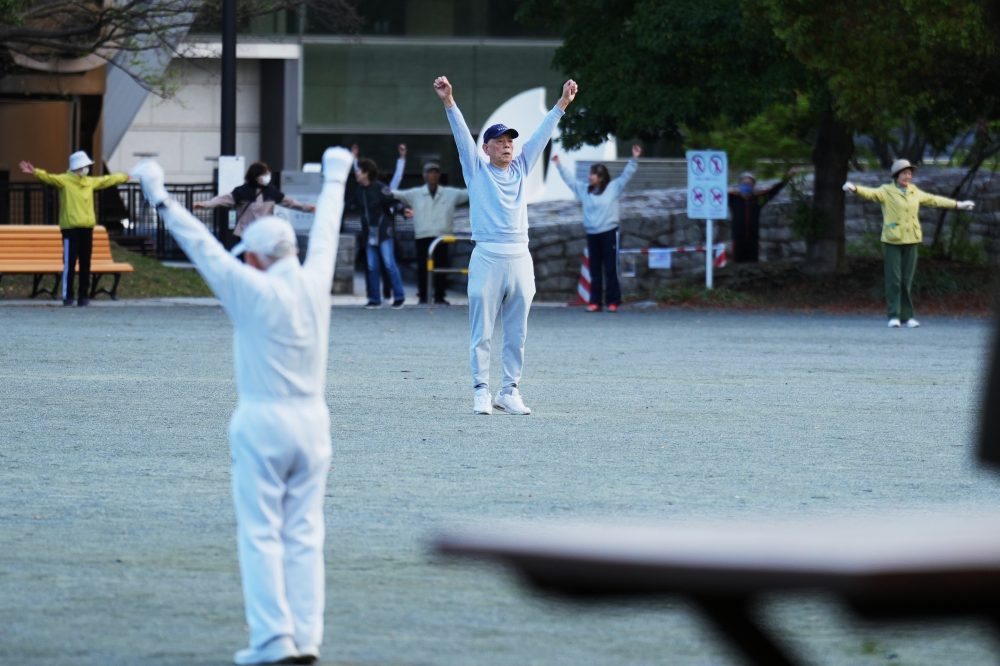

Every morning at 6:30 AM across Japan, millions of people begin their day with a synchronized fitness ritual that has endured for nearly a century.
Known as Radio Taiso, which translates to Exercise Radio, this nationwide tradition involves broadcast calisthenics performed by participants in parks, offices, schools, and homes throughout the country. The routine consists of basic movements set to gentle piano music and simple spoken directions.
First established in 1928 during Emperor Hirohito’s coronation year, Radio Taiso has maintained its popularity because the exercises accommodate people of all ages and fitness levels while requiring no special equipment or training.
The 10-minute workout includes fundamental movements like reaching skyward for stretching, torso twists, hip bends, arm swings, shoulder rolls, and stationary jogging or jumping. Participants can adjust the intensity to match their abilities while following the soothing musical accompaniment.
Health experts point to this daily practice as one contributing factor to Japan’s exceptional longevity rates, which rank among the highest globally for both physical health and social connection.
The routine is available on YouTube with instructions in multiple languages including English. Approximately twelve core exercises can be performed either standing or sitting, encouraging continuous movement throughout the brief session.
The program consists of three segments lasting about three minutes each, with gradually increasing difficulty levels that remain accessible to beginners. Regular participants typically memorize the sequences, while newcomers can easily follow along without prior experience.
Starting with arm movements including lifting, rotating, and side-to-side stretching, the routine progresses to waist bends and twists. Shoulder raises combine with light jumping movements and marching in place, incorporating neck stretches, chest expansions, and small squats for leg strength.
Each exercise repeats four to eight times with ongoing reminders to maintain relaxed breathing and controlled inhalation and exhalation.
At Tokyo’s expansive Kiba Park in the eastern district, 88-year-old Mieko Kobayashi joins a dedicated group almost daily for the morning session.
“If it’s cold or raining, I don’t go,” she said. “By moving my body, I feel better.”
Kobayashi and her 77-year-old companion Yoshiko Nagao explained that many daily participants live alone, making this gathering an essential social connection, especially for elderly community members.
“Laughing and chatting while taking a walk after (the exercise) is also good,” Nagao added. “We come even on New Year’s Day.”
Kenji Iguchi, 83 years old but appearing decades younger, has maintained his routine for approximately two decades.
“It’s for my joints, mainly the knees and back, because of my age,” Iguchi said.
“I get up a 5 a.m. anyway,” he added. “I come to the park about 6 and do a round of walking ahead of the Radio Taiso session. Most of the faces are familiar, and coming here and getting together with them is also one of the things I look forward to.”
Japan maintains one of the world’s highest life expectancy rates at approximately 85 years, surpassed only slightly by Hong Kong. This compares to roughly 79 years in the United States. Experts attribute Japanese longevity to dietary habits, healthcare access, and cultural practices that keep elderly citizens engaged and active.
Government statistics released last year revealed that 99,763 Japanese citizens had reached 100 years or older, marking the 55th consecutive year of record-breaking centenarian numbers. The count included 87,784 women (88%) and 11,979 men (12%). Japan holds the global record for centenarians relative to its total population of about 122 million.
The concept originated from a similar American radio program sponsored by Metropolitan Life Insurance Company a century ago. According to the Japan Radio Taiso Federation, postal ministry officials who visited the United States in the 1920s brought the idea back to Japan.
Within ten years, millions were participating in the daily routine. Postal workers initially led the program’s expansion by distributing informational materials and conducting training workshops.
Following Japan’s 1945 World War II defeat, American occupation forces prohibited the exercises, viewing the group activities as potentially “totalitarian” with military overtones.
Popular demand restored the group sessions in 1951, just before the American occupation concluded in 1952.
A 2023 federation survey found that more than 20 million Japanese people participate in Radio Taiso at least weekly.
The practice has spread internationally, gaining particular popularity in Brazil, which hosts the world’s largest Japanese diaspora community outside Japan.