
Federal health authorities warn that the current Ebola crisis in Central Africa may balloon to 20,000 infections or higher, based on how effectively health workers can isolate sick individuals to prevent further transmission, according to fresh analysis from American disease experts.
On Friday, the Centers for Disease Control and Prevention released computer-generated projections showing potential outcomes ranging from 10,000 infections up to more than 20,000. Should the dire predictions prove accurate, the worst-case numbers could rival the most devastating Ebola crisis on record — the 2014-2016 West African epidemic that produced over 28,000 documented infections and claimed more than 11,000 lives.
“Without strong public health interventions, the modeling work suggests an outbreak of that scale is possible,” said Dr. Satish Pillai, incident manager for the CDC’s Ebola response, in a briefing with reporters.
Jennifer Nuzzo, director of Brown University’s Pandemic Center, said the modeling “affirms what we have worried about since the beginning: This outbreak is following dangerous trajectory” if more is not done to stop the spread of Ebola.
However, she warned that forecasting outbreak patterns can be exceptionally challenging. “I wouldn’t read too much into the specific numbers. It’s really hard to make an accurate projection when you have limited data,” she added.
The Africa Centres for Disease Control and Prevention reported Friday that approximately 400 confirmed infections have occurred, resulting in 63 fatalities. Health experts believe additional cases likely exist that remain undiagnosed or unreported.
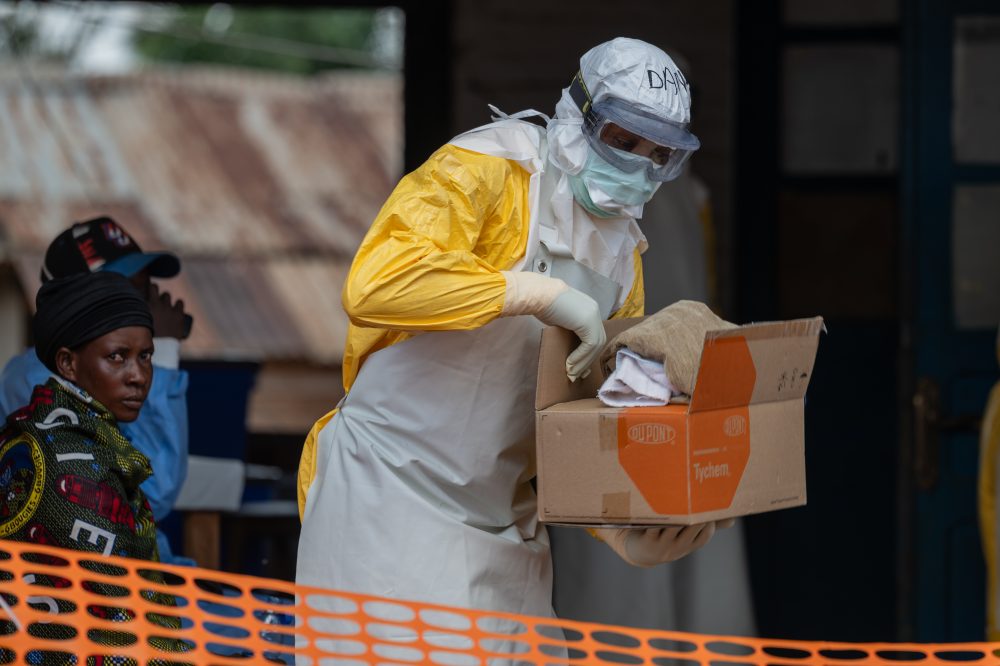
The pathogens responsible for Ebola disease transmit through contact with bodily fluids such as vomit, blood and semen. No targeted treatments or vaccines exist for the Bundibugyo virus driving the current crisis. The illness frequently proves deadly.
The World Health Organization classified the outbreak as a global health emergency in May. Some specialists think infections may have begun in February, though health workers initially conducted tests for a different Ebola strain.
Response efforts have faced complications from armed conflict between Congo’s government and the Rwanda-backed M23 rebel group, plus attacks by the Islamic State-affiliated group the Allied Democratic Force. The fighting has triggered massive population displacement in affected regions, authorities report.
Earlier this week, Nuzzo indicated the threat to the United States appears minimal. “I don’t think it’s a scenario that it’s going to come here and spread broadly,” she told reporters. The CDC supported that evaluation in Friday’s published analysis.
This assessment stems partly from U.S. government choices to prohibit entry of non-passport holders, plus green-card holders who visited Congo, Uganda or South Sudan within the preceding 21 days. Additionally, American passport holders who traveled to those nations undergo health examinations and processing through four designated airports.
The CDC’s modeling study seeks to forecast potential developments based on various factors — including existing infection and death totals, plus response team effectiveness in rapidly identifying and isolating infected individuals before transmission to others occurs.
Assuming roughly 50 fatalities had occurred with about 20% of infected persons successfully isolated by late May, most simulations indicate at least 20,000 cases and 4,000 deaths will happen in Africa over three months.
Pillai noted the actual isolation rate remains unknown but is believed to fall “on the lower end of the scenarios” that CDC modeled.
Improved isolation rates of 50% or 70% might reduce case numbers closer to 10,000, CDC representatives stated. However, if actual May death counts exceeded current recognition, outcomes could worsen, CDC officials explained.
Some CDC projections during the major West African Ebola outbreak proved wildly inaccurate. The CDC released modeled figures in 2014, as the epidemic spiraled beyond control and international health authorities rushed to organize response measures.
The CDC predicted that in a worst-case scenario with no intervention, as many as 1.4 million people could become infected. That estimate exceeded actual results by more than 50 times.