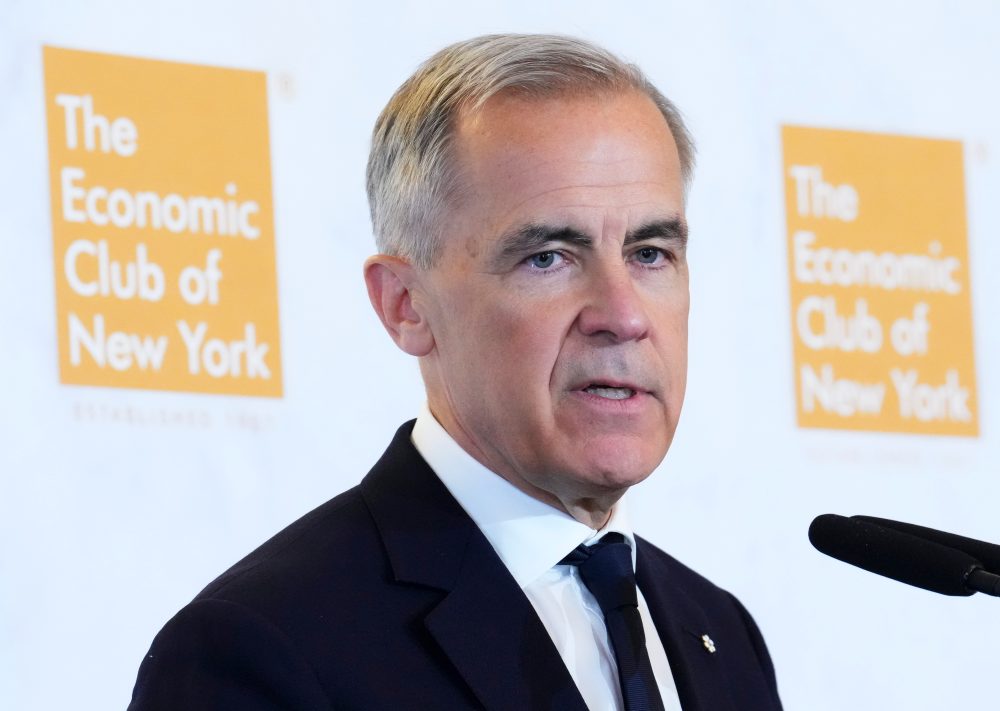

Canada’s Prime Minister delivered a speech Thursday advocating for enhanced cooperation with the United States, speaking just weeks before President Donald Trump makes a decision about extending the free trade agreement between the two nations.
Speaking to the Economic Club of New York, the Prime Minister outlined his vision for what he termed a “true partnership” that would reimagine collaboration in sectors facing challenges from worldwide competition.
His comments came in advance of July’s required evaluation of the United States-Mexico-Canada Agreement, known as USMCA.
The Canadian leader explained that his country is expanding its trade relationships beyond America, establishing commercial agreements with numerous nations globally.
“Our core objective across these partnerships is to increase our strategic autonomy. Because we live in a world where integration has been weaponised. Because a country that cannot feed, fuel or defend itself is not truly sovereign,” the Prime Minister stated.
Recent actions by Trump, including initiating trade disputes and floating the idea of Canada joining the US as its 51st state, have angered Canadians and helped create political conditions that may help the Prime Minister secure his position after pledging to stand up to Trump.
The Canadian leader has become a voice for an international effort encouraging nations to build alliances as a counterbalance to US influence under Trump’s leadership. He has established an ambitious target for Canada to increase its exports to non-US markets by 100% over the coming ten years, citing how American trade penalties are discouraging business investment.
“Canada Strong will help make America great again. The examples are legion where we should work together and compete with the world together. And to those ends, we have made specific, practical proposals to the US Administration,” the Prime Minister declared.
While the Canada-U.S.-Mexico Agreement has shielded Canada from the most severe effects of Trump’s trade penalties, the agreement faces upcoming review, and important industries including aluminum and steel have suffered significant damage from tariffs.
The Prime Minister highlighted that Canadian aluminum shipments to America represent energy equivalent to ten Hoover dams, arguing it would be illogical to seek replacement sources.
“With America’s growing energy needs, does it make sense to build the Gigawatts needed to replace Canada?” the Prime Minister questioned.
Regarding automotive trade, he emphasized that Canada represents America’s largest customer, stating that “an integrated North American market for production is the best and most durable way to confront intense global competition.”
The Prime Minister also discussed critical minerals, explaining that Canada’s extensive deposits of potash, nickel, copper and uranium position the country as America’s most dependable supplier for ensuring affordable food production, strengthening national security, and meeting surging demand for powering artificial intelligence systems.
“At a time of a global energy crisis, Canada provides the United States with the reliable power and critical minerals that help fuel American growth: 99% of U.S. natural gas imports, 85% of electricity imports and 60% of crude oil imports,” the Prime Minister noted.
He pointed out that Canada purchases more American products than China, Japan and Germany combined, making it America’s top customer.
“We know that, when Canada and the United States have had our differences over the years, we have always — eventually — worked through them, because our shared values and common interests run deep. They run through our economies,” he explained.
Canada’s minister for U.S. trade, Dominic LeBlanc, plans to travel to Washington next week for discussions. LeBlanc has previously cautioned that the trade agreement might face yearly reviews, suggesting that creating uncertainty could be part of the Trump administration’s strategy.