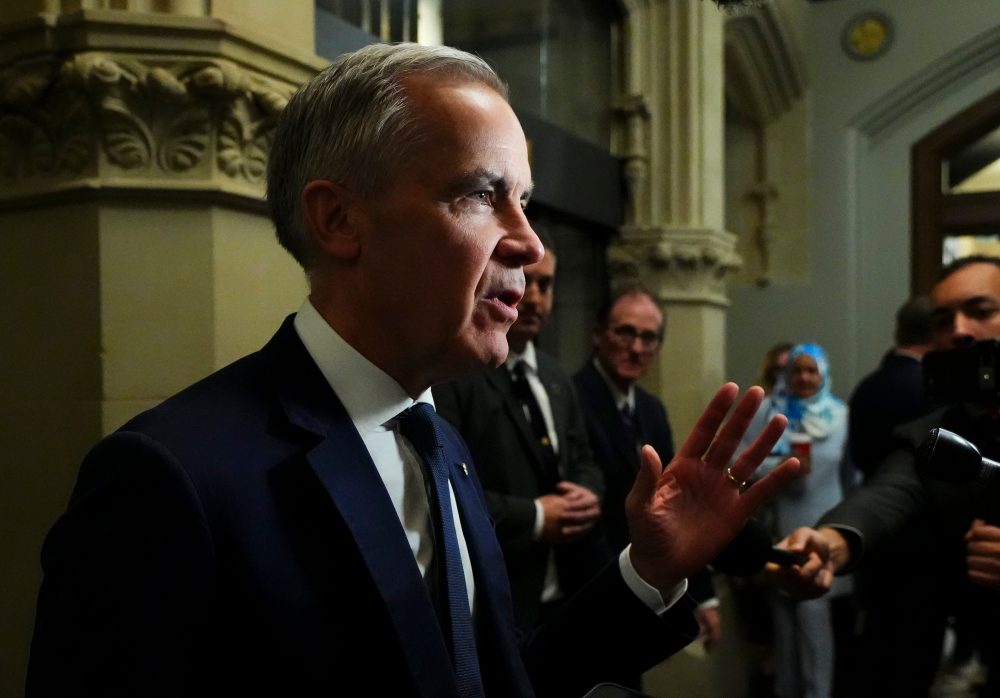

OTTAWA, Ontario (AP) — Canada’s Prime Minister Mark Carney, who gained international recognition as a voice against powerful nations bullying smaller ones, is anticipated to dial back his criticism of President Donald Trump during the forthcoming European summit.
Following his January address at the World Economic Forum in Davos, Switzerland, Carney gained global political prominence when he proclaimed the end of the international rules-based system and criticized major powers for intimidating smaller nations. His comments earned him widespread acclaim and overshadowed Trump at the event.
However, the Group of Seven meeting of developed democratic nations starting Monday in France precedes the July 1 evaluation of the U.S.-Mexico-Canada Agreement, or USMCA, the current version of the North American trade deal that has linked the economies of the United States, Mexico and Canada since the early 1990s. This represents a pivotal point in trade negotiations, with Trump indicating this week he might choose not to extend the agreement.
Given that over 70% of Canada’s exports are destined for the U.S., maintaining this agreement is vital for Canada’s economic interests.
Canadian historian Robert Bothwell noted that Trump poses a greater challenge for Carney “than anybody else because we are more exposed to the United States than anybody else.”
Trump departs for the G7 immediately following his hosting of UFC matches at the White House on Sunday for his 80th birthday celebration.
The gathering occurs amid escalating friction between Trump and Canada. One of the globe’s most enduring and friendly partnerships — forged through geography, shared history and centuries of mutual interests — has deteriorated, evidenced by multiple recent instances of leadership discord.
Ontario Premier Doug Ford, who leads Canada’s largest province, saw his scheduled reception with the U.S. Chamber of Commerce in Washington abruptly cancelled Monday. Vic Fedeli, one of Ford’s ministers, commented that if Trump compelled the chamber to cancel, “Ford should be wearing that as a badge of honor.”
Trump reiterated this week that the U.S. has no need for Canadian products. Carney has established an objective for Canada to increase its non-U.S. exports by 100% over the coming decade, stating that Trump’s trade conflict is creating investment uncertainty.
Additionally, the launch of a significant Canadian bridge spanning the Detroit River that Trump had previously threatened to obstruct was postponed Thursday due to outstanding concerns.
Trump’s behavior, including initiating a trade conflict and proposing Canada join as the 51st U.S. state, has angered Canadians and established the political conditions for Carney to secure the prime minister position after pledging to challenge Trump.
Trump administration representatives continue emphasizing that only two nations, China and Canada, struck back against America during the trade dispute. U.S. Trade Representative Jamieson Greer identifies Canada’s counter-measures as a significant concern in negotiations.
Daniel Béland, a political science professor at McGill University in Montreal, observed that Carney appears to have tempered his approach toward the Trump administration to prevent further deterioration in relations.
“There is a clear tension between what Prime Minister Carney said in his Davos speech about middle powers standing up to hegemons and his attempt to nudge the U.S. administration ‘in the right direction’ with regard to the USMCA review and trade policy more generally,” Béland said.
Carney has minimized the significance of Trump’s latest statements regarding Canada becoming the 51st state.
Both Canada and Mexico seek USMCA renewal for an additional 16 years. Trump has considered withdrawing from the pact. More probably, it will face yearly evaluations over the next decade.
Carney is scheduled to meet with French President Emmanuel Macron on Friday in Paris before the summit in Évian-les-Bains, France.
The prime minister will also visit Ireland this weekend for discussions with the Irish prime minister as part of efforts to expand trade beyond the U.S.
This marks Carney’s ninth European visit in the 15 months since assuming the prime minister role in March 2025.
The U.S. “will clearly remain Canada’s largest trading partner for the predictable future,” Béland stated, describing it as an unavoidable reality that Carney “must keep front of mind even as he seeks to make Canada somewhat less dependent on trade with the U.S.”