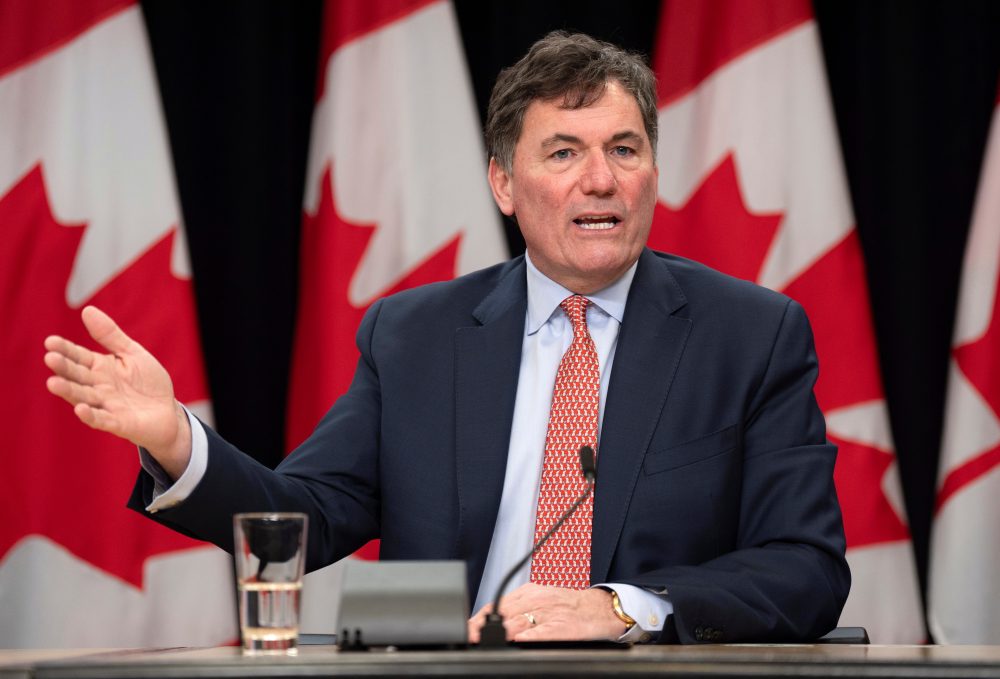

Canada’s trade minister responsible for U.S. relations warned Thursday that the North American trade agreement between the United States, Mexico, and Canada might undergo yearly evaluations, potentially creating ongoing business uncertainty under the Trump administration.
Speaking to business leaders in Toronto, Dominic LeBlanc announced plans to meet with U.S. Trade Representative Jamieson Greer in Washington next week, prior to the required USMCA evaluation scheduled for July.
“If there’s no consensus in the review the agreement continues. Then there’s an annual review that starts and if uncertainty is one of the objectives from one of our (USMCA) partners you can imagine scenarios of how this might go,” LeBlanc explained to the audience.
The Canadian official noted that questions surrounding the trade agreement’s stability are already impacting business decisions across Canada.
“Net business investment is down,” LeBlanc stated. “Therein lies one of the big challenges. We have to control what we can control.”
Canadian Prime Minister Mark Carney has established an ambitious target to expand Canada’s non-American exports by 100% over the coming ten years, citing concerns that U.S. tariffs are discouraging investment. Carney recently completed trade negotiations with China and is currently conducting business in India.
President Trump originally negotiated the USMCA during his previous presidency and incorporated a provision requiring the agreement’s review in 2026.
The president has discussed encouraging American automotive companies to relocate their Canadian operations to the United States, while Greer has promoted bringing industrial manufacturing back to America.
Despite these concerns, LeBlanc expressed cautious optimism about the trade agreement’s prospects, noting that Trump’s recent tariff announcements maintained existing exemptions for Canada and Mexico under the USMCA framework.
“So, they’re doing that because it’s in the American economic interest to do that,” he observed.
While the USMCA currently protects most Canadian exports to America, specific industries including aluminum, steel, automotive, and lumber continue to face tariff pressures that are affecting Canada’s economic performance.
LeBlanc revealed that Canada appeared close to reaching an agreement on industry-specific tariffs during the fall, but negotiations ended abruptly when Trump responded negatively to an anti-tariff television advertisement created by Ontario’s government.
The minister acknowledged that Trump administration representatives have engaged in public political discussions about trade policy, but suggested private diplomatic conversations remain more productive.
“There is a public prosecution of the argument, the political argument in the United States, and there are the private government-to-government-to-government conversations, which are not discouraging,” LeBlanc concluded.