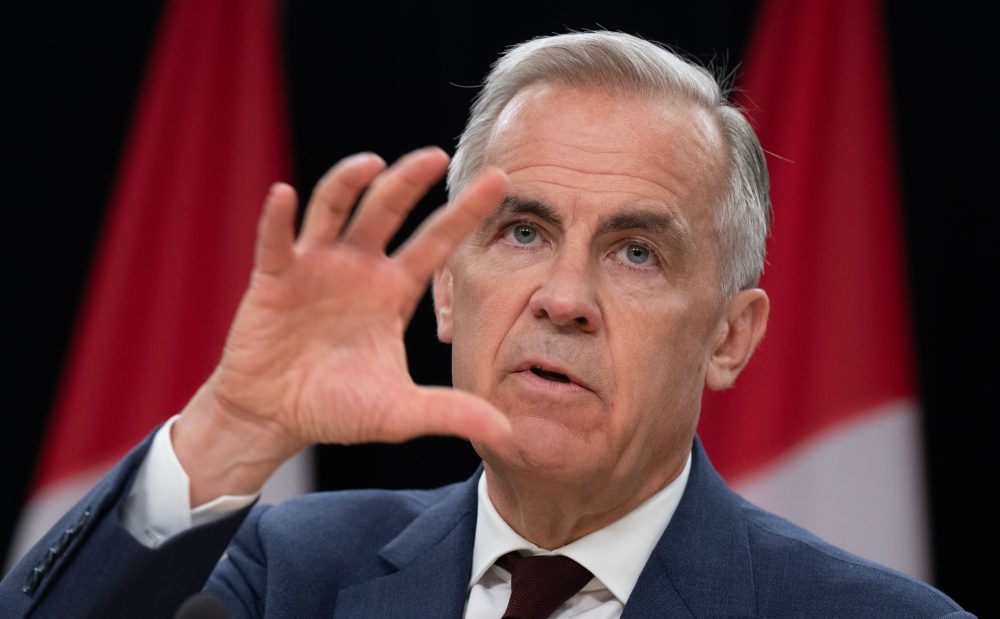

TORONTO (AP) — Canadian Prime Minister Mark Carney announced Thursday that he believes Canada should restore its diplomatic presence in both Iran and Venezuela, reversing decisions made by earlier administrations that shuttered the embassies in those countries.
Carney made the case that without functioning embassies, the Canadian government struggles to assist its citizens living or traveling in those nations and is less able to respond effectively to humanitarian emergencies — even when Ottawa strongly disagrees with those governments’ actions.
“Engagement is not endorsement,” Carney said. “Having an embassy, having consular services in a country, does not mean we endorse the policies of that country.”
Carney pointed specifically to Venezuela, where a recent earthquake has created urgent conditions and where Canada’s lack of an on-the-ground diplomatic presence is limiting its ability to deliver timely assistance.
While he made clear that no final decision has been reached, Carney said the current situation is untenable and must change.
“Moving towards that, in my judgement, a decision to be made, is what we need to do,” Carney said when speaking about restoring the embassies.
The embassy in Tehran was closed in 2012 under former Conservative Prime Minister Stephen Harper, who severed diplomatic ties with Iran entirely and expelled Iranian diplomats from Canada, describing the Islamic Republic as the most serious threat to global peace.
Canada’s embassy in Venezuela was suspended in 2019 after the regime of then-Venezuelan President Nicolás Maduro refused to renew visas for Canadian diplomatic staff.
“There are a series of countries with whom we don’t see eye to eye, to put it mildly, where we don’t have representation in the country,” Carney said. “And that puts us at a disadvantage, first and foremost, to helping Canadians that are in these countries.”
Carney acknowledged there are legitimate reasons those embassies were closed, but argued that their continued closure means Canada is failing to meet a fundamental obligation of its government.
“There is a humanitarian crisis in Venezuela and there is a need to act very quickly so in my opinion we must change the way we are doing things,” Carney said.
Carney also revealed that U.S. President Donald Trump reached out to him by phone on Wednesday. The two leaders discussed the upcoming NATO summit next month, along with developments involving Iran and the broader Middle East situation. Carney noted that U.S. Defense Secretary Pete Hegseth and other officials were also part of that call.