
LOS ANGELES (AP) — When devastating fires swept through Southern California in January 2025, destroying homes and damaging places of worship, religious leaders found themselves united in ways they never expected.
Rabbi Amy Bernstein, whose Pacific Palisades home was destroyed and synagogue damaged, describes how the disaster “blew everything open” for area faith communities.
“If our hearts must break, let them break open,” Bernstein explained. She leads Kehillat Israel, where 300 of 900 member families lost their homes. “This tragedy has really pushed us closer to one another. We’re working to change the things we need changed.”
Religious leaders across the fire-ravaged areas of Pacific Palisades, Altadena and Pasadena have formed unprecedented interfaith partnerships to help their communities rebuild 16 months after the catastrophe.
These spiritual leaders have had to quickly master complex topics like insurance policies and zoning laws while keeping their displaced congregations connected and raising funds for essential needs. In Altadena, pastors are fighting to protect longtime Black residents who gained homeownership despite historical redlining but now face pressure from developers seeking investment opportunities.
Throughout this challenging period, clergy members have addressed both the emotional and spiritual wounds of their communities while planning how to reconstruct damaged or destroyed sanctuaries. The fires claimed or damaged more than a dozen religious buildings.
The Rev. Grace Park, associate pastor at Pacific Palisades Presbyterian Church, which was completely destroyed, credits strengthened interfaith relationships for helping leaders navigate these unprecedented challenges.
Religious leaders from Methodist, Presbyterian, Catholic, Jewish and yoga communities have discovered shared experiences in loss and learned to support each other during crisis, Park noted.
“It’s a sense of mutual affection and respect, learning from each other and leaning on one another,” Park said. “We’re sharing the joys and the deep valleys of what it means to lead through a time of tragedy.”
Brother Satyananda, a senior monk at the Self Realization Fellowship, lost his residence and personal belongings in the blaze. Most of the campus, established by Paramahamsa Yogananda who introduced ancient Indian spiritual practices to Western audiences, survived the fire.
Satyananda remembers when Bernstein noticed his distress and provided “motherly compassion.”
“We share the same profession where we’re tuned to people in need,” he explained. “Now, our relationship has changed because we’re tuning into each other. There’s a greater level of trust.”
Pastor BJ King of LoveLand LifeCenter previously collaborated with the late Rev. Cecil B. Murray on interfaith healing efforts following the 1992 Los Angeles riots.
“Back then, there was a choice whether or not to get involved,” King said. “But with these fires, there is no choice. It has affected everybody.”
King’s congregation now holds virtual services after their rented Altadena church building sustained smoke damage. Twelve member families lost their residences. Beyond addressing basic needs, King established a program connecting mental health professionals with community members.
“Many people didn’t even know they needed that,” he observed.
Pastor Jonathan DeCuir of Victory Bible Church in Pasadena emphasizes how faith leaders have maintained crucial communication with officials, including meetings with Gov. Gavin Newsom to advocate for their communities.
DeCuir chairs the Legacy Land Project, a nonprofit providing financial assistance, legal help, contractor guidance and medical services to fire victims.
The crisis has created unprecedented cooperation among area clergy, DeCuir says.
“Denominational lines have been crossed,” he noted. “Even if we have different theological stances or approaches to ministry, we are all now looking at how to care for our people and community. If we don’t come together, Altadena will never ever be the same. The people won’t be there anymore. That, to me, is terrifying.”
Pastor Mayra Macedo-Nolan, executive director of Clergy Community Coalition in Pasadena, argues that while congregations extend beyond physical buildings, churches serve as “beacons of hope” in traumatized neighborhoods. Her organization advocates for prioritizing houses of worship equally with businesses in reconstruction planning.
“When people start seeing churches rebuilding in Altadena, they’re going to feel like it’s going to be OK because the churches are coming back,” she said.
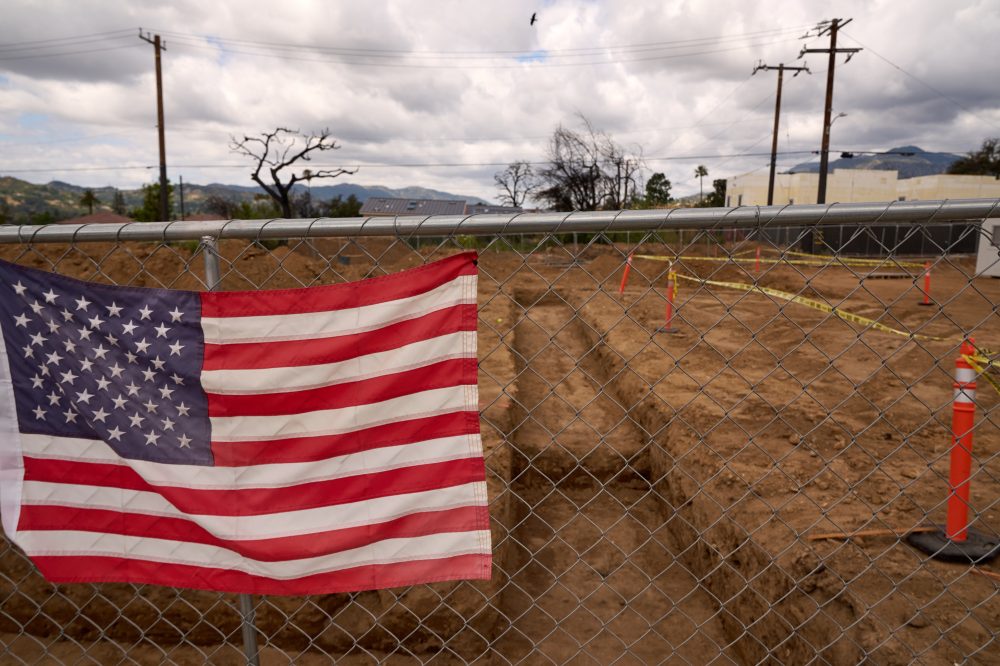
On April 26, Altadena Fountain of Life Church held a groundbreaking ceremony for a new sanctuary to replace their building that stood for over 30 years before the fire destroyed it. Pastor Jonathan Lewis, who serves approximately 75 congregants, hopes to complete construction by next Easter.
“It’ll be a Resurrection Sunday for our church, too,” Lewis said.
Alexis Duncan, an Altadena native who attended that church growing up, brought her 6-year-old daughter to the groundbreaking. She lost both her residence and church building in the fire.
“It means everything to me that they’re rebuilding because I want the church to be there for my daughter as she grows up,” Duncan said. “This new beginning gives me and my family hope and the encouragement to come back.”
Some congregations, including Altadena Community Church, a United Church of Christ parish, are taking time to reconsider their future mission. The Rev. Michael Lewis, who began leading in February after his predecessor’s retirement, said the congregation is exploring multiple options for their one-acre property, including affordable housing development.
“We know that a church is not intended to be a landlord and the pastor is no property manager,” Lewis explained. “But, we’re also thinking about who is able to return to Altadena? How will this rich, economically diverse community that was scattered by the fire come back?”
The church has operated since the 1940s as a gathering place for actors, poets and musicians, with the former sanctuary doubling as a performance venue. Lewis said they plan to include a stage in the new facility.
“It’ll look different from what we had before,” he said. “Once we figure out how to build community, we can decide what physical structures will help us support that community.”
Kehillat Israel plans to carry their Torah scrolls back to their sanctuary on May 15, becoming one of the first houses of worship to return to the Palisades since the disaster.
Bernstein notes that Judaism has “a long history of starting over.”
“It’s encoded in our cultural approach to the world, that there are things that can always be taken away from you,” she said. “But what you become can never get taken away.”