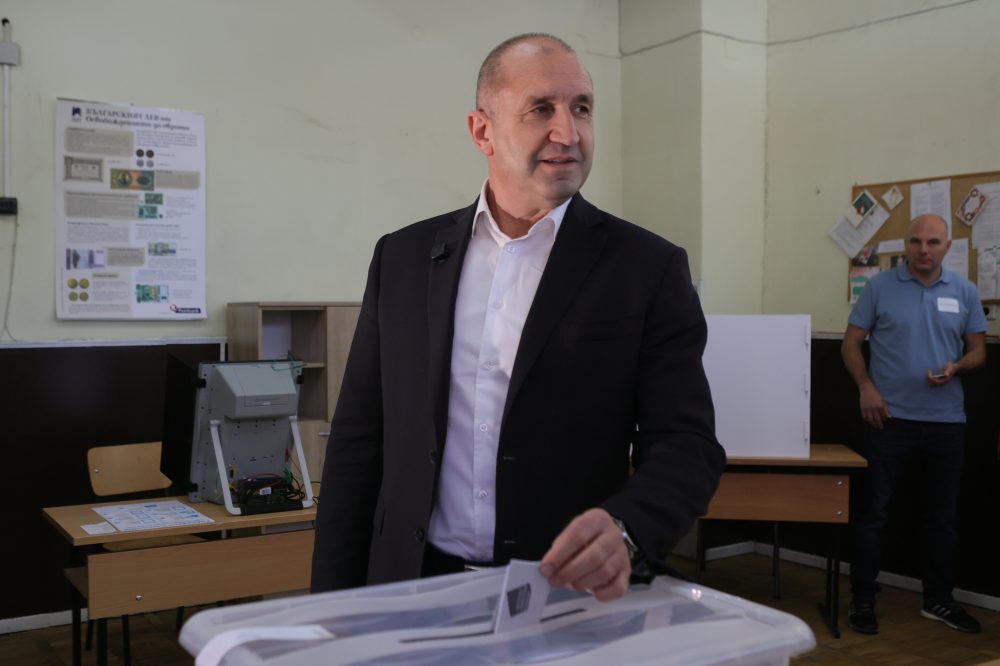

SOFIA, Bulgaria (AP) — Former Bulgarian President Rumen Radev’s center-left coalition has secured a decisive victory in the country’s parliamentary elections, bringing an end to five years of political instability, election officials announced Monday.
Election results with 96% of votes tallied showed Radev’s Progressive Bulgaria coalition capturing 44.7% of the vote by early Monday. The commanding lead put them more than 20 points ahead of their closest competitors – veteran politician Boyko Borissov’s center-right GERB party and the reform-minded We Continue the Change party, which finished in a virtual tie at 13.4% and 12.9% respectively.
Two additional parties are expected to claim seats in Bulgaria’s 240-member parliament based on preliminary tallies.
Borissov acknowledged his defeat and offered congratulations to the winning coalition.
Speaking to reporters, Radev characterized his coalition’s success as “unequivocal,” calling it a “victory of hope over distrust, a victory of freedom over fear.” He pledged that Bulgaria would “make every effort to continue on its European path.”
“But believe me, a strong Bulgaria and a strong Europe need critical thinking and pragmatism. Europe has fallen victim to its own ambition to be a moral leader in a world without rules,” Radev stated.
Throughout his presidential tenure, Radev developed a reputation for pro-Russian sympathies. He consistently challenged European Union initiatives to provide military assistance to Ukraine in its conflict against Russia’s invasion. Radev has maintained that backing Ukraine could drag Bulgaria into the war and has advocated for renewed diplomatic engagement with Russia to resolve the crisis.
The 62-year-old former military pilot stepped down from his largely ceremonial presidential role in January, several months before his second term expired, to pursue the more influential position of prime minister.
Radev, who completed a Master of Strategic Studies at the U.S. Air War College in 2003 before becoming Bulgaria’s air force commander, draws support from two distinct groups: those seeking an end to oligarchic corruption and those attracted to his Euroskeptic and Russia-aligned positions.
The nation’s previous conservative administration fell in December following massive anti-corruption demonstrations that brought hundreds of thousands of protesters, primarily young people, into the streets.
Radev’s public standing rose as he positioned himself against established criminal networks and their connections to senior political figures. During campaign events, he promised to “remove the corrupt, oligarchic model of governance from political power.”
Bulgaria, a member of both NATO and the European Union, has faced ongoing criticism for failing to address corruption and weaknesses in its legal system.
The country of 6.5 million people has endured divided parliaments since 2021, creating unstable governments that have lasted less than a year before falling to street demonstrations or legislative maneuvering.
Weary of constant electoral cycles, Bulgarian citizens expressed cautious reactions to the election outcome.
“Above all, we expect a more stable judicial system, and for trust in institutions to truly be restored. Until now, they have been heavily influenced by various figures, many of whom, as we can see from the current results, have now left the government,” said Nikoleta Dimitrova, a 37-year-old shop assistant from Sofia.
Accountant Cveta Gerogieva, 55, remained skeptical: “I hope that we will really live a better life, but I am not sure that there will be stability for a long period. Probably we will vote again.”