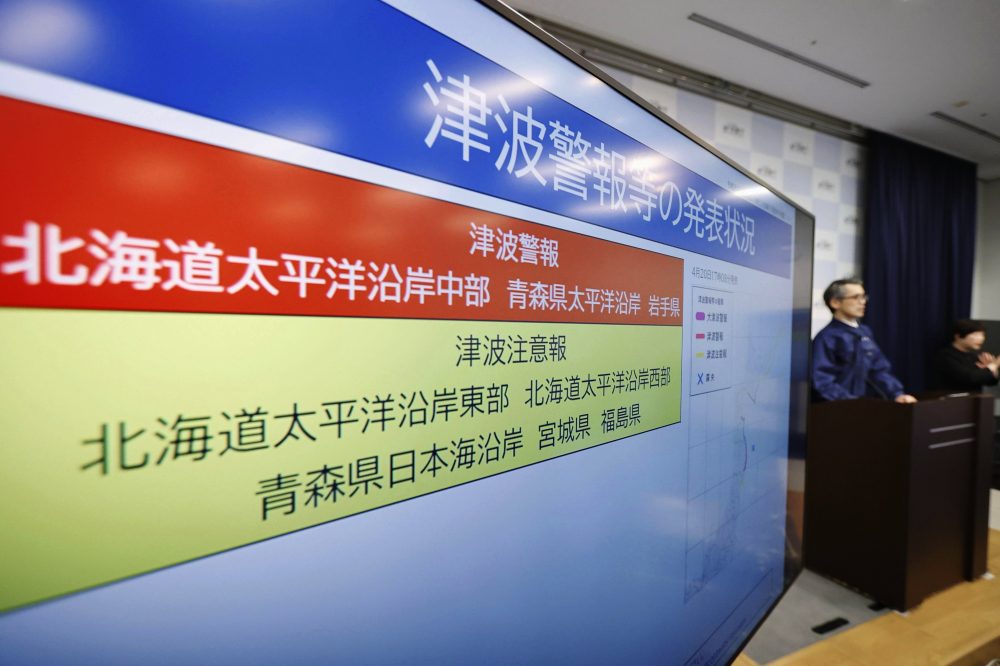

TOKYO — Japanese officials Monday warned residents along northern coastlines about heightened possibilities of a catastrophic earthquake after a powerful 7.5-magnitude tremor struck earlier in the day.
Government meteorological experts and Cabinet officials announced there’s approximately a 1% probability that a mega-quake could hit Japan’s northern shores within the coming week following Monday’s significant seismic event near the Chishima trough.
Authorities emphasized their warning does not constitute an earthquake forecast, but they encouraged citizens to enhance emergency preparations, including stockpiling food supplies and readying evacuation kits, while maintaining normal routines.
This marks the second such regional warning issued within recent months. A similar alert was announced after a major December earthquake, though no subsequent large quake materialized.
Monday’s powerful tremor occurred off the Sanriku coast in northern Japan at approximately 4:53 p.m. local time (0753 GMT), striking at a shallow depth of roughly 10 kilometers (6 miles), meteorological officials reported.
The earthquake triggered tsunami waves, with authorities detecting an 80-centimeter (2.6-foot) surge at Kuji port in Iwate prefecture within an hour of the initial quake. A smaller 40-centimeter (1.3-foot) wave was recorded at another port within the same prefecture.
Tsunami warnings remained active across Japan, with officials cautioning about potential waves reaching 3 meters (10 feet) in height. However, the Pacific Tsunami Warning Center based in the United States declared the tsunami danger had subsided.
Japanese meteorological agencies instructed coastal residents to immediately evacuate shoreline and riverside areas, seeking higher elevation shelter. Officials also warned communities to prepare for possible aftershocks lasting approximately one week.
Television broadcasts on NHK showed numerous residents driving to elevated parks and facilities. In Hokkaido’s Tomakomai town, one resident brought his child to a hilltop park after collecting them from tutoring school, planning to remain until authorities lifted the alert.
Emergency management officials said Iwate and three additional northern prefectures issued voluntary evacuation recommendations affecting more than 128,000 residents.
Fire and disaster management authorities reported they continue monitoring conditions, but no casualties or structural damage have been confirmed, including at power facilities and other critical infrastructure.
Nuclear safety regulators confirmed all atomic power plants and associated facilities in the affected region remained undamaged with no irregularities detected.
A similar 7.5-magnitude earthquake in December resulted in dozens of injuries.
Monday’s event occurred 15 years after the devastating March 11, 2011, magnitude 9.0 earthquake and tsunami that devastated northern Japan, killing over 22,000 people and displacing nearly half a million residents, primarily due to tsunami destruction.
Approximately 160,000 Fukushima residents evacuated their homes due to radioactive contamination from the tsunami-damaged Fukushima Daiichi nuclear facility. About 26,000 of those evacuees have not returned, having relocated permanently, living in areas that remain restricted, or harboring ongoing radiation concerns.