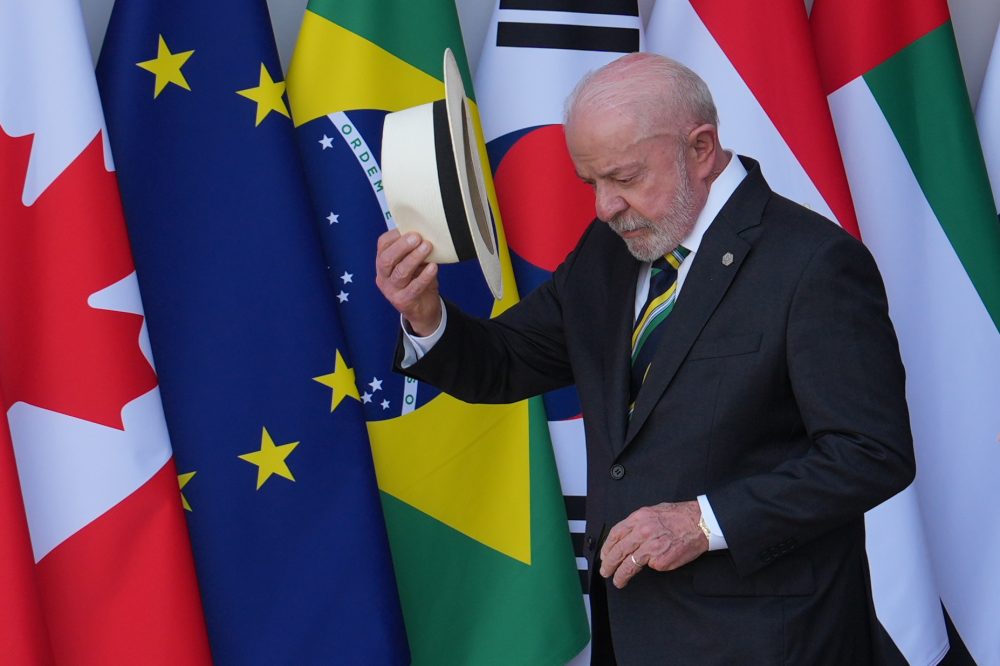

RIO DE JANEIRO — Brazilian President Luiz Inácio Lula da Silva and his chief political rival, Sen. Flávio Bolsonaro, found themselves in a sharp public dispute this week over the Trump administration’s proposal to slap 25% tariffs on Brazilian products — even as both men claim to be working against the measure.
The two leading contenders for October’s presidential election have been trading accusations over who is better positioned to push back against the proposed taxes, signaling that each believes the tariff issue could prove decisive with voters.
Sen. Bolsonaro, the son of former President Jair Bolsonaro, argued that the tariffs actually benefit Lula politically. Meanwhile, Lula’s government pushed back against the U.S. characterization of Brazil’s trade policies as unfair, discriminatory, or harmful to American commerce.
The Trump administration first announced a 50% tariff on Brazilian imports last July, citing what it called a “witch hunt” against Jair Bolsonaro, who was on trial at the time for allegedly attempting to overturn his 2022 election loss to Lula. He was later convicted.
In a letter, U.S. President Donald Trump accused Brazil of engaging in unfair trade practices and directed U.S. Trade Representative Jamieson Greer to launch a formal investigation. That probe resulted in charges against Brazil in June, including allegations of weak anti-corruption enforcement and unfair tariff structures. Notably, the U.S. has maintained a goods trade surplus with Brazil for several years.
Relations between the two countries had appeared to improve after Lula and Trump met last year, but the June tariff proposal reignited tensions. Lula publicly warned Trump against interfering in Brazil’s domestic electoral process.
The tariff threat prompted Lula to once again champion Brazilian sovereignty — a stance that generated a significant and unexpected surge in his popularity last year.
Flávio Bolsonaro addressed the political dimension directly in a formal submission he sent Wednesday to the office of the U.S. Trade Representative. He included polling data showing that Lula’s electoral standing had risen during periods of heightened U.S. tariff pressure.
“Brazilian public polling shows that the incumbent government’s electoral position has strengthened during precisely the periods when U.S. tariff pressure has been most salient,” Bolsonaro wrote, arguing that moving forward with tariffs would give Lula a “political victory.”
Bolsonaro also suggested in the document that the tariffs be postponed rather than dropped entirely, saying the findings of the trade investigation could be “reaffirmed in full even as implementation is suspended.”
Lula wasted no time firing back, calling the submission “yet another act of treason against the fatherland.”
It was also noted that Jair Bolsonaro’s other son, Eduardo, who resides in Texas, was convicted this year for illegally lobbying the U.S. government to pressure Brazilian officials into halting his father’s trial.
“It is unacceptable that the Bolsonaro family, with its sellout policies, seeks to submit Brazil to the interests of the United States,” Lula wrote Thursday on X. “There has never been, nor is there, any justification for a tariff hike now or later.”
Just three hours after Lula’s post, Flávio Bolsonaro responded on X, claiming that Lula is the only person who actually “wants the tariff hike against Brazilian products.” He also announced plans to travel to the U.S. the following week to continue pushing against the additional tariffs.
On the trade investigation itself, Lula’s government rejected several of the U.S. complaints, including the claim that Brazil’s PIX instant payment system unfairly undercuts competing electronic payment services. The government maintained that its policies are lawful, evenhanded, and supportive of market competition.
The two rivals have also clashed over a separate U.S. decision to designate two of Brazil’s major organized crime groups — First Command of the Capital, known as PCC, and Red Command — as terrorist organizations. Sen. Bolsonaro backed the designation, while some analysts viewed it as an attempt by the U.S. to influence Brazil’s election. Lula has argued the label is inappropriate because the groups are motivated by profit, not political ideology.
Earlier this week, the U.S. announced sanctions against companies and individuals connected to PCC, describing the organization as “the largest transnational criminal organization in the Western Hemisphere.”