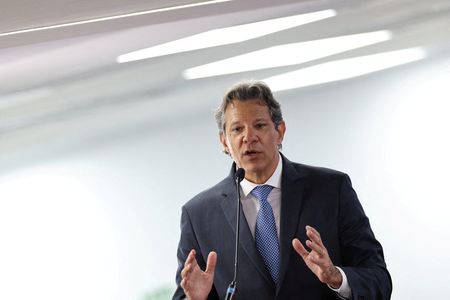

Brazil’s Finance Minister Fernando Haddad officially stepped down from his cabinet position Thursday as he prepares to launch a gubernatorial campaign in São Paulo state, providing President Luiz Inácio Lula da Silva with a crucial political ally during this election year.
During a Thursday event in São Paulo, Haddad formally announced his departure from the finance ministry, followed by President Lula’s confirmation that Deputy Finance Minister Dario Durigan will take over the role in a move that political observers had anticipated.
The 63-year-old Haddad had telegraphed his intentions to leave the ministry position in late 2025, initially indicating he planned to focus on supporting Lula’s reelection campaign scheduled for October.
However, the political landscape has grown increasingly challenging for the leftist president, with recent polling data showing him in a statistical dead heat with Senator Flavio Bolsonaro, whose father, former right-wing President Jair Bolsonaro, narrowly lost to Lula in the 2022 election.
Speaking to the leftist publication Opera Mundi in a recent interview, Haddad admitted that “the scenario has become more complicated,” while confirming his candidacy plans without explicitly stating his intention to seek the São Paulo governorship.
Both Haddad and Lula are scheduled to appear at a Workers Party gathering at a São Paulo labor union facility at 7 p.m. local time (2100 GMT), a location that holds special significance for the president, who began his career as a metalworker.
The current political environment presents mounting challenges for Lula, complicated by rising oil prices stemming from escalating Middle East tensions that could trigger increased inflation. Haddad’s gubernatorial bid appears even more daunting given the competition he faces.
Polling data indicates that current Governor Tarcísio de Freitas, a well-regarded Bolsonaro supporter, maintains a substantial lead in voter preference surveys.
Despite the challenging odds, the Workers Party leadership believes Haddad’s gubernatorial campaign could strengthen Lula’s position in a state that plays a pivotal role in presidential elections.
Should Haddad lose this race, it would extend a series of unsuccessful political campaigns for the attorney, who holds advanced degrees in economics and philosophy.
Following his successful 2012 São Paulo mayoral victory, Haddad suffered a first-round defeat in his 2016 reelection attempt. He also lost the 2018 presidential race after stepping in for Lula, who was prohibited from running due to a corruption conviction that was subsequently overturned on procedural issues.
Haddad’s 2022 gubernatorial campaign in São Paulo also ended in defeat, though party officials credited his candidacy with helping Lula capture a majority of votes in the state capital during that year’s presidential contest.
During his tenure as finance minister, Haddad spearheaded significant reforms to Brazil’s consumption tax system, addressing long-standing complexity issues that economists viewed as obstacles to economic growth.
He also implemented new fiscal guidelines aimed at stabilizing government finances, establishing budget objectives that the administration later modified. Critics targeted Haddad over Brazil’s accelerating public debt levels, primarily attributed to substantial interest payments amid concerns about expanding government expenditures.
Under Haddad’s leadership, Brazil’s income tax structure underwent changes that increased obligations for wealthy taxpayers while providing relief for lower-income citizens, eliminated regressive tax benefits, and promoted various climate-focused financing initiatives.
His tenure also included higher taxes on business credit, foreign currency transactions, and imported goods, reinforcing opposition claims that the leftist administration prioritized generating new revenue over reducing government spending.