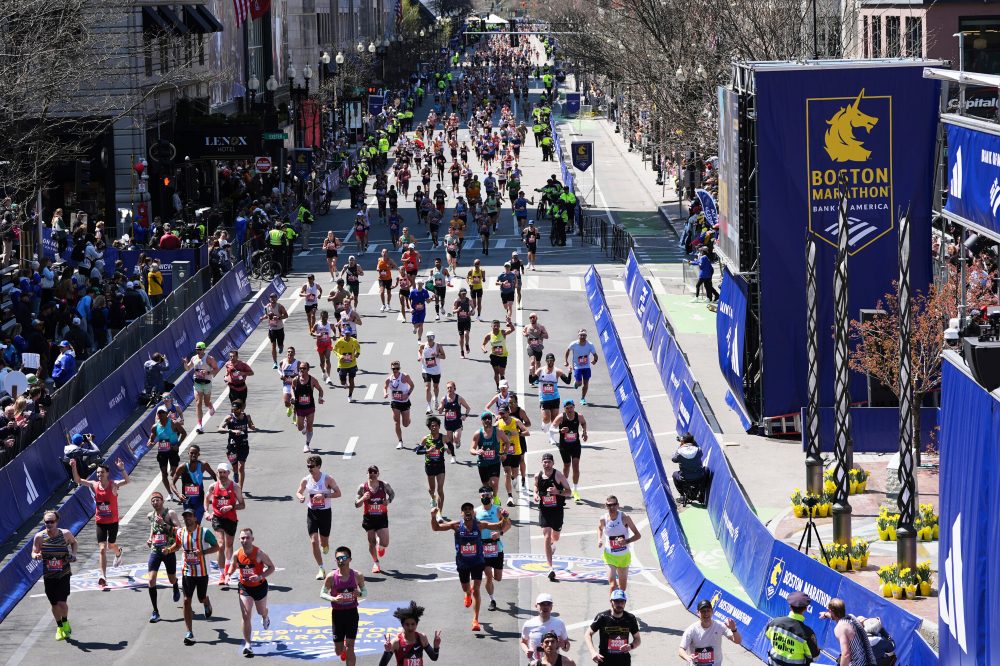

BOSTON — Completing the Boston Marathon presents enough challenges without runners having to fight through crowds from start to finish in Copley Square.
That’s why race officials brought in a crowd management specialist this year to handle the massive field of over 32,000 participants as they traverse 26.2 miles through eight Massachusetts communities — many featuring narrow roadways dating back to Colonial America.
“There are certain things that we can’t change — that we don’t want to change — because they make the Boston Marathon,” said Marcel Altenburg, a senior lecturer of crowd science at Manchester Metropolitan University in Britain. “Like, I’m a scientist, but I can’t be too science-y about the race. It should stay what it is because that’s what I love. That’s what the runners love.”
The Boston Marathon stands as the globe’s most historic and prestigious annual marathon event. The race drew inspiration from the endurance challenge that premiered at the first modern Olympics in 1896 — paying homage to messenger Pheidippides, who ran to Athens carrying news of Greek triumph over Persian forces at Marathon.
Following his announcement — “Rejoice, we conquer!” — Pheidippides collapsed and died.
Boston Marathon officials aim for a far better outcome for their participants, even as participation has exploded from just 15 runners in 1897 to as many as 38,000 for the centennial edition in 1996. Numbers have stabilized around 30,000 since 2015.
The expanding participant pool has pushed the boundaries of narrow New England streets and challenged host communities, which want to quickly reopen roads for daily traffic and business activities.
“It would be kind of great someday to be able to grow the race a little bit more,” race director Dave McGillivray said. “The problem with this race is that it’s about two things: time and space. We don’t have either. … So, we’re trying to be innovative.”
Enter Altenburg’s expertise.
The former German army captain, who participates in ultra marathons, has collaborated with major racing events, large sporting competitions, airports and exhibitions to maintain safety and smooth operations for massive crowds.
For the Boston Marathon, which attracts hundreds of thousands of spectators beyond the runners, his computer models enable simulations that predict how the race will unfold under various scenarios.
“We have simulated the Boston Marathon more than 100 times to run it once for real. That is the one that counts,” Altenburg said in a telephone interview. “They gave me, pretty much, all creative freedom to simulate more waves, simulate more runners and — within the existing time window — they allowed me to change pretty much anything for the betterment of the running experience.
“And then we checked every aid station, every mile, the finish, every important point, (asking): Is the result better for the runner? Is that something that we should explore further?”
The most visible modification on Monday involves dividing runners into six starting waves — groups arranged by qualifying times — rather than three. These waves, introduced to Boston in 2011, create better spacing so participants don’t need to walk after starting, particularly where Main Street in Hopkinton narrows to just 39 feet.
Additional behind-the-scenes adjustments affect bus unloading at the starting area, water and aid station positioning, and finish line organization, where runners receive medals, thermal blankets, refreshments, and any necessary medical care.
“For an event that’s as old as ours, 130 years, it allowed us to be a startup all over again,” said Lauren Proshan, the chief of race operations and production for the Boston Athletic Association.
“The change isn’t meant to be earth-shattering. It’s to be a smooth experience from start to finish,” she said. “It’s one of those things that you work really, really hard behind the scenes and hope that no one notices — a behind-the-curtain change that makes you feel as if you’re just floating and having a great day.”
Reducing portable restroom wait times would also be welcomed.
“What I loved about working with the BAA was how aware they are of what the Boston Marathon is. And they won’t change anything lightly,” Altenberg said. “So it was very detailed work from literally the moment the race last year ended to now. That we check every single option. That we really make sure that if we change something about this historic race, then we know what we’re doing.”
The Boston Athletic Association will evaluate participant feedback over the next three years before considering expansion or additional modifications.
“Fingers crossed, hope for the best, but we’ll get feedback from the participants,” McGillivray said. “And they’ll let us know whether or not it worked or not.”
However, extending course closure time isn’t feasible, and the historic route remains unchanged. This limits how much crowd science can address one of athletics’ most demanding challenges.
“I can talk. I’m a scientist. I just press a button and it’s going to be,” Altenburg said. “But the runners still have to do it.”