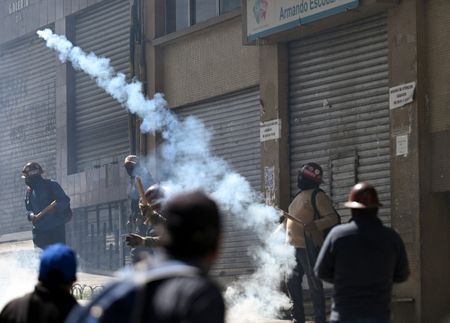

Thousands of demonstrators backing Bolivia’s former leftist leader Evo Morales took to the streets of La Paz on Monday, escalating civil unrest that has paralyzed the nation for almost two weeks and created critical shortages of essential goods including food, fuel and medical supplies.
The widespread disruptions have left commercial vehicles stranded on major highways and prevented patients from accessing medical care, according to government officials. Bolivia has requested assistance from Argentina, which responded by dispatching a military transport plane loaded with food aid.
ORIGINS OF THE CIVIL UNREST
What started as labor strikes in early May has transformed into a countrywide movement encompassing trade unions, mining workers, transportation employees and agricultural communities. Demonstrators are demanding that President Rodrigo Paz’s administration reverse budget-cutting policies and tackle escalating costs of living, with some groups demanding his removal from office.
Political experts indicate the civil disorder has expanded beyond local complaints to encompass broader opposition to the government’s economic policies.
PRIMARY CONCERNS OF PROTESTERS
The demonstrations focus on mounting financial hardships. Educational workers are seeking increased salaries and additional funding, while transportation unions have initiated indefinite work stoppages due to fuel scarcities and supply chain issues. Native and farming communities are resisting land reform policies they claim benefit wealthy property owners.
Even after the administration withdrew a disputed land reform law earlier this month, demonstrations have persisted.
GOVERNMENT’S REACTION
Paz, who assumed the presidency in November and inherited a struggling economy, has justified budget reductions and cuts to fuel subsidies as essential for restoring fiscal stability.
He is developing a legislative reform proposal for Congress that involves progressively removing fuel price regulations and implementing strategies to increase domestic energy output and investment.
The administration has attempted to reduce tensions through dialogue and salary improvements while sending approximately 3,500 security personnel to remove highway blockades. Officials report that roughly 57 individuals have been detained.
Government representatives have accused opposition figures and Morales supporters of promoting the roadblocks, which they claim have led to at least three fatalities, including patients who could not reach medical facilities.
EVO MORALES’ INVOLVEMENT
Morales, who led Bolivia from 2006 to 2019, has endorsed the demonstrations, characterizing them as a reaction to economic difficulties and political targeting.
Thousands of his followers have gathered after a judge found him in contempt earlier this month for not appearing in court regarding a trafficking case. Morales maintains his innocence.
“As long as the structural demands such as fuel, food, and inflation are not addressed, the uprising will not be halted,” he wrote on X.
INVESTOR SENTIMENT
Market responses have remained subdued so far, partly because Bolivian government bonds typically see limited trading activity. The additional yield that investors require for holding Bolivian debt compared to similar U.S. Treasury securities decreased in May to its lowest level since at least 2020, according to LSEG data.
Nevertheless, analysts caution about increasing risks.
“Bolivia is in a period of social and political stress, as an escalating national strike converges with mass protests and widespread roadblocks,” JPMorgan said in a client note.
HISTORICAL CONTEXT FOR BOLIVIA
Highway blockades have traditionally been a standard strategy employed by protesters. During the tenure of former left-wing president Luis Arce, comparable disruptions organized by groups supporting Morales along with mining and agricultural communities sometimes brought major transportation corridors to a standstill and resulted in billions in economic damage.
Political analysts note that Paz confronts the difficult task of stabilizing the economy while forming new political and social partnerships in a deeply divided political landscape.
“There are no easy or quick solutions in sight,” said economist Gonzalo Chavez.