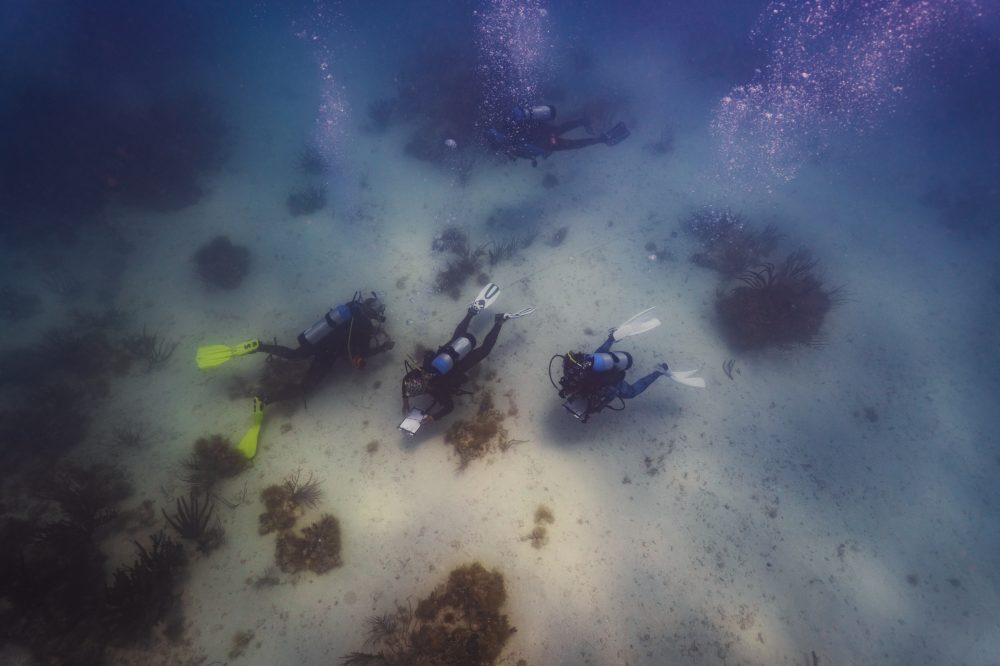

A group of Black divers recently completed an emotional journey to Key West, Florida, where they visited an underwater memorial commemorating victims of the slave trade from more than three centuries ago.
Ruthie Browning descended into the clear waters expecting to find “a big, old rock with stuff growing all over it.” Instead, she discovered something far more profound at the site where the British slave vessel Henrietta Marie met its fate 326 years ago.
The ship had transported 200 enslaved individuals from West Africa to Jamaica before beginning its return voyage to Britain in 1700, during the height of the trans-Atlantic slave trade. The vessel was lost in the turbulent waters of New Ground Reef, where the Atlantic Ocean and Gulf of Mexico converge.
A concrete memorial now marks the location of the tragedy.
When Browning and her fellow pilgrims prepared for their dive in early May, conditions were ideal. The memorial, positioned 20 feet beneath the surface, could be seen clearly through the still water. “I thought I’d look at it, pay my respects and that’ll be that,” she explained.
However, the experience proved far more moving than anticipated. Tears welled in her eyes as she quietly waited, hoping her ancestors might communicate with her.
While observing the memorial, which has transformed into a living reef adorned with corals and sponges, she sensed her ancestors speaking: “My daughter, we’re so glad you’re here.”
Deeply moved, Browning remained near the memorial, which bears the inscription: “Henrietta Marie. In memory and recognition of the courage, pain and suffering on enslaved African people. Speak her name and gently touch the souls of our ancestors.”
She experienced overwhelming thankfulness.
“Without their stamina, their spirit and survival, I wouldn’t be here today. None of us would be here today,” she reflected.
For these Key West visitors, the journey represented an act of reverence, a search for ancestral connections, and spiritual nourishment for future generations. They had attempted to reach the memorial the previous summer, but rough seas prevented the dive.
“The ancestors were not smiling down on us then,” explained Jay Haigler, master diving instructor with Underwater Adventure Seekers, the world’s oldest Black scuba diving club. “This year was different.”
Michael Cottman, who authored two books about the Henrietta Marie and participated with the National Association of Black Scuba Divers when they installed the memorial in 1992, noted that such journeys were never intended to be simple.
Cottman describes the location as containing “spiritual turbulence.”
“Even if it wasn’t carrying enslaved people, it embodies the oppression of our people,” he stated.
The organization conducted annual pilgrimages during the 1990s, though these eventually ceased. The recent expedition was initiated by an underwater interview project suggested by Stanford University anthropologist Ayana Omilade Flewellen, who sits on the board of Diving With a Purpose, a Black scuba diving organization focused on documenting slave shipwrecks.
The underwater interviews also provided Flewellen with a personal connection as a pilgrim. “I felt a kind of tenderness in my heart.”
The spiritual encounter helped her process traumatic history rooted in death and suffering.
“It’s hard to attach your life with this history,” she said. “The only way I could do that was turn toward what the divers were experiencing on this pilgrimage. That’s where it all bloomed and blossomed.”
The pilgrims also gathered on shore. At Higgs Beach on Key West’s southern side, they visited a memorial and burial site for 297 African refugees who perished in 1860 after the U.S. Navy rescued them from three slave vessels — Wildfire, William and Bogota. More than 1,400 refugees were housed by the government in a facility and given food and medical treatment, according to Corey Malcom, the Florida Keys History Center’s lead historian.
Though many were returned to Africa, hundreds died from the terrible conditions aboard the ships, he explained.
The burial site remained largely unknown for decades until historians and geologists located it using ground-penetrating radar. In 2010, a large pit containing 100 additional bodies was found at a community dog park across the street. The area is now enclosed, Malcom noted.
On Saturday, pilgrims gathered at the cemetery for an emotional libation ceremony, a sacred, ancient ritual from Afro-Caribbean spiritual traditions. Group members tearfully honored their ancestors one by one, pouring white rum onto the beach. The clear alcohol is thought to serve as a messenger, inviting ancestral spirits for their blessings.
“To honor your ancestors and the road they’ve traveled is very, very important because we’re all connected,” said Addeliar Guy, one of the group’s elders and an experienced diver.
Joel Johnson spent weeks preparing for his first open-water dive at the Henrietta Marie location. Johnson, who serves as president and CEO of the National Marine Sanctuary Foundation, said he was surprised by the vibrant life surrounding the monument as he approached. Fish swam among corals that moved with the currents, while shells lay scattered on the sandy floor.
Conservation efforts and habitat protection also preserve the history beneath the waves, Johnson observed.
“This was not a place of death, but a place of life,” he said. “I didn’t feel like I was grieving for my ancestors. I felt like I was in the stream of history, recognizing that I’m a part of that. It made me happy.”
While submerged, Michael Philip Davenport, president of Underwater Adventure Seekers, felt inspired to create artwork depicting ancestors rising from the monument.
“Their spirituality is still in that space,” he said. “I was feeling their lives and their tragedy.”
Dr. Melody Garrett, an anesthesiologist, began training with Diving With a Purpose in 2011 and has participated in missions to locate the Guerrero, a Spanish pirate vessel that sank in 1827 while carrying 561 enslaved Africans.
“A pilgrimage like this is so important now more than ever because there is an effort to cover up, rewrite and change history,” she said. She referenced the Trump administration’s actions to eliminate references to slavery and Black history at National Park Service locations and federal museums, calling it divisive “anti-American propaganda.”
For Garrett, witnessing these historical remnants provides her with a strong sense of American identity as the nation approaches its 250th anniversary.
“Black people have been here since before this country’s inception, longer than many other people have,” she said. “This is our country.”
Pieces of the Henrietta Marie’s wooden hull remain buried beneath sand layers at the site. The wreckage was found in 1972 by treasure hunter Mel Fisher, but hundreds of intact artifacts weren’t recovered until 1983. Only a handful of slave ships have been discovered among the 35,000 vessels used to transport over 12 million enslaved Africans; most ships were deliberately destroyed to conceal the illegal trade.
The recovered items, which fill an entire floor of the Mel Fisher Maritime Museum in Key West, include more than 80 sets of iron shackles, many sized for children.
When Kory Lamberts first walked across wooden planks in the exhibit, they creaked unexpectedly.
“It was visceral,” he said. “It took me to a place. It also tells me that these were young people — children. These are baby shackles. There’s no sugarcoating it. The truth really hits you.”
During his Key West visit, Lamberts — who operates a nonprofit promoting aquatic equity — said he brought back fish from the Henrietta Marie site, which he imagined had absorbed the ancestors’ DNA. The group consumed the fish for dinner the evening after their dives — like a religious sacrament.
“I don’t practice a faith, but isn’t this what people are doing every Sunday at church?” he asked. “I wasn’t just bonded with this site through the experience of being there, but at this molecular level with a full circle moment of connection with myself and my history.”