
Crowds gathered in Beirut on Sunday to honor the memory of a beloved Lebanese conservationist who lost her life after an Israeli strike destroyed her home along Lebanon’s southern coast.
Mona Khalil, 76, had dedicated more than two decades to safeguarding sea turtles along Lebanon’s shoreline. She was critically wounded when a strike hit her home in the village of Mansouri earlier this month and passed away from those injuries on Friday.
Over the years, Khalil helped transform a building that had once belonged to her grandmother into the Orange House — a small but influential conservation center and ecotourism destination in Mansouri. The site became a sanctuary for endangered loggerhead and green sea turtles and served as a training ground where volunteers learned to document nesting activity along the coast.
Word of her death prompted an overwhelming wave of grief from environmentalists and the many people who had volunteered and worked alongside her over the years.
Journalist and environmental activist Fadia Jomaa first crossed paths with Khalil in 2016 while conducting research on sea turtles in Lebanon. That encounter led her to join Khalil’s conservation efforts as a volunteer.
For those who gave their time to the project, Jomaa explained, “this relationship didn’t stop at being a volunteering relationship — Mona became our mother.”
Jomaa eventually became one of Khalil’s most trusted collaborators, helping oversee the sea turtle conservation project. She even brought her own children along to volunteer, introducing them to the vital work of protecting nesting turtles and their hatchlings on Lebanon’s southern coast.
During the previous conflict between Israel and the Lebanese militant group Hezbollah in 2024, Khalil initially refused to abandon Al-Mansouri beach, according to Jomaa. It took the Lebanese army to convince her to leave for her own safety. “She was the last one to leave the area,” Jomaa recalled.
“She had an awful time in Beirut,” Jomaa said, noting that Khalil desperately longed to return south to the Orange House and the beach she had spent years protecting.
A new conflict between Israel and Hezbollah broke out in March. Hezbollah launched cross-border fire into Israel on March 2, two days after Israel and the U.S. struck its ally, Iran.
Khalil had the option to leave Lebanon entirely. She held both Dutch and Lebanese citizenship, having previously lived in the Netherlands before returning to Lebanon and making her home in what had once been her grandmother’s residence — the structure that would come to be known as the Orange House. But she refused to flee again.
“She said I am a civilian, I have no weapons, I will shut my door,” Jomaa recounted.
On June 4, an Israeli strike hit Khalil’s home. She and her domestic worker were immediately taken to the hospital. The intended target of the strike remained unclear, and the Israeli military did not respond to a request for comment.
Jomaa said Khalil’s condition seemed encouraging following surgery, but she ultimately succumbed to her wounds two weeks later.
“It is a great loss for conservation, for the country, and for all of us who cared about the sea and the natural heritage of Lebanon,” said Johnny Baaklini, a former Orange House volunteer who had worked closely with Khalil.
Like Jomaa, Baaklini remembered that Khalil “treated us, the conservation advocates, like her kids.” He added, “It feels impossible to describe the impact Mona personally had on me and on so many other young naturalists.”
The center of Khalil’s life work was a narrow strip of shoreline — Al-Mansouri beach in Tyre province. Every nesting season, she and her volunteers would walk the beach after dark, tracking fresh marks in the sand and carefully moving vulnerable nests away from human disturbance and artificial lighting.
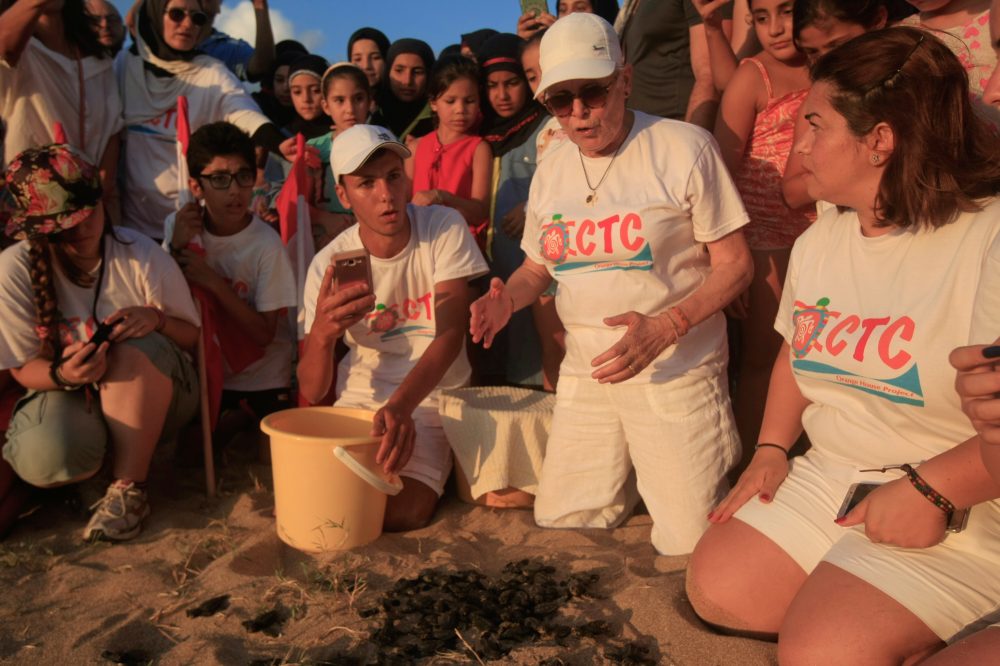
Beyond conservation, the Orange House also operated as a small beachfront bed-and-breakfast. During nesting season each summer, Khalil organized turtle hatchling viewings for visitors, drawing families who brought their children to witness the remarkable sight. These events typically took place at sunset, with volunteers guiding groups to watch the tiny hatchlings emerge from protected nests and make their way toward the sea.
Jomaa recalled conversations in which Khalil would gesture toward an olive tree or a small hill overlooking Al-Mansouri beach and say, “My soul will stay here” and “This is where you will bury me.” Where Khalil will ultimately be laid to rest remains uncertain, tied to the ongoing security situation in the region, Jomaa said.