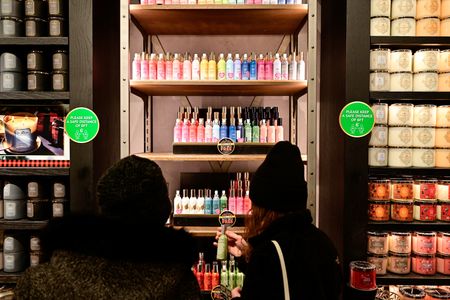

The fragrance and personal care retailer Bath & Body Works announced Wednesday that it anticipates a more significant drop in yearly revenue than Wall Street experts had predicted, citing consumers who are tightening their budgets and spending less on high-priced candles and body care products.
The company’s stock price, which dropped by nearly 50% in the previous year, climbed approximately 5% in pre-market trading following the release of strong holiday season results.
Financial pressures from inflation concerns and employment market uncertainty have led shoppers to reduce purchases of costly luxury items, creating challenges for retailers like Bath & Body Works that depend on discretionary spending.
The Ohio-headquartered retailer now projects annual net revenue will drop between 2.5% and 4.5%, significantly worse than the 1.9% decrease that analysts had estimated, based on LSEG data.
The company also predicted full-year adjusted earnings per share would land between $2.40 and $2.65, with the middle point falling short of analyst expectations of $2.56.
Despite these challenges, the retailer successfully boosted customer demand during the crucial holiday shopping period through enhanced marketing campaigns and promotional strategies.
CEO Daniel Heaf has implemented what he calls the “No-Regret Moves” business transformation strategy, which emphasizes customer loyalty programs, digital platform improvements, and brand revitalization through updated marketing, product packaging, and distribution methods.
“We are making progress, but transformations of this scale take time. We are undertaking a comprehensive, end-to-end evolution of our business,” Heaf said.
To reach more customers and compete in the challenging retail environment, the company recently began selling its products through Amazon’s online marketplace in the United States.
Last November, Bath & Body Works announced plans to reduce product sizes and discontinue certain secondary product lines, including hair care and men’s grooming items, by early 2026 to concentrate on its core business areas.
The retailer reported quarterly revenue of $2.72 billion, surpassing analyst projections of $2.62 billion.
For the quarter ending January 31, the company delivered adjusted earnings of $2.05 per share, exceeding analyst estimates of $1.77 per share.