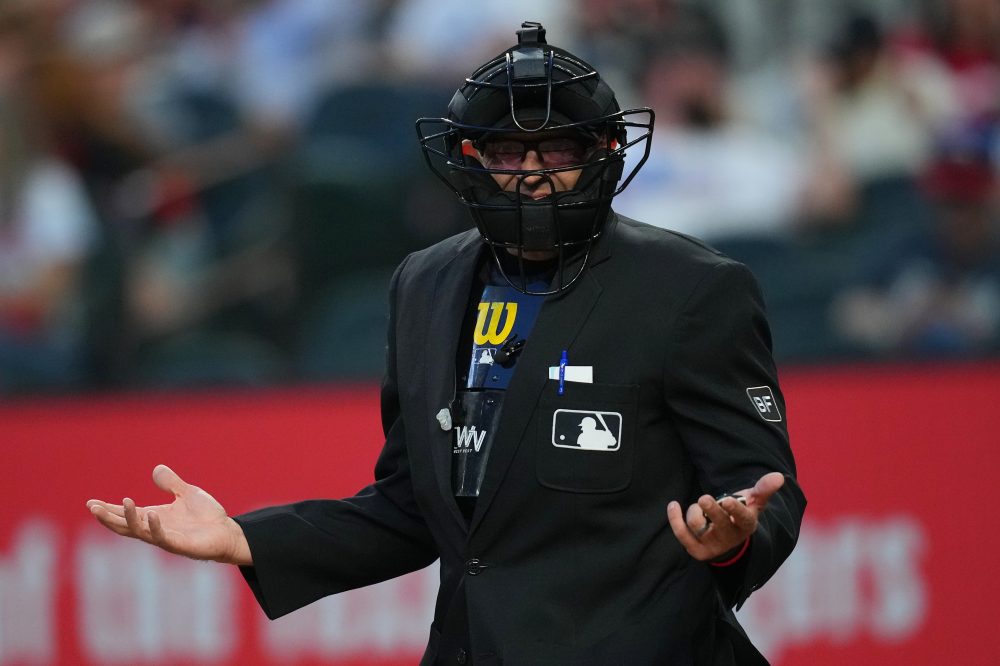

PHOENIX — Arizona Diamondbacks relief pitcher Paul Sewald acknowledges that Major League Baseball’s new Automated Ball-Strike technology should theoretically provide equal treatment to hitters and pitchers.
However, in reality, he believes one group is getting the upper hand.
And it’s not the players on the mound.
“It’s what (MLB) wanted — people on base,” Sewald explained. “Tough time to be a pitcher. Balls flying everywhere, you’ve got a smaller strike zone. But you just go out there and do the best you can.”
Is Sewald’s assessment accurate? The statistics suggest the strike zone has indeed gotten tighter, though the data tells a complex story.
Base on balls have surged to levels approaching historical records during the season’s opening month. While there’s no definitive proof that the ABS system caused this increase, Diamondbacks catcher James McCann posed a logical question: “Of course it is. What other rules have changed?”
Through Wednesday’s contests, MLB hitters have walked in 9.8% of their plate appearances this season, potentially marking the highest percentage since 1950. This figure typically decreases as the season advances, since pitchers generally struggle with command during cold weather conditions in northern markets throughout March and April.
However, even accounting for seasonal factors, walks have increased dramatically compared to last year.
The strike zone modification was anticipated. MLB needed to redefine the zone’s parameters to work with automated umpiring. The previous Official Baseball Rules described a zone extending from the batter’s torso midpoint down to the “hollow beneath the kneecap.” The updated zone uses more exact measurements, beginning at 27% of a hitter’s standing height and extending to 53.5%. The ABS zone measures 17 inches across, matching home plate’s width, with all pitches evaluated at the plate’s center point.
The walk increase doesn’t completely reveal who’s gaining advantages in the ABS era. MLB’s overall batting average has dropped slightly to .240 through Wednesday, marginally below last year’s .242 mark during March and April games. This challenges Sewald’s assertion about “balls flying everywhere.”
The contrasting viewpoints are intriguing as MLB players adapt to the new regulations and statistics.
New York Yankees outfielder Cody Bellinger isn’t reading too much into the early statistics. He noted that batters and pitchers constantly engage in strategic battles, and balance will eventually emerge.
“I think there’s always an adjustment to something new,” the 2019 National League MVP explained. “It’s also such a short sample size. It’s (20-25) games into the season, so numbers skyrocket both ways early on.”
McCann remains unconvinced. The experienced catcher believes a more restrictive strike zone will naturally result in additional walks.
“I think it’s tighter in general,” McCann stated. “Umpires are getting instant feedback on what’s a strike or a ball and everything’s becoming much more uniform. That’s what the guys who had used it in the minor leagues told me was going to happen before the season started, and they were exactly right.”
Chicago Cubs star infielder Nico Hoerner offered a somewhat different perspective, suggesting that hitters might currently benefit by avoiding pitches at the strike zone’s upper edge, though all adaptations eventually reach their limits.
“Getting on base has been emphasized for a long time,” Hoerner noted. “Walking is incredibly valuable as a hitter. A lot of pitchers — their approach is to avoid slug at all cost. Sometimes that involves throwing less strikes. But I’m sure there will be a back and forth, just like every trend in baseball.”
Recent history indicates MLB rule modifications can create lasting impacts. Stolen bases increased nearly 50% from 2022 to 2023 following a rules package that introduced a pitch clock and restricted pitcher pickoff attempts.
Base stealing has remained elevated in subsequent seasons, even after teams adapted to the new regulations.
When MLB lowered the pitcher’s mound in 1969, walk rates jumped from 7.6% to 9.1%. The rate declined somewhat afterward but didn’t drop below 8% again until 2013.
Miami Marlins manager Clayton McCullough views the ABS situation differently. He’s monitoring the trends but doesn’t expect the elevated walk rate to persist.
The upcoming five months will provide answers.
“I think that we’ll get to a point where it gets close and stabilizes to what it’s been, where relievers are walking around 10%. Starters are going to be more around 8%,” McCullough predicted. “My hypothesis sitting here now early in the year is that by the time the season ends, (walk rates) will look very much like they have, say the last several seasons.”