
BARCELONA, Spain — Barcelona’s renowned Sagrada Familia basilica displays towering spires resembling sandcastles, intricately carved stonework mimicking abundant vegetation, a rainbow-hued interior, and countless hidden gems scattered throughout. Even faithful parishioners who regularly attend services at this world-celebrated monument continue to be amazed by its wonders.
The Catalan rector of the Sagrada Familia, Josep Turull, who oversees parish operations, recently provided The Associated Press with an exclusive behind-the-scenes look at his most cherished discoveries before Pope Leo XIV’s eagerly awaited Mass scheduled for Wednesday evening.
“We say that one of the elements of the Sagrada Familia Basilica is that you never exhaust it,” Turull said. “I have spent the last eight years as its rector, and each day I discover something new.”
Every morning, Turull walks toward the basilica’s ornately adorned exterior walls. These surfaces contain countless religious imagery and symbolic elements, with some readily understood by those familiar with basic Christian teachings, while others remain puzzling and surprisingly bold for a house of worship.
The west-facing Façade of the Passion appears austere, displaying anguished figures with bodies twisted into sharp, geometric positions. This design matched architect Antoni Gaudí’s vision — “harsh and cruel, as if made of bones,” to represent the suffering and agony of Christ’s final days.
Years following Gaudí’s passing, sculptor Josep Subirachs balanced the façade’s somber mood by incorporating whimsical touches. Gaudí’s likeness appears above the main entrance, gazing toward Jesus as he bears his cross toward Calvary. And what about that puzzle-like number grid positioned beside Judas kissing Jesus during his betrayal?
This “magic square” represents the certainty of Christ’s death; combining the numbers from any direction consistently yields 33, representing Jesus’s age when crucified.
Another riddle awaits observant viewers who examine the scene depicting Peter’s denial of Christ: a tiny, square-shaped maze. Turull explained that it represents the importance of maintaining faith in God during times of confusion.
Following Mass, Leo will exit to provide a blessing for the Tower of Jesus Christ, which elevated the Sagrada Familia to become the globe’s tallest church upon its completion in October.
The basilica’s upper reaches overflow with natural elements, including the rooster that crowed during Peter’s denial of Christ, reptilian creatures serving as gargoyles, and clusters of fruit adorning the spire tops.
Living creatures also inhabit the structure; a peregrine falcon family has made their home in the tower honoring St. James, deterring pigeons and their droppings.
Gaudí’s architectural wonder was selected as an optimal location for reestablishing this species, representing one of the final places in the city where these birds had nested before vanishing in the 1970’s. The falcons have successfully reproduced at the basilica for more than twenty years.
Turull noted that these swift predatory birds “recover the cycle of natural life.”
Among the millions of yearly guests who marvel at the rainbow light streaming through the basilica’s colored glass windows, compete for photo opportunities, and gather around tour leaders, many miss what Turull describes as its “spiritual heart.” Accessing this requires entering through a humble side door and walking down steps.
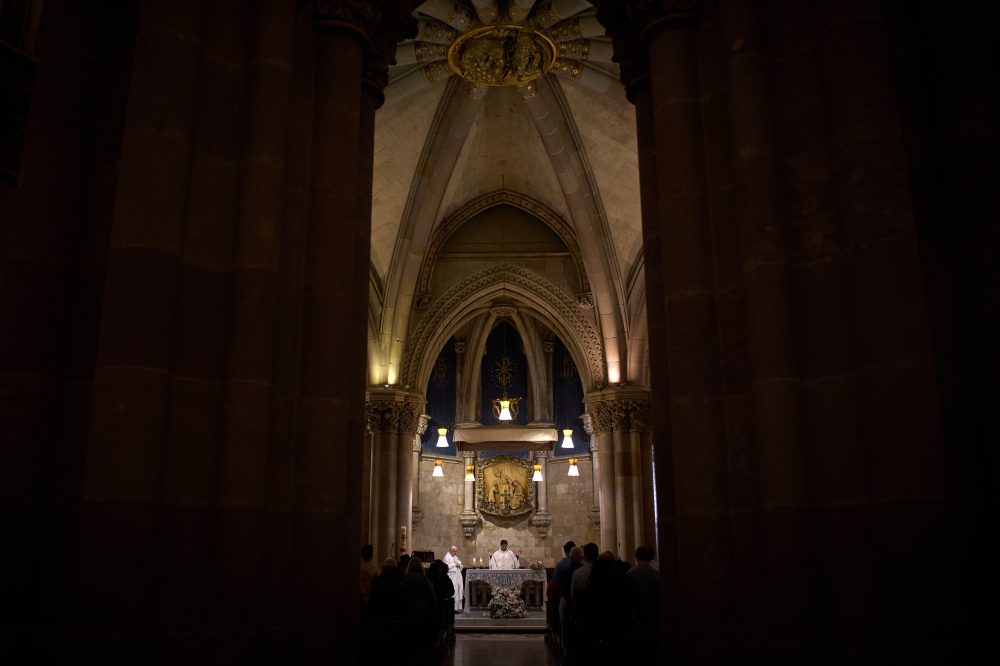
Below ground lies a considerably smaller, more personal chapel where dozens of worshippers quietly participate in Mass while faith successfully keeps tourism away.
Appropriately, this location houses Gaudí’s final resting place in an understated tomb within an alcove. The devout Catholic architect passed away precisely one century ago when struck by a streetcar.
“People come to ask for his intercession,” Turull said, gesturing to the tomb interred in the floor. “That’s why there are so many candles. Because people place their trust in him. Many people have received favors for having prayed at the tomb of Gaudí.”
The Vatican continues a lengthy evaluation process that might ultimately result in Gaudí’s sainthood. Following Pope Francis’s designation of Gaudí as “venerable” in 2025, the Vatican must verify a miracle credited to his intervention for beatification, followed by confirmation of a second miracle for canonization.
The basilica has suggested the pope visit Gaudí’s tomb during his stay, though this remains uncertain.
Before returning upstairs, Turull stops at a massive seashell — an authentic specimen, not stone carving — functioning as a holy water font. He explained that Gaudí had this Philippine seashell mounted in wrought iron and attached to the pillar.
“Gaudí always takes nature as an example,” Turull said, referencing the way the natural world inspired his designs and decorations.
Up a winding stairway, a private chamber filled with sunlight contains two standalone oak storage units decorated with detailed metalwork. Created by Gaudí, they store the basilica’s most valuable relics and significant ceremonial garments. These include Pope Benedict XVI’s chasuble — a vestment worn during Mass — from his 2010 consecration of the Sagrada Familia.
This room will serve as Pope Leo’s preparation area, where he’ll don a specially crafted chasuble being created at a workshop exclusively for this event.
Turull revealed the garment will incorporate symbolic details reflecting the occasion’s significance and design elements connected to the basilica’s newly erected Cross of Jesus Christ. However, he refuses to share additional details; certain aspects must remain confidential.