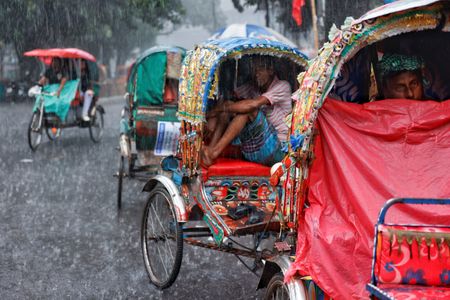

DHAKA — Relentless monsoon rains have unleashed devastating floods and landslides across southeastern Bangladesh, killing at least 44 people and leaving more than a million residents stranded as emergency crews worked urgently Saturday to get aid to overwhelmed communities.
According to the country’s disaster management ministry, the flooding has spread across seven districts — Chattogram, Cox’s Bazar, Bandarban, Rangamati, Khagrachhari, Moulvibazar and Habiganj — disrupting everyday life, cutting off thousands of families, and affecting 267,918 households.
Downed power lines, wrecked roads, and severed communication networks have hampered rescue and relief operations. Many residents have gone days without being able to prepare meals as floodwaters filled their homes, while others are dealing with thick mud that has covered kitchens and living areas.
Nurul Islam, a resident of a flood-affected neighborhood in Chattogram, described the desperate conditions his family is facing. “There is still water inside our home and we have no way to cook. The dry food we had has run out, and we spend the nights in the dark with our children because there is no electricity,” he said.
Countless families are surviving on ready-to-eat foods such as flattened rice, puffed rice, and biscuits that require no cooking. However, washed-away roads and collapsed bridges have made it extremely difficult for relief workers to access some of the most severely affected areas.
Both army and navy units are using boats to transport food, clean drinking water, medicine, and other critical supplies to communities that have been cut off from the outside world.
Disaster Management and Relief Minister Iqbal Hossain traveled to affected areas in Chattogram, where he addressed the ongoing response efforts. “The government is doing everything possible to support flood victims. Relief, safe drinking water and medical supplies are being distributed, and we urge people whose homes have been inundated to move to the nearest shelter,” he stated.
Earlier in the week, the heavy rainfall also triggered landslides inside Rohingya refugee camps located in Cox’s Bazar, where 16 refugees — including women and children — lost their lives. The camps are home to more than one million Rohingya refugees, many of whom live in makeshift shelters built on steep, tree-stripped hillsides that are particularly vulnerable when monsoon rains arrive.
Bangladesh ranks among the most disaster-vulnerable nations on earth, with seasonal monsoon flooding, river erosion, and landslides a recurring threat. Scientists have noted that climate change is intensifying extreme rainfall events, making disasters like this one more frequent and more severe.