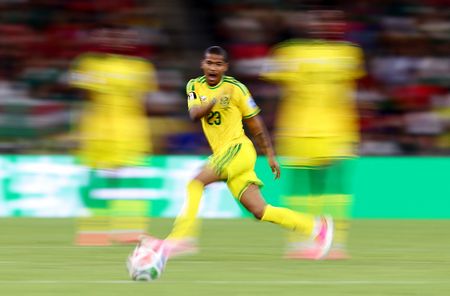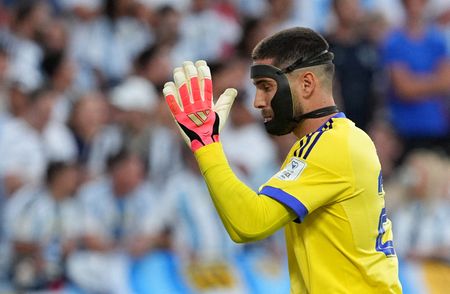

When soccer players collide in the air, the injuries that follow aren’t always the ones that make headlines. Concussions and torn ligaments get plenty of attention — but broken noses, it turns out, can leave athletes with lasting damage long after the final whistle.
Dr. Farhad Ardesh, a facial plastic and reconstructive surgeon based in Beverly Hills, California, says nasal injuries in soccer are among the sport’s most underestimated risks.
“Sometimes a minor injury on the outside can cause major damage on the inside,” said Ardesh, who has worked with professional athletes including soccer players. “You might have the nose that just looks a little swollen or a little crooked, but the inside of the nose actually has a zigzag pattern or an S-shaped deformity that’s really affecting this player’s breathing.”
The issue has gained new visibility at the 2026 World Cup, where multiple players have competed while wearing protective facial masks following jaw or facial injuries. England’s Djed Spence, Austria’s Stefan Posch, and Algeria goalkeeper Luca Zidane have all appeared on the pitch with facial protection. The trend echoes recent high-profile cases, including France’s Kylian Mbappe wearing a mask to shield a broken nose at Euro 2024, and Croatian defender Josko Gvardiol donning similar protection at the 2022 World Cup.
While fans in the stands may see the mask as a symbol of toughness, Ardesh views it differently.
“The face is very fragile after an injury, whether it’s from trauma like getting hit with an elbow or if it’s from surgery,” he said. “We want to protect the bone.”
Ardesh compared the facial trauma soccer players endure to what is seen in boxing or mixed martial arts.
“People don’t think of soccer as being a combat sport,” he said. “But you’ve got elite athletes that are running as fast as humanly possible and jumping really high. When you’re talking about an elbow or a shoulder directly to the nose, it’s more or less like taking a right hook to the face.”
Contrary to what many might assume, the ball itself is rarely the main culprit. Instead, Ardesh said most facial injuries come from contact with heads, shoulders, elbows, knees, feet, or the ground after a fall.
The nose is particularly at risk due to its prominent position on the face.
“The nose is what’s sticking out from our faces,” Ardesh said. “It’s the first thing that’s probably going to take any kind of impact.”
A broken nose that goes untreated or is improperly evaluated can lead to a range of serious complications, including chronic nasal obstruction, a deviated septum, long-term breathing difficulties, a visibly misaligned nose, or the need for reconstructive surgery months down the road. For elite athletes, Ardesh said, restricted airflow can directly affect how they perform.
“If patients are not getting good airflow through their nose, they’re not going to be performing at their best,” he said. “The goal of rhinoplasty and septoplasty is not only to improve the aesthetics of the nose but also make sure they’re getting the best breathing possible.”
In the immediate moments after a facial blow, the priority is stopping the bleeding and ruling out more serious injuries. Players should lean forward to keep blood from running down the throat.
Once a player sees a specialist, one critical concern is a septal hematoma — a buildup of blood inside the wall dividing the nose. If left untreated, it can cut off blood supply to the cartilage and cause a collapsed, saddle-shaped deformity.
Because swelling can obscure the true extent of damage in the early hours after impact, Ardesh said imaging may be necessary to check for fractures involving the eye socket, cheekbone, or jaw, as well as to screen for concussion. For a straightforward nasal fracture, he typically waits one to two weeks for swelling to go down before attempting to reset the bones. More involved procedures, such as rhinoplasty or septoplasty, may follow three to six months later depending on the player’s breathing, appearance, and overall function.
“The goal for these players is that they want to get back on the field,” he said. “But we need to assess all the injuries and come up with an individualized plan.”
Goalkeepers face an especially elevated risk because of the nature of their position, regularly throwing themselves into situations where they come into direct contact with opposing players.
“They can get elbowed, head-butted or kneed,” Ardesh said. “They are at higher risk for taking on a straight-on facial impact.”
Despite the risks, Ardesh does not foresee mandatory facial protection becoming a widespread requirement in soccer, given the sport’s demands for speed, clear vision, and player comfort. He believes optional masks for players recovering from specific injuries are the more practical approach.
“These are fighters,” Ardesh said of professional players. “They don’t want to leave the field.”