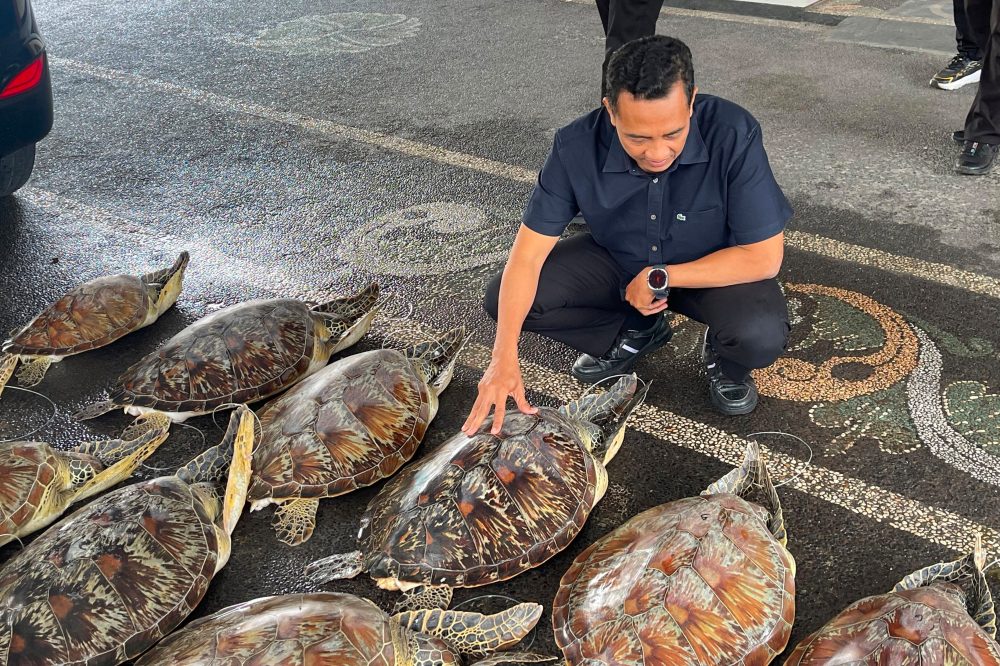

Police on the Indonesian tourist island of Bali have broken up an illegal wildlife operation involving 21 live green sea turtles, authorities announced Friday.
Officers conducted a raid on June 10 along the island’s Pegametan coast after local residents tipped off police about suspected illegal turtle trading in the area. The raid resulted in the seizure of all 21 living animals. Nanang Pri Hasmojo, who heads law enforcement for the Bali police force, confirmed the details of the operation.
A 67-year-old man, identified only by his initials KS, was taken into custody. Investigators believe he was responsible for holding the turtles before they could be distributed and sold.
During early questioning, the suspect reportedly told police that the turtles had been sent to him by an associate from waters near Madura, an island located in East Java province. He allegedly received the animals directly on the beach, where another individual was supposed to pick them up for resale.
“We are continuing to investigate the case and pursuing other suspects involved in the network,” Hasmojo stated. The suspect has been charged under Indonesia’s wildlife protection laws and could face up to 15 years behind bars along with substantial fines if convicted.
Indonesia has legally protected turtle species since 1990 through conservation and fisheries legislation. A regulation issued by the Environment Ministry in 2018 further strengthened protections for the six species of sea turtles found in Indonesian waters, and additional government rules ban their trade entirely.
Sea turtle poaching — carried out by both local communities and organized criminal operations — is considered a major factor in a global conservation crisis. The International Union for Conservation of Nature reports that six of the world’s seven sea turtle species are now classified as threatened.
A 2022 study conducted by researchers at Arizona State University and published in the journal Global Change Biology found that more than 1.1 million sea turtles were killed between 1990 and 2020. The killings were largely driven by demand for meat, alleged aphrodisiacs, and use in traditional and spiritual practices.
According to that same study, the green turtle — scientifically called Chelonia Mydas — made up 56% of all sea turtle killings over that 30-year span.
Bali was historically one of the biggest hubs for green turtle trafficking. That trade was fueled in part by the traditional use of turtle meat in religious offerings tied to Balinese Hinduism, the dominant faith on the island, which is home to roughly 4.5 million people.