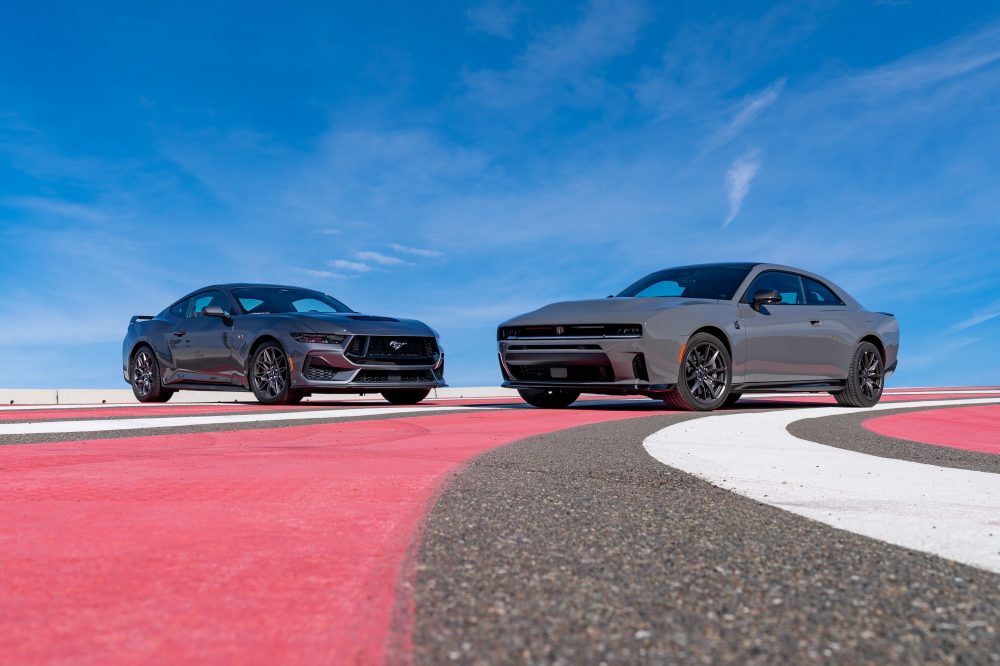

Two iconic American muscle cars face off in a battle that’s been brewing since the 1960s, as automotive experts compare the latest Ford Mustang against Dodge’s completely redesigned Charger. While both vehicles honor their high-performance heritage, each takes a different path to deliver thrills behind the wheel.
Ford’s current Mustang has evolved toward sports car performance, featuring precise handling and the track-focused Dark Horse variant. Meanwhile, Dodge has transformed the Charger into a more practical machine, launching it as an electric vehicle under the Daytona name in 2024 before adding turbocharged six-cylinder options in the R/T and Scat Pack versions. Automotive reviewers examined four specific models: the Mustang GT, Mustang Dark Horse, Charger R/T, and Charger Scat Pack.
Dodge’s new two-door Charger serves as the spiritual successor to the discontinued Challenger, though it’s considerably larger and heavier than its predecessor. The extra weight comes partly from standard all-wheel-drive across the Charger lineup, which enhances traction in poor weather and improves launch performance.
Under the hood, both Charger variants feature Dodge’s new turbocharged six-cylinder engine. The R/T generates 420 horsepower while the Scat Pack’s enhanced version delivers 550 horsepower. This power enables the Scat Pack to sprint from zero to 60 mph in just 4.2 seconds, outpacing both the 480-horsepower Mustang GT and 500-horsepower Dark Horse in testing. However, testers found the Charger’s stopping distances disappointing, and its vague steering provides little feedback when pushing through corners.
Ford’s Mustang continues its transformation from traditional muscle car to sports car, particularly evident in the Dark Horse model designed for road course performance rather than straight-line acceleration. Both GT and Dark Horse variants offer agile handling, quick acceleration, and impressive braking capability. The Mustang’s V8 engine also produces a more appealing sound and can be paired with a manual transmission for enhanced driving involvement.
In the performance category, reviewers declared the Mustang the winner.
Without adjustable suspension options, the six-cylinder Charger models achieve a reasonable compromise between comfort and handling. Combined with well-tuned throttle response, a smooth eight-speed automatic transmission, and a hatchback-style rear opening for easier cargo loading, the Charger excels at daily driving tasks and highway cruising.
Technology represents the Charger’s strongest advantage. The interior features abundant USB ports, wireless phone charging, and a crisp 12.3-inch touchscreen with quick response times and comprehensive features. Dodge also maintains separate physical controls for climate functions, earning praise from reviewers.
Mustang comfort varies significantly based on equipment choices. Both GT and Dark Horse models offer performance-oriented adaptive suspension systems with adjustable firmness settings. However, the Mustang’s compact dimensions create cramped rear seating and limited storage space regardless of options.
The Mustang’s large 13.2-inch display modernizes the cabin compared to previous generations, but relocating all climate controls to the touchscreen creates more complicated and distracting adjustments while driving.
For comfort and technology, reviewers favored the Charger.
Starting at $48,645 including delivery fees, the Mustang GT costs several thousand dollars less than the base Charger R/T at $51,990. However, upgrading to the Dark Horse requires a significant jump to $66,075, with options easily pushing the total above $70,000.
The Charger Scat Pack begins at $56,990, representing strong value for buyers prioritizing acceleration and luxury features. Like the Mustang, extensive options can quickly inflate the final price.
Reviewers called the value comparison a tie.
Dodge’s reimagined Charger delivers turbocharged performance, generous interior space, and modern technology that its predecessor lacked. However, it trails the Mustang GT and Dark Horse in several performance measures, and its six-cylinder engine cannot match the character and appeal of the Mustang’s V8. While the Charger offers distinct advantages, the Mustang emerges as the overall winner in this comparison.