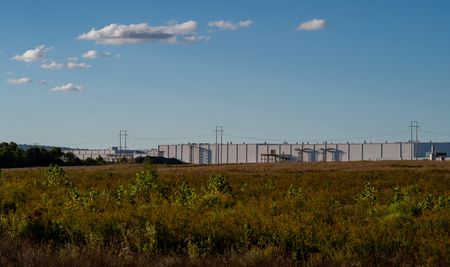

Automotive manufacturers and battery producers are rushing to transform their electric vehicle battery facilities into energy storage production plants as EV sales continue to decline across the United States. The shift aims to capitalize on growing demand for power storage systems driven by artificial intelligence and data center expansion.
Major companies including General Motors, Ford Motor, and their Asian battery partners – Japan’s Panasonic Holdings, South Korea’s Samsung SDI, and LG Energy Solution – have invested over $100 billion in battery manufacturing facilities during the past ten years. However, the electric vehicle market has struggled under current administration policies favoring fossil fuels.
Energy storage systems utilize lithium-ion battery technology similar to EV batteries, storing electricity from renewable sources like solar and wind power for release during peak demand periods. Growing U.S. demand stems largely from data centers and cloud computing operations that consume massive amounts of electricity.
Despite the anticipated energy storage growth, industry analysis shows it won’t compensate for the dramatic drop in EV battery demand. Electric vehicle sales were already underperforming manufacturer expectations before the $7,500 consumer tax credit ended on September 30, leading to a sales decline exceeding 25% over six months.
Factory conversions require significant time and financial investment, plus companies must master technology currently dominated by Chinese manufacturers. Bob Lee, North America head for LG Energy Solution, announced his company is converting three North American facilities for storage battery production. He anticipates continued struggles with excess capacity, describing it as “fallout” from the EV market downturn.
“Like any other industry that goes through a difficult period like this, I don’t think it’s going to be all rosy,” he said.
Ford announced a $2 billion investment in a new battery storage division over two years to “create a new, diversified and profitable revenue stream.” GM’s partnership with LGES, known as Ultium Cells, revealed plans last month to convert a Tennessee EV battery facility for storage cell production.
Converting production facilities presents complex and expensive challenges. North American stationary battery demand will reach 76 gigawatt-hours this year according to Benchmark Mineral Intelligence, but automotive industry investments have created approximately 275 GWh of factory capacity. While storage demand may nearly double to 125 GWh over five years, it still won’t absorb the surplus automotive capacity.
LG Energy Solution plans to convert factory space for up to 50 GWh annual storage battery production by year’s end, representing only one-third of the company’s regional capacity across its own facilities and joint ventures with General Motors, Honda, and Hyundai.
Energy storage systems typically use lithium iron-phosphate (LFP) batteries, which cost less than the nickel-based chemistry predominant in North American EV batteries. Converting factories to LFP production can require 18 months and cost hundreds of millions of dollars, according to battery industry executives.
U.S. battery manufacturers face additional complications from China’s dominance in LFP technology and supply chains. American producers are working to reduce Chinese material dependence to qualify for federal tax credits for domestic battery production established under the previous administration and maintained under current leadership. Companies must gradually eliminate Chinese content over coming years to receive full tax benefits.
Trade restrictions create further obstacles, with U.S. tariffs on Chinese-made cathode and anode materials – the battery electrodes that transfer electrical charges – reaching 35% according to Benchmark Mineral Intelligence.
The automotive industry’s energy storage pivot has accelerated recently. In March, the GM-LGES partnership announced $70 million in spending and worker retraining to produce storage battery cells at their Nashville-area plant. Ford disclosed in December plans to repurpose underutilized Kentucky factory space for storage battery manufacturing.
Traditional automakers are attempting to catch up with Tesla, where Elon Musk’s company has spent approximately ten years developing its energy storage business into one of the EV manufacturer’s fastest-growing segments. The storage division proved more profitable than Tesla’s automotive business in 2025, achieving gross margins around 30% compared to roughly 15% for vehicle sales, excluding regulatory credit earnings.
Tesla’s Megapack storage unit deployments have increased dramatically, including $430 million in revenue last year from sales to Musk’s xAI company, demonstrating how AI-driven data center demand directly translates to battery orders.
Kurt Kelty, GM’s battery chief and former Tesla executive, told reporters in January that the company remains committed to building U.S. battery manufacturing industry and supply chains. Whether for EVs or storage systems, he said, “it really doesn’t matter.”