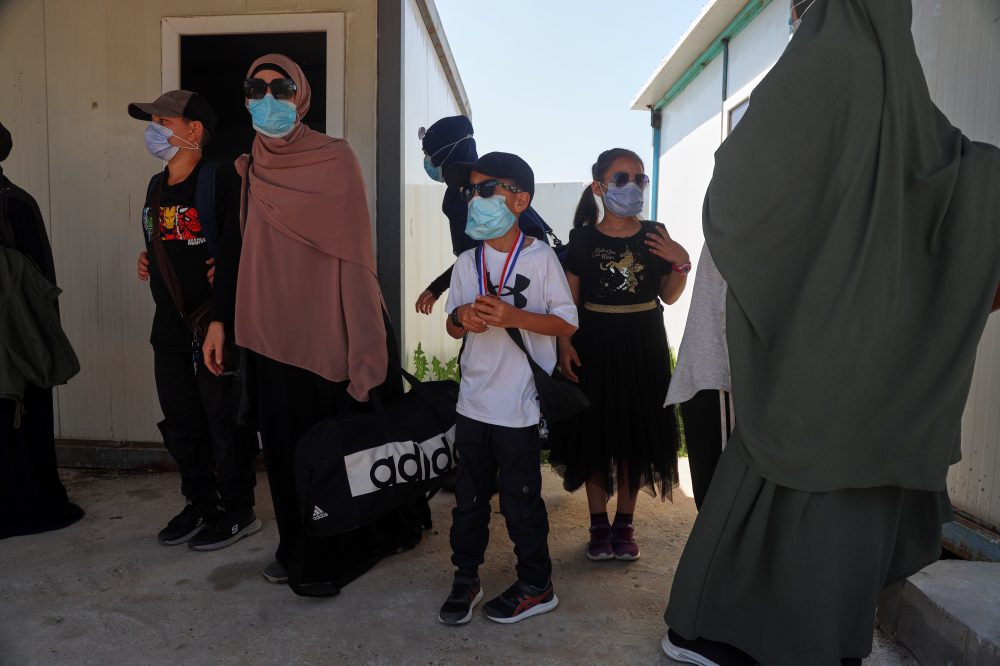

BEIRUT (AP) — Thirteen Australian women and children with suspected connections to Islamic State militants remain stranded in Syria after their home country’s government blocked their return, Syrian authorities announced Wednesday.
The four families departed from Roj camp last Friday, a detention facility located near Iraq’s border that holds relatives of alleged extremist fighters, and made their way to Syria’s capital city.
A camp representative had indicated at the time that the families would spend approximately three days in Damascus before being transported back to Australia.
However, when the Associated Press inquired about their whereabouts, Syria’s information ministry revealed in an official statement that following the families’ departure from the camp, the foreign ministry learned that “the Australian government had refused to receive them.”
According to the information ministry’s statement, the families were prevented from accessing Damascus International Airport.
“These families are still awaiting a solution, which can only be achieved through coordination with the relevant international parties.”
During a Wednesday press briefing, Australian Prime Minister Anthony Albanese declared that “we are providing no support for repatriation and no assistance for these people.”
Syria’s information ministry reported that the families had secured passports through legal representation, which were provided by an unnamed “individual” while they remained in northeastern Syria under Kurdish-led Syrian Democratic Forces control.
Lebanese-Australian physician Jamal Rifi had previously informed Australian news outlets that he was facilitating the repatriation process. Attempts to contact Rifi for additional comments were unsuccessful.
An earlier repatriation effort in February involving 34 women and children from the same camp was also blocked by Syrian officials.
Following the collapse of Islamic State’s territorial control in Syria during 2019, former fighters from various nations and their family members have been detained in multiple camps and facilities throughout northeastern Syria. Despite the group’s defeat, dormant cells continue conducting lethal operations across Syria and Iraq.
The larger al-Hol detention facility has since been shuttered, with thousands of suspected Islamic State members previously detained in Syria being relocated to Iraq by U.S. forces to face prosecution.
These transfers occurred following clashes between government troops and the Syrian Democratic Forces in January. Government forces captured significant portions of SDF-controlled territory. During the resulting turmoil, numerous detainees escaped from al-Hol while others broke out of a separate detention facility.
Australian administrations have previously facilitated the return of Australian women and children from Syrian detention facilities on two separate occasions. Additional Australians have also returned home through independent means.