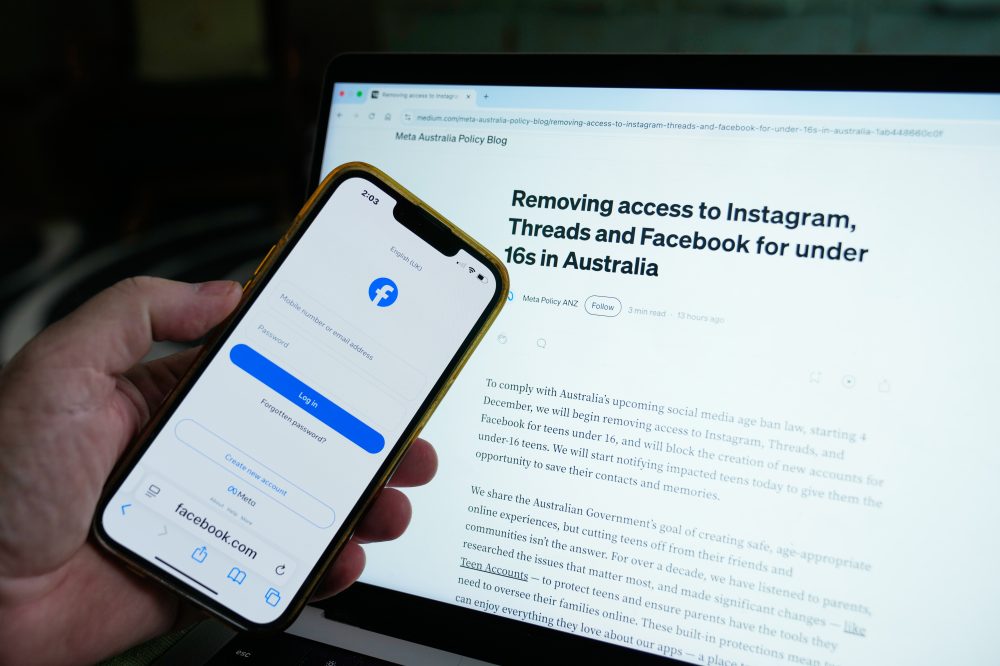

MELBOURNE, Australia — Australia is preparing to significantly toughen its penalties against social media companies, including Facebook and Instagram, after critics say the country’s groundbreaking ban on social media accounts for children under 16 is falling short.
Communications Minister Anika Wells, speaking Monday, pointed the finger at the platforms themselves, saying their pushback against age restrictions is forcing the government’s hand on strengthening the rules that went into effect on December 10.
“We can all agree we would like the scheme to work better than it is currently, but that is on Big Tech taking the Mickey,” Wells told the Australian Broadcasting Corp., using an Australian slang expression meaning to deceive or mock someone.
On Sunday, the government announced it would submit draft legislation to Parliament this week that would raise the maximum penalty to 99 million Australian dollars — roughly $68 million — for platforms that fail to take reasonable steps to stop Australian children from maintaining accounts.
The proposed amendments would also expand the authority of eSafety Commissioner Julie Inman Grant, the country’s top online safety official, giving her greater ability to demand records and information to verify that platforms are following Australian law.
Under the new powers, the commissioner could also seek information from outside parties — such as companies that provide age verification technology — to evaluate the platforms’ claims about how children under 16 continue to get around the ban.
Senior opposition lawmaker Jane Hume indicated her party would likely support the reforms, acknowledging that the “social media ban wasn’t working” due to weaknesses in the original legislation.
“The legislation was clearly undercooked in the first place. The eSafety Commissioner wasn’t given the powers to be able to pursue these Big Tech companies,” Hume said.
Parliament originally passed the law with broad bipartisan support in 2024, and the affected platforms were given more than a year to prepare for the ban’s implementation.
Countries around the world that are considering or have already enacted similar restrictions have been keeping a close eye on how Australia’s approach has played out.
Initially, the government reported that more than 5 million children had their accounts removed, deactivated, or restricted once the ban became law. However, eSafety reported in March that seven out of ten children who had accounts on restricted platforms as of December 10 were still active on Facebook, Instagram, Snapchat, and TikTok.
In April, Commissioner Inman Grant said she was weighing legal action against those platforms as well as YouTube, alleging they were not doing enough to keep children off their services. She noted she was satisfied with the progress made by the other restricted platforms — X, Kick, Reddit, Threads, and Twitch.
Wells said she has been receiving monthly progress reports from eSafety since March and that “we are not seeing improvements.”
“These (draft) changes ensure that the eSafety Commissioner has the tools and powers she needs to hold platforms to account and we’re making sure that she can do just that,” Wells added.