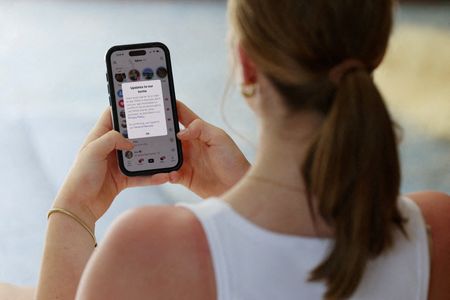

Australia’s groundbreaking social media age restriction has captured international attention, with lawmakers from Spain to Malaysia considering similar measures since the ban on users under 16 took effect in December.
The worldwide interest appears to have prompted Prime Minister Anthony Albanese’s administration to strengthen enforcement efforts this week, moving away from what officials had previously described as productive industry collaboration just two months earlier, according to technology policy analysts.
As the government takes a more assertive approach with platforms like Instagram and TikTok, Albanese’s center-left administration welcomes the international attention from at least eight countries expressing interest in comparable restrictions, while working to address reports that many teenagers continue using these platforms, experts note.
INTERNATIONAL PRESSURE MOUNTS
“The whole world’s watching Australia in this experiment, and therefore it looks like weak government to back down or pretend that the failures in reasonable efforts aren’t happening,” explained Jeannie Paterson, co-founder of the Centre for Artificial Intelligence and Digital Ethics, who frequently provides government counsel on technology matters.
A representative for Communications Minister Anika Wells stated that global attention had not influenced her tougher position, refusing additional comment.
Following the ban’s implementation, officials announced in mid-January that social media companies had shut down 4.7 million accounts suspected of belonging to minors, leading industry observers to anticipate a potential one-year grace period for enforcement.
Government officials from Britain, Canada, and several U.S. lawmakers have reached out to Australian authorities regarding the social media restriction – a measure strongly supported by parents but opposed by the multi-trillion-dollar technology sector required to implement it.
However, these positive developments have been overshadowed by continued reports of minors maintaining social media presence.
On Tuesday, the government announced investigations into Meta’s Instagram and Facebook, TikTok, Alphabet’s YouTube, and Snapchat for potential law violations, collecting evidence for possible legal proceedings.
The eSafety regulator had previously indicated enforcement actions would only occur in cases of widespread non-compliance.
According to the regulator’s first detailed compliance assessment, nearly one-third of parents reported their under-16 child maintained at least one social media account. Among these cases, two-thirds said the platform never requested the child’s age.
Angela Flannery, former general counsel for the government’s Communications Department who now provides private sector guidance, noted, “The government is quite heartened generally by the number of other jurisdictions that are looking at imposing restrictions on the under-16s globally.”
However, considering Tuesday’s “disheartening” compliance findings, Flannery added, “They probably want to be seen to be taking action to keep encouraging other jurisdictions to enforce or to enact similar bans.”
Meta and Snap expressed commitment to ban compliance, TikTok refused comment, and Alphabet did not respond to requests regarding the government action.
U.S. COURT DECISIONS PROVIDE SUPPORT
The eSafety assessment revealed that cyberbullying and image-based abuse complaints – issues the government claimed the ban would address – remained unchanged, while parents reported inability to inform platforms about their underage children’s continued accounts. Minors failing age verification were being encouraged to retake tests until successful, the regulator found.
The restriction requires platforms to implement “reasonable steps” preventing under-16 users from maintaining accounts or face penalties up to A$49.5 million ($34 million).
Communications Minister Wells attributed the problem not to parent or child non-compliance but to Big Tech undermining government policy.
Recent U.S. court decisions likely encouraged Australia’s platform pursuit, according to sources familiar with the ban’s implementation, including last week’s trial verdict requiring Meta to pay $375 million in penalties for safety failures enabling child exploitation on Facebook, Instagram and WhatsApp, plus another ruling finding Meta and Google negligent for creating social media platforms harmful to young people.
“The court cases in New Mexico and California have helped the court of public opinion,” said Julian Sefton-Green, a Deakin University new media professor advising the commissioner’s two-year ban impact study.
“They’re jury decisions, that social media is liable for the well-being of young people, so I think the government’s going to take heart from that.”
Rob Nicholls, a University of Sydney regulation researcher, suggested the lawsuits might encourage platform redesigns complying with Australian restrictions by prioritizing minor protection.
“The effect of that design change will be to reduce access for under-16s,” he explained. “If you’ve got to do it to avoid litigation in the States, you may as well do the same thing around the world.”