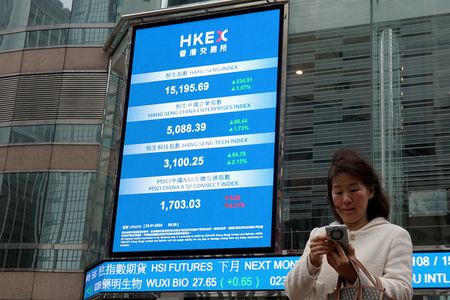

Asian financial markets displayed a more cautious tone Thursday as the tenuous Gulf ceasefire began showing strain, pushing petroleum prices upward and serving as a reminder to investors that inflationary pressures will persist for an extended period.
The Strait of Hormuz showed little evidence of meaningful reopening, with Iran asserting authority over the crucial petroleum shipping lane and requiring fees for secure transit.
“You have a fifth of the world’s oil supply moving through a corridor that is still effectively under the influence of one of the parties to the conflict,” said Nigel Green, CEO at deVere Group. “That’s not stability.”
“You don’t need a full blockade to move oil markets sharply higher again,” he added. “Missiles are still being launched in the Gulf, Israel is still engaged on another front, and yet markets are behaving as though the region has normalised.”
Consequently, U.S. crude futures climbed 2.8% to reach $96.99 per barrel, while Brent crude increased 2.1% to $96.74.
Japan’s Nikkei index fluctuated around unchanged levels after surging 5.4% in the prior trading session. South Korean markets declined 0.4% following the previous day’s 6.8% rally. The MSCI Asia-Pacific index excluding Japan dropped 0.3%.
U.S. markets showed weakness in pre-market trading, with S&P 500 and Nasdaq futures both declining 0.2% as Wednesday’s rally momentum faded.
European markets presented mixed signals, with EUROSTOXX 50 futures gaining 0.1%, German DAX futures falling 0.3%, and British FTSE futures advancing 0.5%.
**PRICE PRESSURES MOUNTING**
Energy costs remaining approximately 40% above pre-conflict levels means an inflationary surge will soon appear in economic data worldwide.
Thursday’s expected U.S. core inflation data for February is projected to show a substantial 0.4% monthly increase for the second consecutive month, occurring before the recent energy price spike.
Federal Reserve meeting minutes revealed increasing numbers of officials believe interest rate increases may be necessary to combat inflation, though many still prefer rate reductions as the next policy move.
This development limited Treasury bond gains, which were smaller compared to significant advances in European debt markets. Ten-year U.S. Treasury yields remained at 4.29%, up from 3.96% before Iran was attacked.
Federal funds futures now indicate only 7 basis points of rate cuts for the remainder of this year, abandoning expectations for 50 basis points of reductions since February’s end.
“The committee broadly agreed that it was too early to act, suggesting the Fed will likely remain on hold this year, in line with our view,” said analysts at JPMorgan in a note.
They also anticipate risks shifting toward just one European Central Bank rate increase this year instead of two.
The changing interest rate outlook helped the dollar recover some initial losses, with the euro unchanged at $1.1660 and below its peak of $1.1721.
The dollar stabilized at 158.60 yen after declining to 157.89 during Wednesday’s session.
Gold remained flat at $4,718 per ounce following an overnight peak of $4,777.