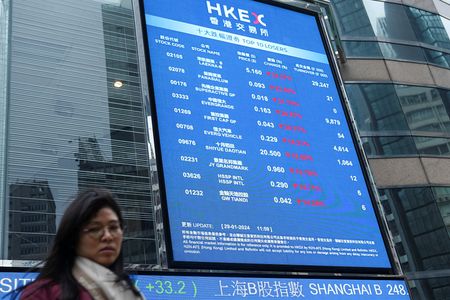

Asian financial markets were unsteady on Wednesday, one day after a worldwide selloff hit technology and semiconductor stocks hard, with market watchers raising red flags about the potential for more turbulence ahead.
The MSCI index tracking Asia-Pacific shares outside of Japan dipped 0.02%. South Korean stocks, which had crashed 10% on Tuesday in their worst single-day decline since March, bounced back with a 2.2% gain. Japan’s Nikkei index swung back and forth between positive and negative territory, ultimately sitting 0.8% lower.
Michael McCarthy, a market analyst at Moomoo Securities Australia, described the recent trading environment as deeply concerning. “Price action in markets over the last seven trading days has been alarming, not just when it falls, but also when it rises,” he said. “When markets move so rapidly, in either direction, it’s a sign of instability.”
That cautious mood also gripped Wall Street overnight, following similar trends across Europe and Asia. U.S. stocks fell amid concerns over growing debt-financed spending on artificial intelligence and speculation that the Federal Reserve might take a more aggressive approach to interest rates. At the same time, investors moved toward the safety of government bonds, pushing Treasury yields lower.
The Dow Jones Industrial Average slipped 0.09%, the S&P 500 dropped 1.4%, and the Nasdaq Composite fell 2.2%. The yield on the benchmark 10-year U.S. Treasury note declined 1.41 basis points to 4.493%.
Oil prices continued their slide, trading near four-month lows reached in the previous session. The decline came as signs emerged that oil tankers stuck in the Gulf since the beginning of the Iran war are preparing to pass through the Strait of Hormuz.
Despite that development, questions remain about whether the peace arrangement will hold. The United States and Iran have offered contradictory accounts of what was agreed upon in their deal, including critical matters such as nuclear inspections and control of the Strait of Hormuz.
The strength of the U.S. dollar has put significant pressure on the Japanese yen, which hovered near 40-year lows at 161.57 per dollar. That situation has kept traders on alert for a possible government intervention to support the weakened currency.
A summary of opinions released Wednesday from the Bank of Japan’s meeting this month — in which the central bank raised interest rates to a 31-year high of 1.00% — showed that some board members are pushing for additional rate increases to bring the policy rate closer to what is considered a neutral level for the economy.
The dollar index, which tracks the greenback against a group of major currencies including the yen and euro, edged up 0.02% to 101.43, near its highest point in a year. The euro slipped 0.06% to $1.1375, while the British pound fell 0.08% to $1.3192.
Gold prices also retreated, falling 0.48% to $4,088.71 per ounce, as expectations of higher interest rates reduced demand for assets that don’t generate income.
In digital currency markets, Bitcoin climbed 0.84% to $62,914.94, while Ethereum gained 0.43% to reach $1,669.35.