
Stock markets throughout Asia suffered dramatic losses Wednesday as growing concerns over Middle East conflicts sparked fears of rising oil prices that could reignite inflation and postpone anticipated interest rate reductions.
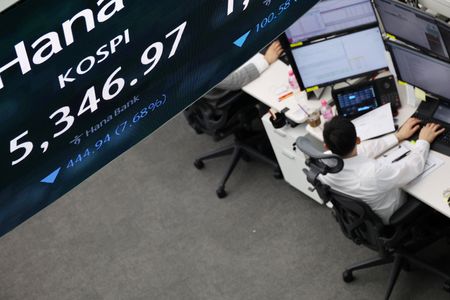
The region’s major market indicator, MSCI’s Asia-Pacific index excluding Japan, plummeted 4.2%. South Korea experienced particularly severe declines, with the KOSPI index losing more than 11% and activating emergency trading circuit breakers. Combined with previous losses, Korean markets have dropped 17% over just two trading sessions. Meanwhile, Japan’s Nikkei index declined 4.3% and Taiwan’s main index fell 3.6%.
Technology stocks, particularly semiconductor companies, bore the brunt of the selling pressure as international investors rapidly exited positions they had built up during earlier market gains.
Tareck Horchani, Head of Prime Brokerage Dealing at Maybank Securities in Singapore, explained the market dynamics: “We are definitely seeing foreign outflows driving the move, particularly in the large-cap tech names that had led the rally year-to-date. Korea had been one of the strongest markets globally, up nearly 50% at its peak on the back of the AI and memory cycle, so positioning was crowded.”
Horchani noted that the selloff appears more related to investor positioning than company fundamentals: “This looks more like a positioning unwind and risk reduction rather than a fundamental deterioration in earnings. When oil spikes and FX volatility jumps, especially for oil-importing markets like Korea and Japan, global funds tend to de-risk quickly from the most liquid index heavyweights. That’s exactly where the selling has been concentrated: Samsung, SK Hynix and other large caps.”
The market expert also highlighted broader economic concerns: “There is also a clear macro overlay. Higher oil prices raise concerns about inflation and could delay Fed easing, which hits high-beta tech and cyclical names disproportionately. So yes, part of this is profit-taking, but it’s more broadly a global risk-off move rather than investors permanently moving to cash.”
However, Horchani observed some selective buying: “Importantly, domestic institutional accounts have been selectively adding, and we are seeing rotation into defensives and defence-related names rather than indiscriminate selling across all sectors.”
Christopher Forbes, Head of Asia and Middle East at CMC Markets, characterized the Korean market decline as a technical rather than fundamental issue: “The Kospi’s 15% two-day collapse is a textbook momentum unwind, not a structural break… when U.S.-Israeli operations practically closed the Strait of Hormuz, there were no diversified bids to absorb the selling. The order book evaporated. Foreign investors pulled over US$7 billion in two sessions.”
Forbes suggested potential for recovery: “The biggest upside catalyst is the record hedge fund short book. According to Goldman’s prime brokerage, shorts outpaced longs two-to-one in early February. If tensions ease quickly, a violent squeeze could follow. Samsung and SK Hynix remain healthy businesses.”
Rupal Agarwal, Asia Quant Strategist at Bernstein in Singapore, emphasized regional vulnerabilities: “The impact on Asian markets has been higher because Asian economies are more vulnerable to the Strait of Hormuz closure and because in the run-up to the war, momentum trends were very sharp in many parts of Asia such as Korea.”
Agarwal outlined conditions needed for market stabilization: “For markets to find a floor, we need signs of de-escalation on the war front or status quo which could then move the focus back to fundamentals. It is difficult to time such geopolitical events but given the positioning was extreme on the way up, it would take some time for things to normalize.”
Radhika Rao, Senior Economist at DBS Bank in Singapore, detailed regional economic impacts: “Amongst the ASEAN-6 countries, the net oil trade balance is most adverse in Thailand, Malaysia, and Vietnam (as % of GDP), with the pass-through to price pressures most material in Thailand and the Philippines. Additionally, while less strategic, Thailand and Singapore are top LNG buyers in the region, but with a well-distributed supplier mix, especially in Singapore.”
Rao predicted cautious central bank responses: “Much of the region will likely monitor developments in the Middle East with trepidation. THB, MYR, and SGD are down more than 1% this week, and regional currencies might underperform if the U.S. dollar stays bid. Regional central banks are unlikely to act pre-emptively on policy, preferring to remain on hold while maintaining a keen watch on the domestic currency and bond yield movements.”
In Japan, Shingo Ide, Chief Equity Strategist at NLI Research Institute in Tokyo, warned that previous market assumptions no longer hold: “Up to now, the market has been bought up on narratives like ‘Takaichi’s policies’ and expectations of double-digit profit growth next fiscal year. But both of those pillars are wobbling. This isn’t the moment to be talking about investing on the back of ‘Takaichi policies.’ If the priority shifts to measures against higher prices and higher crude oil — things that have to be dealt with first — then you run out of money.”
Ide expressed concerns about corporate earnings: “And corporate earnings, too: if elevated oil prices persist, profits are obviously going to be squeezed. In other words, the premises we’ve been relying on no longer hold. Seen that way, I wouldn’t call 54,000 yen ‘oversold’.”
While acknowledging uncertainty about market bottoms, Ide noted widespread profit-taking: “I don’t think it just keeps falling forever. It’ll find a level where it stabilises somewhere—but whether that’s 54,000, 52,000, 50,000, or some level on Korea’s KOSPI, we simply can’t say at this point. Across a broad range of sectors, a lot of investors had been looking for a point to take profits. But there hadn’t been a clear trigger for a serious downturn, and that backdrop persisted. Now, all at once, profit-taking selling has ballooned.”