
Markets across Asia climbed to their strongest position in six weeks on Wednesday, buoyed by investor optimism surrounding possible renewed diplomatic discussions between the United States and Iran.
Following Wall Street’s lead, Asian equities rose as prospects for revived peace negotiations helped drive crude oil costs lower, while the U.S. dollar found stability after a week-long decline.
President Donald Trump indicated that discussions with Iran might restart in Pakistan within the coming 48 hours, following the breakdown of weekend diplomatic efforts that led Washington to establish a blockade of Iranian ports. Both Pakistani and Iranian representatives confirmed that talks could potentially resume.
The prospect of continued diplomatic efforts helped ease market tensions, driving benchmark crude prices well under the $100 per barrel mark. Brent crude futures dropped 0.7% to reach $94.13 per barrel, after tumbling nearly 5% during overnight trading.
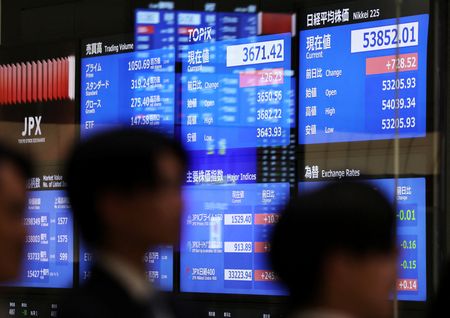
Equity investors responded positively, with MSCI’s comprehensive Asia-Pacific stock index excluding Japan advancing 1.5% to reach its strongest point in six weeks. Japan’s Nikkei index similarly rose 1.2% to 58,561 points, approaching the record peak of 59,332.43 set in late February.
Chinese blue-chip stocks increased 0.5% while Hong Kong’s Hang Seng index posted gains of 1.2%.
“The impressive price action in risk assets suggests markets are keen to look through the immediate impact of the Middle East conflict,” said Tony Sycamore, an analyst at IG.
“There is a growing expectation that the standoff will soon be resolved, allowing the U.S. administration to pivot towards declaring victory, before stimulating the economy ahead of the midterms.”
During Tuesday’s Wall Street session, the Nasdaq surged 2% to record its tenth consecutive day of increases, while the S&P 500 approached a record closing peak.
March producer inflation figures from the United States also offered positive signals, as price increases came in below economist projections, helping ease concerns about conflict-related inflation pressures.
Market confidence that the Iranian conflict may conclude soon also benefited Treasury bonds, which had recently suffered due to inflation concerns.
The two-year U.S. Treasury yield decreased 1 basis point to 3.704% on Wednesday, following a 3 basis point drop overnight. The 10-year yield similarly fell 1 basis point to 4.2439%, after declining 4 basis points during overnight trading.
The safe-haven dollar found stability after seven consecutive sessions of decline. The euro maintained its position at $1.1791, having reached a six-week peak of $1.1811 during overnight trading.
Gold prices edged up 0.1% to $4,846 per ounce.
Despite continued disruption of oil flow through the Strait of Hormuz, the International Monetary Fund warned Tuesday that global economic growth prospects have dimmed, cautioning that worldwide economic conditions could approach recession if the conflict intensifies.