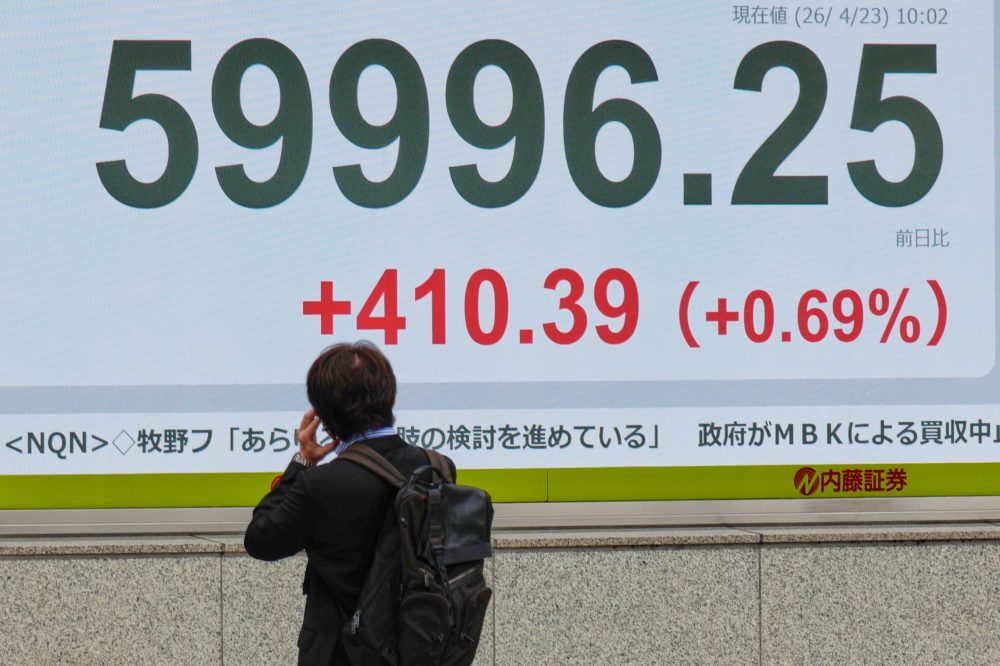

HONG KONG (AP) — Asian markets gave back early gains on Thursday following an initial surge that briefly sent Japan’s Nikkei 225 beyond the 60,000 milestone for the first time, as crude oil prices climbed amid deteriorating hopes for renewed negotiations to resolve the Iran conflict.
American market futures also declined after Wednesday’s record-setting performance on Wall Street, which was fueled by robust quarterly earnings reports.
Japanese and South Korean exchanges momentarily reached historic highs, propelled by technology stock purchases. The Nikkei 225 in Tokyo dropped 1.5% to close at 58,707.60 after earlier touching 60,013.98.
South Korea’s Kospi finished 0.1% down at 6,414.57, surrendering morning advances after briefly crossing the 6,500 threshold. Government data revealed stronger-than-anticipated economic expansion of 1.7% year-over-year for the first quarter, supported by robust export activity, especially computer chips tied to artificial intelligence development.
Hong Kong’s Hang Seng declined 1.1% to 25,865.88, while Shanghai’s Composite index dropped 0.8% to 4,073.71.
Australia’s S&P/ASX 200 fell 0.8% to 8,770.70.
Taiwan’s Taiex tumbled 1.6% while India’s Sensex decreased 0.6%.
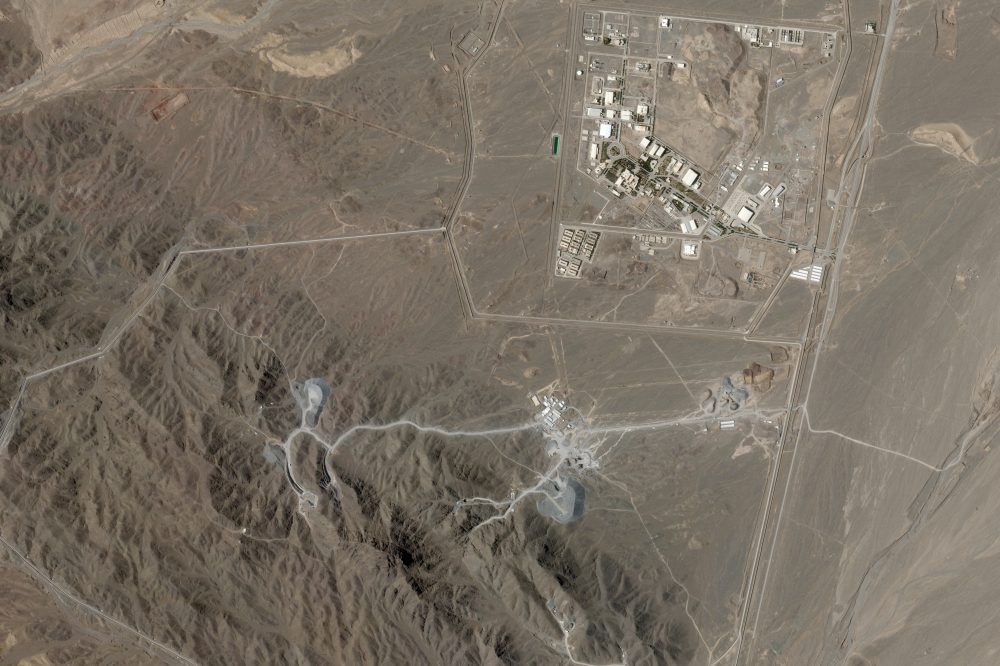
Mounting concerns about the likelihood of ending the Iran conflict, now in its eighth week, continue to dampen market confidence despite President Donald Trump’s ceasefire extension. The timing and possibility of additional peace discussions remain uncertain.
Iranian forces attacked three vessels in the Strait of Hormuz on Wednesday following the implementation of a U.S. naval blockade of Iranian ports last week, with Trump confirming the blockade would persist.
Shipping activity through the Strait of Hormuz, which typically handles approximately one-fifth of global oil transport before the conflict began, remains mostly suspended. Prospects for reopening grew dimmer after Iran’s Revolutionary Guard captured two of the three targeted ships.
International energy costs have skyrocketed due to the Iran conflict’s impact on supply. Brent crude, the global benchmark, rose 1.5% early Thursday to $103.39 per barrel, compared to around $70 before the war started in late February.
U.S. benchmark crude increased 1.8% to $94.66 per barrel.
With diminishing hopes for U.S.-Iran resolution and stagnant peace negotiations, oil markets “are having to reprice expectations,” according to ING Bank strategists Warren Patterson and Ewa Manthey in their research analysis.
“As hopes fade, the reality of the supply disruption will set in, leaving further upside for prices,” they noted. “If no progress is made, the market will become increasingly numb to the noise and headlines that have dictated price action recently.”
Wall Street achieved additional milestones Wednesday following impressive corporate earnings and the Iran ceasefire extension, with the S&P 500 surging 1% to 7,137.90, surpassing Friday’s previous record. The Dow Jones Industrial Average rose 0.7% to 49,490.03, while the Nasdaq composite also established a new record, advancing 1.6% to 24,657.57.
GE Vernova stock soared 13.7% after delivering quarterly profits that exceeded forecasts. The energy equipment manufacturer is capitalizing on AI growth through strong equipment orders, including data center infrastructure. Boeing shares climbed 5.5%, and Philip Morris International advanced 7%, both following earnings that topped expectations.
In early Thursday trading, precious metals declined. Gold fell 0.6% to $4,722.70 per ounce, while silver dropped 2.3% to $76.17 per ounce.
The U.S. dollar strengthened to 159.53 Japanese yen from 159.48 yen. The euro traded at $1.1696, down from $1.1705.