
Asian stock markets stumbled slightly at the close of a remarkable quarter on Tuesday, even as a stronger U.S. dollar pushed the Japanese yen to its lowest point in 40 years and headed toward its fourth consecutive quarterly gain.
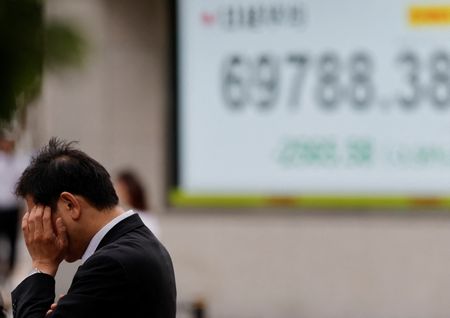
Japan’s Nikkei index, which held relatively steady in early trading, is on track to finish the quarter with a record-setting gain of more than 36%. South Korea’s KOSPI, driven largely by chipmakers, slipped about 1% on Tuesday, though it still posted a stunning second-quarter rise of nearly 65% — more than doubling its value since the start of the year.
Fears about war’s impact on oil prices have largely faded, with benchmark Brent crude futures trading at $72.49 per barrel — levels not seen since before the conflict began — even as a temporary ceasefire remains under pressure.
Kerry Craig, a strategist at J.P. Morgan Asset Management in Melbourne, noted the broader economic impact of lower oil prices. “Now that we have oil prices down, it’s reinforcing our view of more trend-like growth around the world relative to sub-trend that we were thinking about a couple of months ago, and feeding into the better earnings story as well,” he said.
U.S. stock indexes climbed overnight, with futures holding flat during Asian morning trading. The dollar has been gaining ground this quarter as expectations for U.S. interest rates shifted dramatically — from anticipated cuts to potential hikes — driven by the strength of the American economy and ongoing inflation concerns.
That dollar strength has taken a heavy toll on gold, which is on pace for its worst quarterly performance in more than a decade. The yen fell to 162.41 per dollar during Asian trading, its weakest level in four decades, putting currency traders on alert for possible action by Japanese authorities.
Japan’s Finance Minister Satsuki Katayama signaled that officials were prepared to act, saying authorities stood ready to respond appropriately at any time.
The dollar index has climbed 1.3% this quarter. The euro, however, managed to reclaim the $1.14 level this week. Traders are now watching for U.S. jobs data due Thursday — moved up a day because Friday is a holiday — along with a Wednesday appearance by Federal Reserve Chair Kevin Warsh.
New data released Tuesday showed Chinese manufacturing expanded in June, boosted by high-tech exports. European inflation figures and U.S. consumer confidence and job openings data are also on the agenda for the session.
Across the broader Asian region, Taiwan’s benchmark index is set to finish the quarter up more than 40%, while other markets have struggled to keep up with the semiconductor-driven leaders. Hong Kong’s Hang Seng has been a clear underperformer, barely moving Tuesday and sitting on a quarterly decline of 7.5%.
Large investors have behaved in an unusual way throughout this record-setting quarter. As Asia’s major chipmakers have grown to dominate index weightings, foreign investors have actually been selling into the rally, rebalancing their portfolios and managing concerns about concentration. According to BNY, a net $17.3 billion has flowed out of South Korean equities so far this year.
BNY macro strategist Geoff Yu described the trend: “That gap between returns and flows fits a broader pattern across Asia’s tech-heavy markets: strong performance is triggering rebalancing and profit-taking, not fresh institutional buying.”
Meanwhile, Europe’s STOXX index and China’s mainland blue-chip CSI300 are drawing investor interest, with the STOXX on pace for a 9% quarterly gain and the CSI300 up roughly 10% for the quarter.
Craig from J.P. Morgan Asset Management explained the shift in investor thinking. “Some of the concerns that investors have around how much tech exposure they have … (has them) looking for other themes — whether that’s defence, renewables, and how they think about building more robust diversification in their portfolio,” he said.