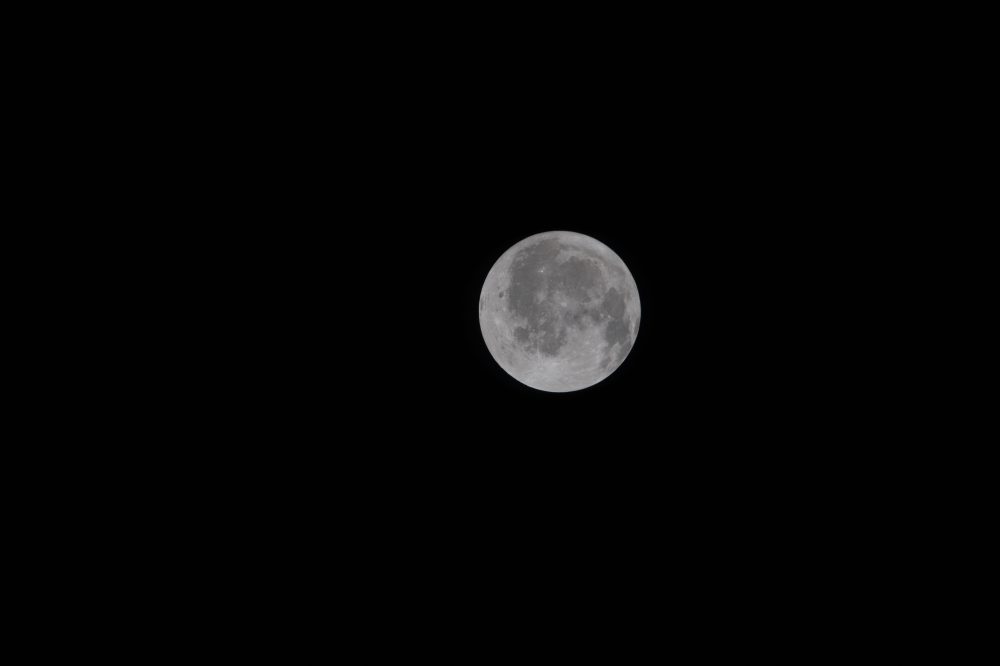

Four astronauts aboard NASA’s Artemis II mission are preparing to make history by surpassing the distance record set by Apollo 13 more than five decades ago. The crew, consisting of three Americans and one Canadian, launched last week on humanity’s first lunar journey since 1972.
On Monday, the astronauts will conduct a flyby of the moon, traveling roughly 4,000 miles farther from Earth than Apollo 13’s crew achieved in 1970. This will make them the most distant human travelers from our planet as they swing around the lunar surface before beginning their return journey.
The approximately six-hour close encounter with the moon will provide the crew with unprecedented views of the lunar far side that the 24 Apollo astronauts before them couldn’t see clearly due to lighting conditions. Additionally, the astronauts will witness a total solar eclipse visible only from their Orion capsule, offering glimpses of the sun’s corona.
Flight director Judd Frieling explained the mission’s broader purpose: “We’ll get eyes on the moon, kind of map it out and then continue to go back in force.” The ultimate objective includes establishing a lunar base complete with landing vehicles, exploration rovers, drones and living quarters.
The current distance record belongs to Apollo 13, whose crew reached 248,655 miles from Earth in 1970. That mission’s astronauts never landed on the moon after an oxygen tank explosion endangered their lives during the journey. Mission Control used a gravity-assisted trajectory around the moon to bring them safely home, making Apollo 13 NASA’s most famous “successful failure.” Commander Jim Lovell, Fred Haise and Jack Swigert followed this emergency route that relied on Earth and lunar gravity with minimal fuel consumption.
Artemis II follows the same figure-eight flight path since the crew won’t orbit or land on the moon. However, their maximum distance from Earth should exceed Apollo 13’s record by approximately 4,000 miles.
Astronaut Christina Koch commented on the significance of breaking the record, saying that while she and her teammates don’t focus on superlatives, it represents an important milestone “that people can understand and wrap their heads around,” connecting past achievements with present and future accomplishments.
During the lunar encounter, the four crew members will work in pairs to photograph the moon’s surface through their windows. Due to their April 1 launch date, less of the moon’s far side will be illuminated compared to other potential launch windows. Nevertheless, NASA geologist Kelsey Young expects them to observe “definite chunks of the far side that have never been seen” by human eyes, including significant portions of the Orientale Basin.
The astronauts will relay their observations while capturing images of the gray, crater-covered landscape. Their equipment includes professional-grade cameras as well as individual iPhones for spontaneous photography opportunities.
Young’s team prepared lunar geography study cards for the crew before launch. “They’ve practiced for many, many, many months on visualizations of the moon,” Young said over the weekend, “and getting their eyes on the real thing, I’m really, really looking forward to them bringing the moon a little closer to home on Monday.”
The April 1 launch timing offers a unique benefit: a total solar eclipse visible exclusively from the Orion spacecraft. This celestial event will treat the astronauts to several minutes of views showing the sun’s outermost atmosphere, known as the corona.
The crew will monitor for unusual solar activity during the eclipse and use their “unique vantage point” to describe corona features, according to Young. All four astronauts brought eclipse glasses for eye protection.
Communication with Mission Control will be interrupted for nearly 40 minutes when Orion passes behind the moon. NASA’s Deep Space Network, featuring large antennas in California, Spain and Australia, cannot maintain contact during this period due to blocked sight lines.
These communication gaps created tension during Apollo missions, though Frieling notes that “physics takes over and physics will absolutely get us back to the front side of the moon.”
After departing the lunar area, Artemis II will require four days to reach Earth. The capsule is scheduled to splash down in the Pacific Ocean near San Diego on April 10, completing a nine-day mission that began with their Florida launch.
During the return flight, the astronauts will establish radio contact with the International Space Station crew. This marks the first instance of simultaneous human presence near the moon and in Earth orbit, prompting NASA to arrange a space-to-space conversation. The discussion will include both participants from the first all-female spacewalk in 2019: Koch aboard Orion and Jessica Meir on the station.