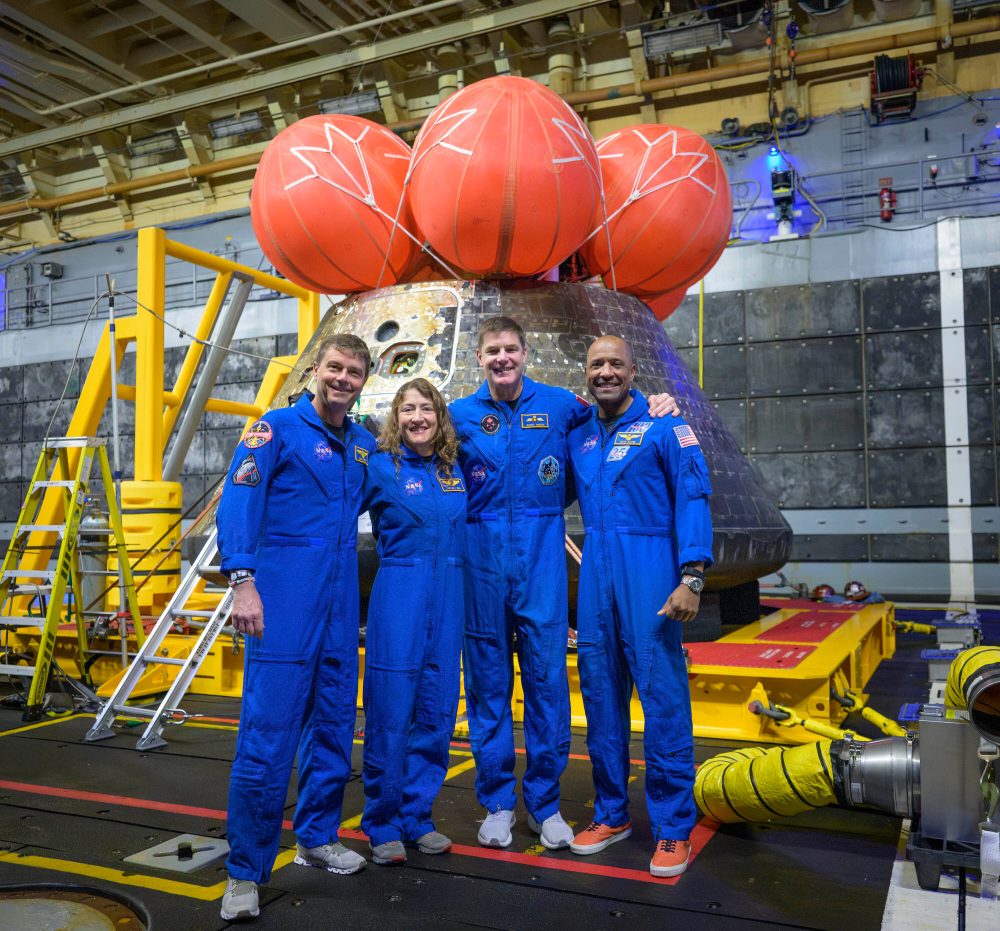

HOUSTON — The four astronauts who completed NASA’s historic Artemis II lunar mission were greeted by hundreds of cheering supporters Saturday at Ellington Field, marking their triumphant return after breaking deep space distance records.
The crew touched down at the facility near Johnson Space Center and Mission Control after flying in from their San Diego splashdown location the previous evening.
Following emotional reunions with family members, the astronauts addressed a packed hangar filled with space center employees and distinguished guests. The audience included NASA Administrator Jared Isaacman, flight controllers, launch personnel, spacecraft managers, military officials, congressional representatives, current and former astronauts, and many others.
“The long wait is over. After a brief 53-year intermission, the show goes on,” Isaacman declared. “Ladies and gentlemen, your Artemis II crew,” he announced as the audience erupted in standing ovation.
The homecoming held special significance for Commander Reid Wiseman and his international crew, as they returned to Houston exactly 56 years after Apollo 13’s launch — the mission famous for its “Houston, we’ve had a problem” emergency that became a celebrated rescue.
Wiseman addressed his fellow crew members, saying: “We are bonded forever.”
“This was not easy,” Wiseman reflected. “Before you launch, it feels like it’s the greatest dream on Earth. And when you’re out there, you just want to get back to your families and your friends. It’s a special thing to be a human and it’s a special thing to be on planet Earth.”
Pilot Victor Glover spoke lovingly of his family, telling his wife and four daughters: “I love you but not just those five beautiful cocoa skinned ladies there, but all of you.”
Mission specialist Christina Koch shared her profound experience viewing Earth from deep space.
“Honestly, what struck me wasn’t just Earth, it was all of the blackness around it. Earth was just this lifeboat hanging undisturbably in the universe. Planet Earth you are a crew,” she explained.
Canadian astronaut Jeremy Hansen praised the launch teams for their careful decision-making during the mission’s multiple delays, commending their willingness to call off launches when conditions weren’t right.
Hansen described how the crew represented love and joy as the four astronauts stood together in an embrace. “When you look up here, you’re not looking at us. We are a mirror reflecting you. And if you like what you see then just look a little deeper This is you.”
Canadian Space Agency President Lisa Campbell described the achievement as “a powerful moment” and told Hansen he exemplifies “the best of what it means to be Canadian.”
Throughout their nearly 10-day journey, the astronauts ventured farther into space than any previous lunar explorers and witnessed unprecedented views of the moon’s far side. They also experienced a total solar eclipse during their voyage.
The mission achieved a new distance milestone when the crew reached 252,756 miles from Earth before looping around the moon’s far side, surpassing Apollo 13’s previous record.
The astronauts also captured a stunning new perspective of Earth with an “Earthset” photograph showing our planet disappearing behind the moon’s cratered surface. This image mirrored the iconic “Earthrise” photograph taken by Apollo 8 astronauts in 1968.
While the mission succeeded brilliantly, the crew did face one practical challenge — a broken restroom system. NASA has committed to resolving this issue before future extended lunar missions.
Wiseman, Glover, Koch and Hansen became the first humans to journey to the moon since Apollo 17 concluded NASA’s initial lunar exploration program in 1972. A total of 24 astronauts traveled to the moon during the Apollo era, with 12 actually walking on its surface.
Apollo 13 commander Jim Lovell, who also participated in Apollo 8, had recorded an encouraging wake-up message for the Artemis II crew before his death last summer.
The mission’s success proves vital for NASA’s future plans. The agency is now preparing for next year’s Artemis III mission, where a different crew will practice connecting their spacecraft with a lunar landing vehicle while orbiting Earth. This will prepare for the critical Artemis IV mission scheduled for 2028, when two astronauts plan to land near the moon’s south pole.