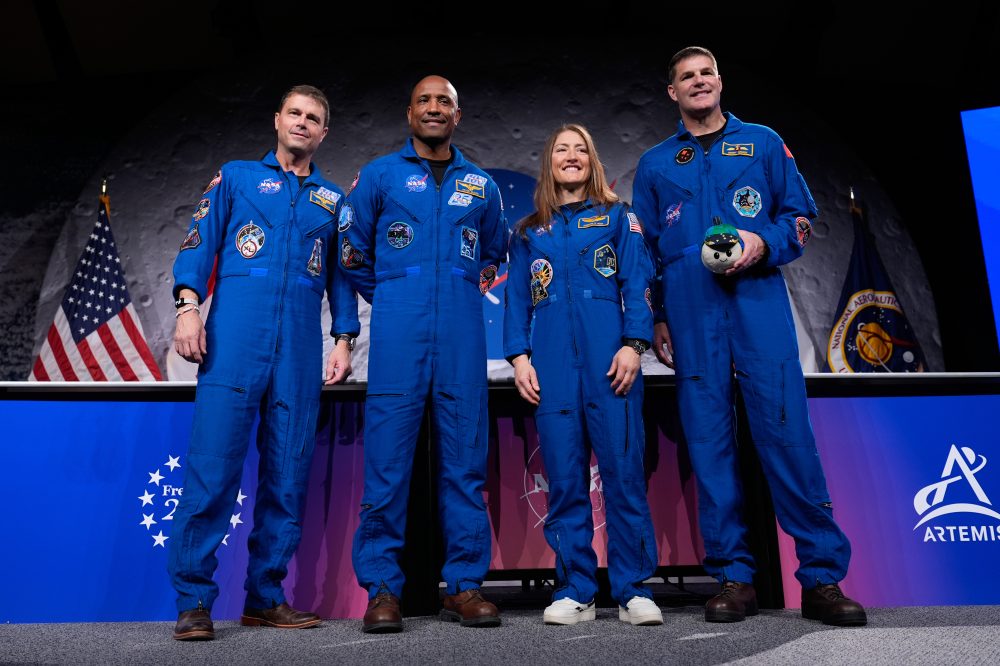

CAPE CANAVERAL, Fla. — Four astronauts who completed NASA’s historic return to lunar exploration shared positive feedback Thursday about their spacecraft’s capabilities, with particular emphasis on how well the heat shield functioned during their return to Earth.
During their initial press conference following their homecoming, the crew of three American astronauts and one Canadian team member expressed confidence that their successful lunar mission positions NASA well for achieving a crewed moon landing within the next two years and establishing a permanent lunar base. The astronauts spoke from NASA’s Johnson Space Center in Houston, where they are based.
The diverse crew included Commander Reid Wiseman, pilot Victor Glover, Christina Koch, and Canada’s Jeremy Hansen, who departed from Florida on April 1 for NASA’s first crewed lunar mission in over 50 years.
The team achieved a new distance record for human space travel, surpassing Apollo 13’s mark as they traveled around the moon’s far side. During their journey, they witnessed lunar features never before seen by human eyes and experienced the spectacular sight of a total lunar eclipse.
Their Orion spacecraft, which they christened “Integrity,” touched down safely in the Pacific Ocean last Friday, concluding their nearly 10-day mission. The crew’s return to Houston occurred on the 56th anniversary of Apollo 13’s launch.
According to Wiseman, he and Glover observed only minimal heat shield material loss during Integrity’s passage through the most intense phase of atmospheric reentry. After boarding the recovery vessel, they examined the capsule’s underside as thoroughly as possible, discovering slight charred material loss where the heat shield connects to the main capsule.
“For four humans just looking at the heat shield, it looked wonderful to us. It looked great, and that ride in was really amazing,” Wiseman said.
However, he emphasized that comprehensive analysis remains necessary. “We are going to fine-tooth comb every single, not even every molecule, probably every atom on this heat shield,” he said.
The heat shield from the initial unmanned Artemis test mission in 2022 returned with extensive damage that delayed Artemis II for months or potentially years. Rather than redesigning the shield, NASA modified the capsule’s reentry trajectory to reduce thermal stress. Upcoming capsules will feature an updated heat shield design.
Glover described the sensation when parachutes deployed just before ocean landing as feeling like free fall, comparing it to “diving backward off a skyscraper.” “That’s what it felt like for five seconds,” he said, noting that once the descent stabilized, “It was glorious.”
Following their return, all four crew members have undergone extensive medical evaluations to assess their balance, eyesight, muscle condition, coordination, and general health status. They also participated in spacesuit exercises under simulated lunar gravity conditions to evaluate the endurance and dexterity future moon explorers might possess upon landing.
NASA has already begun preparations for Artemis III, the subsequent phase in their ambitious lunar base development program. The launch platform returned Thursday to Kennedy Space Center’s Vehicle Assembly Building for preparation of next year’s Artemis mission.
Artemis III, which has not yet received crew assignments, will orbit Earth while astronauts practice connecting their Orion capsule with lunar landing vehicles being developed by Elon Musk’s SpaceX and Jeff Bezos’ Blue Origin.
Artemis IV is scheduled for 2028 according to NASA’s current timeline, with plans for two astronauts to land near the moon’s south pole.
NASA’s goal this time involves establishing a permanent lunar presence, unlike the brief Apollo missions. Twelve astronauts explored the moon’s surface during the Apollo era, starting with Neil Armstrong and Buzz Aldrin in 1969 and concluding with Gene Cernan and Harrison Schmitt in 1972.
Koch expressed that since their return, she and her teammates are “feeling even more excited and just ready to take that on as an agency.”
“We made it happen,” she added.
Hansen noted that achieving these ambitious goals will require accepting additional risks and trusting that future challenges can be resolved as they arise. “We’re not going to be able to pound everything flat before we go. We’re going to have to trust each other,” he said.
Despite their smooth mission experience, Hansen acknowledged that “it was also very clear to us that it can get pretty bumpy.” He emphasized that future crews must “understand it can get real bumpy real fast.”