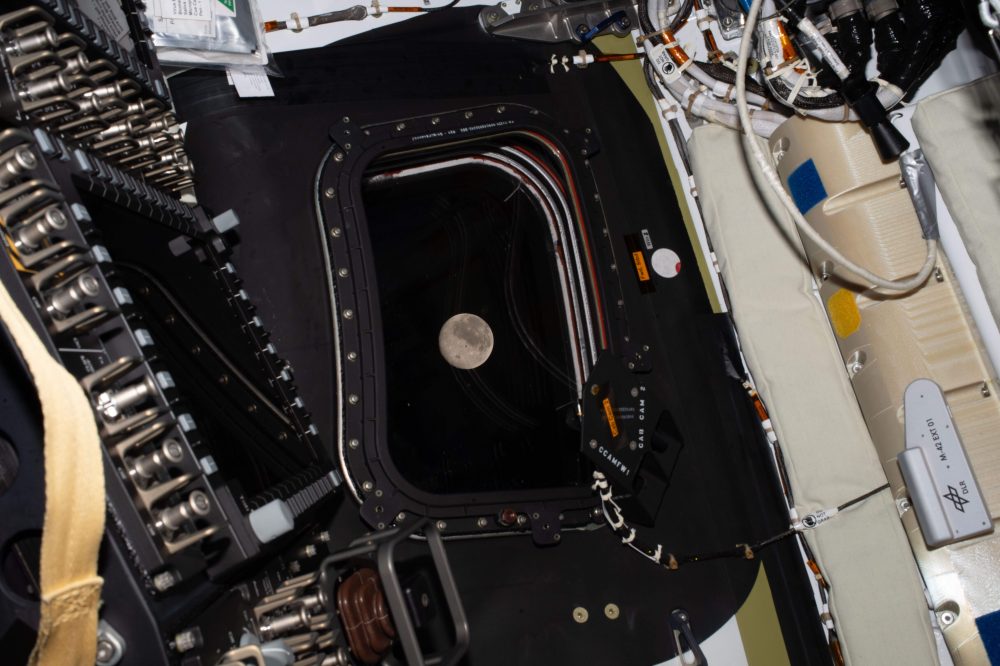

HOUSTON — Four astronauts aboard NASA’s Artemis II spacecraft pushed toward a historic milestone Monday, preparing to break humanity’s distance record from Earth during an ambitious lunar flyby that promises breathtaking views of the moon’s hidden far side.
The six-hour close encounter with the moon marks the centerpiece of NASA’s first crewed lunar mission since the Apollo program, featuring three American astronauts and one Canadian crew member as part of the agency’s plan to land astronauts near the moon’s south pole within two years.
Just under an hour before beginning their detailed lunar observations and flyby maneuver, the four crew members were positioned to claim the title of most distant humans ever, breaking Apollo 13’s record of 248,655 miles (400,171 kilometers) established in April 1970.
NASA’s Mission Control anticipated Artemis II would exceed that benchmark by more than 4,100 miles (6,600 kilometers).
The spacecraft follows the identical flight path used by Apollo 13 following the famous “Houston, we’ve had a problem” oxygen tank failure that ended that mission’s lunar landing hopes.
This flight pattern, called a free-return lunar trajectory, harnesses gravitational forces from both Earth and the moon to minimize fuel consumption. The celestial figure-eight path will automatically guide the astronauts homeward after they swing around the moon’s backside Monday evening.
Mission Commander Reid Wiseman, along with pilot Victor Glover, Christina Koch, and Canada’s Jeremy Hansen, were scheduled to approach within 4,070 miles (6,550 kilometers) of the lunar surface as their Orion spacecraft sweeps past, executes a dramatic turnaround, and begins the journey home. The return trip will span four days, ending with a Pacific Ocean splashdown Friday to complete their test mission.
Wiseman’s team dedicated years to mastering lunar topography in preparation for this moment, even incorporating solar eclipse observations into their training over recent weeks. Their Wednesday launch timing guarantees them a total solar eclipse experience from their unique position behind the moon.
Leading their scientific observation list is Orientale Basin, a massive impact crater featuring three circular rings, with the largest spanning nearly 600 miles (950 kilometers) in diameter.
Additional viewing targets include the Apollo 12 and 14 landing locations from 1969 and 1971, plus sections of the south polar area where future missions plan to touch down. Beyond the moon, the crew will have clear views of Mercury, Venus, Mars, Saturn, and Earth itself.
NASA geologist Kelsey Young, serving as the crew’s lunar advisor, anticipates they will capture thousands of photographs.
“People all over the world connect with the moon. This is something that every single person on this planet can understand and connect with,” Young commented before the flyby while sporting eclipse-themed earrings.
This marks NASA’s first crewed lunar expedition since Apollo 17 concluded in 1972, paving the way for next year’s Artemis III mission, where another Orion crew will rehearse docking procedures with lunar landing vehicles in Earth orbit. The ultimate goal of landing two astronauts near the moon’s south pole will come with Artemis IV in 2028.
Though Artemis II follows Apollo 13’s trajectory, it more closely mirrors Apollo 8, when humans first traveled to the moon, orbited on Christmas Eve 1968, and famously read passages from Genesis.
Glover reflected that traveling to the moon during Christianity’s Holy Week emphasized for him “the beauty of creation.” He described Earth as an oasis surrounded by “a whole bunch of nothing, this thing we call the universe” where humanity exists as one unified presence.
“This is an opportunity for us to remember where we are, who we are, and that we are the same thing and that we’ve got to get through this together,” Glover stated while joining hands with his fellow crew members.