
Armed fighters attacked a convoy of fruit-laden trucks traveling to Mali’s besieged capital city on Wednesday, according to a transportation workers’ union, marking the latest incident in a crisis that erupted following widespread coordinated strikes by separatist and extremist forces throughout the West African country last month.
The assailants fired upon the convoy of Moroccan trucks transporting fruit, said Mounir Benazouz, who represents the road transport division of the Democratic Confederation of Labor union.
What happened to the truck drivers remains unclear, Benazouz stated. “We have no details.”
Mali’s government has yet to verify the attack, and no organization has stepped forward to take credit for the assault.
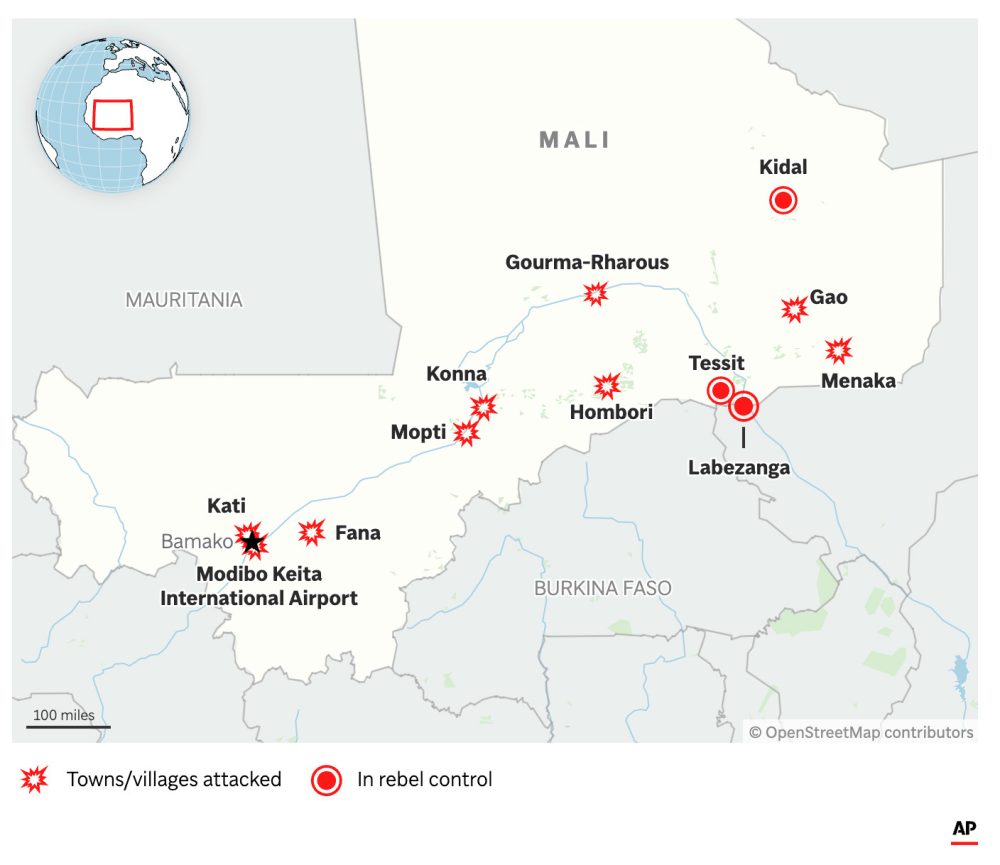
An unnamed security official, who requested anonymity due to restrictions on speaking with media, reported the incident occurred on the route connecting Bamako to Bougouni, located approximately 175 kilometers (109 miles) from the capital.
In recent weeks, extremists affiliated with al-Qaida from the Jama’at Nusrat al-Islam wal-Muslimin organization, known as JNIM, partnered with the separatist Azawad Liberation Front (FLA) to launch synchronized strikes. These assaults represent the most severe violence Mali has experienced since 2012, with fighters and rebels capturing multiple cities, towns, and military installations from Mali’s armed forces and their Russian-backed Africa Corps allies.
Mali’s former defense minister, Sadio Camara, lost his life during these attacks. Following his death, Mali’s military commander Assimi Goita assumed the defense minister’s responsibilities.
JNIM has also declared a siege of Bamako, established checkpoints, and prohibited all entry into the city. Previously in September 2025, the organization implemented a restrictive blockade preventing oil shipments into landlocked Mali.
For more than a week since the blockade announcement, residents have faced difficulties reaching Bamako, particularly along two critical routes — one linking the capital to Kayes, situated 583 kilometers (364 miles) northwest, and another to Kita, located 189 kilometers (118 miles) west.
A Kita municipal official reported that “several hundred travelers” and over 100 buses remain trapped due to “insecurity on the Bamako-Kita route over the past two weeks,” according to the official who spoke anonymously fearing retaliation.
“We need humanitarian aid, especially food and water for the travelers,” he said.
As tensions have intensified, Mali’s ruling military government has alleged that certain officers collaborated in the attacks by working alongside militants and separatists, leading to multiple detentions in Bamako.