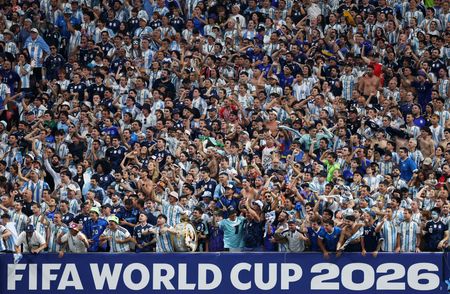

For a large portion of global soccer fans watching this World Cup, the choice of who to cheer for has been straightforward: back whoever happens to be facing Argentina. Throughout the tournament, that allegiance has shifted — first to Algeria in green, then Cape Verde in blue, then Switzerland in red. Even England, a team that draws its own share of international skepticism, found itself flooded with messages of support on social media ahead of last week’s semifinal. Now, heading into Sunday’s championship match, many neutral fans may be reaching for a red Spain jersey.
Argentina ranks among the most accomplished and widely recognized national teams in the history of the sport — but also among the most divisive. Rooted in the legacy of Diego Maradona and the modern-day fame of Lionel Messi, the Albiceleste have built a passionate following at home and around the world, while simultaneously drawing irritation, envy, and outright resentment from rivals.
The Maradona Legacy
Argentina’s football identity has been defined by transcendent individual talent. No figure looms larger than Maradona, who led the country to the 1986 World Cup championship and created one of the sport’s most enduring — and contentious — moments. His two goals against England in the quarterfinals that year remain the stuff of legend: the first, a handball that went uncalled, became known as the “Hand of God,” while the second was later voted the “Goal of the Century” for its breathtaking solo run through the English defense.
English supporters have never quite forgiven that handball, while many Argentines view it as an act of defiance tied to something larger — the 1982 Falklands War, in which Britain retained control of the disputed island territory. That political backdrop has continued to surface. After Argentina’s semifinal victory over England at the 2026 World Cup, players displayed a banner reading “Las Malvinas Son Argentinas” — “The Falklands are Argentine” — in what appeared to be a violation of FIFA’s rules against political statements at matches.
The Messi Factor
Where Maradona was fire and defiance, Lionel Messi brought a quieter but equally commanding presence. His years at Barcelona made him the face of one of club soccer’s most dominant eras, earning him nearly every major honor the sport offers — but also making him a target for fans of rival clubs. His long-running rivalry with Portugal’s Cristiano Ronaldo divided global soccer fandom into two passionate camps.
For years, Messi carried the weight of comparisons to Maradona and criticism that he hadn’t delivered a major title for his country. That changed in 2022, when he led Argentina to the World Cup championship in Qatar. His fame has drawn devoted followings as far away as India and Bangladesh, but others have grown tired of the constant attention surrounding him and the way Argentina’s narrative so often revolves around one man.
A Complicated Reputation in Latin America
Within Latin America, Argentina’s image is layered and complicated. The country has historically viewed itself as culturally distinct — shaped by strong European influences and a football culture that tends to treat winning as confirmation of national superiority. That confidence is sometimes respected, but in many parts of the region it feeds a perception of Argentine arrogance.
That nationalism has at times crossed into genuinely troubling territory. Earlier this month, an Argentine television commentator referred to Mexicans as “detestable” and claimed they envied Argentines “not just in soccer, in everything.” Mexican President Claudia Sheinbaum described those remarks as “outrageous.” In stadiums, some Argentine fans continue to sing a song that mocks the African heritage of French players — a chant that Argentine players themselves apologized for in 2024 after being caught singing it. Other incidents involving racist behavior or fan misconduct have circulated widely on social media and drawn complaints from supporters of other nations.
Rivalries That Run Deep
Argentina’s most intense rivalry is with Brazil, built over decades of competition between South America’s two most successful footballing nations. At the 2014 World Cup, held on Brazilian soil, Argentine supporters taunted the hosts with chants of “Brasil, decime que se siente” — “Brazil, tell me how it feels” — as Argentina advanced through the bracket.
Tensions with Chile flared after Chile defeated Argentina in back-to-back Copa America finals in 2015 and 2016, both decided by penalty shootouts. The relationship with Mexico has also grown charged over the years, fueled by repeated World Cup matchups and heated debates on social media.
Argentina’s style of play — built on technical brilliance and tactical cunning — can be captivating to watch, but critics argue it sometimes strays from the ideals of fair play. For a growing number of fans around the world, “anyone but Argentina” has simply become the default setting whenever a tournament begins.